CAS 445-30-7
:Homarin
Beschreibung:
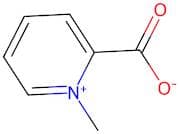
Homarin, mit der CAS-Nummer 445-30-7, ist eine natürlich vorkommende Verbindung, die als quartäres Ammoniumsalz klassifiziert ist. Es kommt hauptsächlich in marinen Organismen vor, insbesondere in bestimmten Arten von Algen und Wirbellosen. Homarin zeichnet sich durch seine chemische Struktur aus, die einen Pyridinring und eine Methylgruppe umfasst, was zu seiner Löslichkeit in Wasser und polaren Lösungsmitteln beiträgt. Diese Verbindung zeigt biologische Aktivität, einschließlich potenzieller antioxidativer Eigenschaften, und wurde hinsichtlich ihrer Rolle bei der Osmoregulation in marinen Organismen untersucht. Homarin ist auch in verschiedenen Bereichen von Interesse, einschließlich Biochemie und Pharmakologie, aufgrund seiner potenziellen Anwendungen zum Verständnis der Meeresbiologie und zur Entwicklung neuer therapeutischer Mittel. Seine Stabilität und Reaktivität können je nach Umweltbedingungen variieren, was es zu einem interessanten Thema sowohl in der ökologischen als auch in der chemischen Forschung macht. Insgesamt dient Homarin als ein wichtiges Beispiel für die vielfältigen chemischen Verbindungen, die in marinen Ökosystemen vorkommen.
Formel:C7H7NO2
InChl:InChI=1S/C7H7NO2/c1-8-5-3-2-4-6(8)7(9)10/h2-5H,1H3
InChI Key:InChIKey=BRTLKRNVNFIOPJ-UHFFFAOYSA-N
SMILES:C([O-])(=O)C=1[N+](C)=CC=CC1
Synonyme:- 2-Carboxy-1-methylpyridinium hydroxide, inner salt
- 2-Pyridinecarboxylic acid, N-methylbetaine
- 2-Pyridinecarboxylic acid, methoinner salt
- Homarine
- Pyridinium, 2-carboxy-1-methyl-, hydroxide, inner salt
- Pyridinium, 2-carboxy-1-methyl-, inner salt
Sortieren nach
Reinheit (%)
0
100
|
0
|
50
|
90
|
95
|
100
5 Produkte.
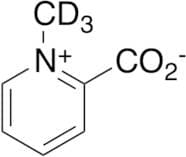
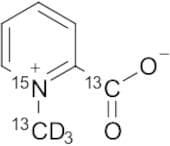
Homarine-d3
CAS:Kontrolliertes ProduktStability Hygroscopic
Applications Labelled Homarine (H458500). Quaternary ammonium base occurring in tissues of marine animals.
References Stein, W., et al.: J. Biol. Chem., 211, 915 (1954), Bystedt, J., et al.: J. Sci. Food Agric., 10, 301 (1959),Formel:C7H4D3NO2Farbe und Form:NeatMolekulargewicht:140.15Homarine
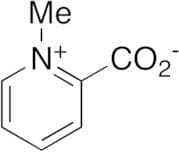
CAS:Kontrolliertes ProduktStability Hygroscopic
Applications Quaternary ammonium base occurring in tissues of marine animals.
References Stein, W., et al.: J. Biol. Chem., 211, 915 (1954), Bystedt, J., et al.: J. Sci. Food Agric., 10, 301 (1959),Formel:C7H7NO2Farbe und Form:NeatMolekulargewicht:137.14Homarine
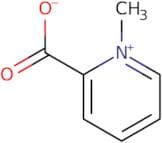
CAS:Homarine is a natural product that is found in the seeds of the Bixa orellana plant. It has been shown to have dose-dependent effects on nitrogen metabolism, enzyme activities and detoxification enzymes. Homarine is also a potential biomarker for several diseases, including fatty acid oxidation disorders, and may be used as an indicator of energy metabolism and chemical structures. This compound has been shown to bind to hydrochloric acid and hydrogen bonds with the amine group of protein molecules, which may lead to changes in their structure or function. Homarine appears to have very low toxicity, which is likely due to its inability to cross the blood-brain barrier and inhibit protein synthesis in neurons.Formel:C7H7NO2Reinheit:Min. 95%Farbe und Form:Yellow PowderMolekulargewicht:137.14 g/molHomarine-15N,13C2,d3
CAS:Kontrolliertes ProduktFormel:C2C5D3H415NO2Farbe und Form:NeatMolekulargewicht:143.133