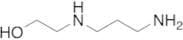
CAS 4461-39-6
:N-(2-Hydroxyethyl)-1,3-propandiamin
Beschreibung:
N-(2-Hydroxyethyl)-1,3-propandiamin, auch bekannt als HEPA, ist eine organische Verbindung, die durch ihre aminischen funktionellen Gruppen und eine Hydroxylgruppe gekennzeichnet ist. Sie weist eine drei Kohlenstoff lange Kette mit zwei Aminogruppen (-NH2) und einer Hydroxylgruppe (-OH) auf, die daran gebunden sind, was zu ihrer Hydrophilie und Fähigkeit zur Bildung von Wasserstoffbrücken beiträgt. Diese Verbindung ist typischerweise eine farblose bis blassgelbe Flüssigkeit oder ein Feststoff, abhängig von ihrer Reinheit und Temperatur. Sie ist in Wasser und verschiedenen organischen Lösungsmitteln löslich, was sie vielseitig für verschiedene Anwendungen macht. HEPA wird häufig in der Synthese von Tensiden, Chelatbildnern und als Baustein in der Herstellung von Polymeren und Arzneimitteln verwendet. Ihre Aminogruppen können an verschiedenen chemischen Reaktionen teilnehmen, einschließlich Acylierung und Alkylierung, was ihre Nützlichkeit in der organischen Synthese weiter erhöht. Darüber hinaus kann sie aufgrund ihrer Struktur biologische Aktivität zeigen, was sie in der medizinischen Chemie von Interesse macht. Sicherheitsvorkehrungen sollten beim Umgang mit dieser Verbindung getroffen werden, da sie Haut- und Augenreizungen verursachen kann.
Formel:C5H14N2O
InChl:InChI=1/C5H14N2O/c6-2-1-3-7-4-5-8/h7-8H,1-6H2/p+2
InChI Key:InChIKey=GHKSKVKCKMGRDU-UHFFFAOYSA-N
SMILES:C(NCCO)CCN
Synonyme:- 1,3-Diamino-N-(2-hydroxyethyl)propane
- 1,3-Diamino-N-(hydroxyethyl)propane
- 2-(3-Aminopropylamino)Ethanol
- 2-Hydroxyethylamino Propylamine
- 2-[(3-Aminopropyl)amino]ethan-1-ol
- 2-[(3-Aminopropyl)amino]ethanol
- 3-(2-Hydroxyethylamino)propylamine
- 3-(Hydroxyethylamino)propanamine
- Ethanol, 2-[(3-aminopropyl)amino]-
- Heapa
- Koei 3311
- N-(2-Hydroxyethyl)-1,3-Diaminopropane
- N-(2-Hydroxyethyl)-Propanediamine-1,3
- N-(2-Hydroxyethyl)Trimethylenediamine
- N-(2-Hydroxyethyl)propan-1,3-diamine
- N-(2-hydroxyethyl)propane-1,3-diaminium
- N-(3-Aminopropyl)-2-aminoethanol
- N-(Aminopropyl)ethanolamine
- N-(Hydroxyethyl)propane-1,3-diamine
- N-(β-Hydroxyethyl)-1,3-diaminopropane
- N-(2-Hydroxyethyl)-1,3-propanediamine
- Weitere Synonyme anzeigen
Sortieren nach
Reinheit (%)
0
100
|
0
|
50
|
90
|
95
|
100
6 Produkte.
N-(2-Hydroxyethyl)-1,3-propanediamine
CAS:Formel:C5H14N2OReinheit:95%Farbe und Form:LiquidMolekulargewicht:118.1775N-(2-Hydroxyethyl)-1,3-propanediamine
CAS:N-(2-Hydroxyethyl)-1,3-propanediamineReinheit:98%Molekulargewicht:118.18g/mol2-[(3-Aminopropyl)amino]ethanol
CAS:Formel:C5H14N2OReinheit:>95.0%(T)Farbe und Form:Colorless to Light yellow clear liquidMolekulargewicht:118.182-(3-Aminopropylamino)ethanol
CAS:Formel:C5H14N2OReinheit:95%Farbe und Form:Liquid, ClearMolekulargewicht:118.182-(3-Aminopropylamino)ethanol
CAS:Kontrolliertes ProduktApplications 2-(3-Aminopropylamino)ethanol is the hydroxy analogue of WR-1065 (A576820), a metabolite of Amifostine (A576810). Amifostine is an organic thiophosphate that has the ability to protect a broad range of tissues from cytotoxicity (e.g. from chemotherapeutic agents) without inducing an antitumour response. 2-(3-Aminopropylamino)ethanol is also used as an nucleophilic tag in the detection of human butyrylcholinesterase adducts.
Not a dangerous good if item is equal to or less than 1g/ml and there is less than 100g/ml in the package
References Antonadou, D., et al.: Int. J. Rad. Oncol. Biol. Phys., 52, 739 (2002); Kemp, G., et al.: J. Clin. Oncol., 14, 2101 (1996)Formel:C5H14N2OFarbe und Form:NeatMolekulargewicht:118.18




![2-[(3-Aminopropyl)amino]ethanol](/_next/image/?url=https%3A%2Fstatic.cymitquimica.com%2Fproducts%2F3B%2Fthumb%2FH1817.jpg&w=3840&q=75)