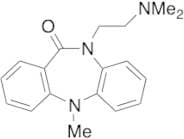
CAS 4498-32-2
:Dibenzepin
Beschreibung:
Dibenzepin ist ein trizyklisches Antidepressivum, das hauptsächlich zur Behandlung von Depressionen und bestimmten Angststörungen eingesetzt wird. Es wirkt, indem es die Wiederaufnahme von Neurotransmittern, insbesondere Noradrenalin und Serotonin, hemmt, wodurch die Stimmung und die emotionale Stabilität verbessert werden. Die chemische Struktur von Dibenzepin besteht aus einem Dibenzocyclohepten-Kern, der zu seinen pharmakologischen Eigenschaften beiträgt. Es wird typischerweise in oraler Form verabreicht und ist bekannt für seine sedierenden Effekte, was es für Patienten mit Schlaflosigkeit im Zusammenhang mit Depressionen vorteilhaft macht. Dibenzepin hat eine relativ lange Halbwertszeit, die in vielen Fällen eine einmal tägliche Dosierung ermöglicht. Wie andere trizyklische Antidepressiva kann es jedoch Nebenwirkungen haben, darunter Mundtrockenheit, Verstopfung und potenzielle kardiovaskuläre Effekte, die eine sorgfältige Überwachung erfordern. Seine Anwendung ist mit dem Aufkommen neuerer Antidepressiva, die oft günstigere Nebenwirkungsprofile aufweisen, zurückgegangen. Insgesamt bleibt Dibenzepin eine relevante Option in bestimmten klinischen Szenarien, insbesondere für Patienten, die möglicherweise nicht auf andere Behandlungen ansprechen.
Formel:C18H21N3O
InChl:InChI=1S/C18H21N3O/c1-19(2)12-13-21-17-11-7-6-10-16(17)20(3)15-9-5-4-8-14(15)18(21)22/h4-11H,12-13H2,1-3H3
InChI Key:InChIKey=QPGGEKPRGVJKQB-UHFFFAOYSA-N
SMILES:C(CN(C)C)N1C=2C(N(C)C=3C(C1=O)=CC=CC3)=CC=CC2
Synonyme:- 10-(2-Dimethylaminoethyl)-5,10-Dihydro-5-Methyldibenzo(B,E)(1,4)Diazepin-11-One
- 10-[2-(Dimethylamino)ethyl]-5,10-dihydro-5-methyl-11H-dibenzo[b,e][1,4]diazepin-11-one
- 10-[2-(dimethylamino)ethyl]-5-methyl-5,10-dihydro-11H-dibenzo[b,e][1,4]diazepin-11-one
- 11H-Dibenzo[b,e][1,4]diazepin-11-one, 10-[2-(dimethylamino)ethyl]-5,10-dihydro-5-methyl-
- Dibenzepine
- Hf 1927
- Victoril
- Dibenzepin
Sortieren nach
Reinheit (%)
0
100
|
0
|
50
|
90
|
95
|
100
3 Produkte.
Dibenzepin
CAS:<p>Applications Antidepressant.<br> Not a dangerous good if item is equal to or less than 1g/ml and there is less than 100g/ml in the package<br>References Lehner, H., et al.: Arzneim.-Forsch., 17, 185 (1967), Egli, A., et al.: Anal. Profiles Drug Subs., 9, 181 (1980),<br></p>Formel:C18H21N3OFarbe und Form:NeatMolekulargewicht:295.38Dibenzepin-d3
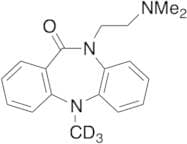
CAS:Kontrolliertes Produkt<p>Applications Antidepressant.<br> Not a dangerous good if item is equal to or less than 1g/ml and there is less than 100g/ml in the package<br>References Lehner, H., et al.: Arzneim.-Forsch., 17, 185 (1967), Egli, A., et al.: Anal. Profiles Drug Subs., 9, 181 (1980),<br></p>Formel:C18D3H18N3OFarbe und Form:NeatMolekulargewicht:298.397Dibenzepin
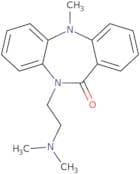
CAS:Kontrolliertes Produkt<p>Dibenzepin is a tricyclic antidepressant drug that is used to treat depression, anxiety, and other mood disorders. Dibenzepin has been shown to increase the glomerular filtration rate in geriatric patients and can be used for the treatment of cardiac effects such as arrhythmia. Dibenzepin also has a linear calibration curve with an R2 value of 0.9996. This drug is metabolized by dextromethorphan via glucuronidation or sulfation, which are two common metabolic pathways. The therapeutic levels of this drug are determined by measuring serum prolactin levels or by using a linear calibration curve with an R2 value of 0.9996. The acute toxicities of dibenzepin can include bowel disease, locomotor activity, and heart rate changes in animals. These side effects can be avoided by performing sample preparation before analysis.</p>Formel:C18H21N3OReinheit:Min. 95%Farbe und Form:Slightly Brown PowderMolekulargewicht:295.38 g/mol