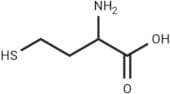
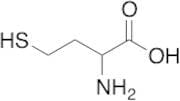
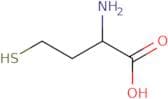
CAS 454-29-5
:(±)-Homocystein
Beschreibung:
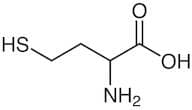
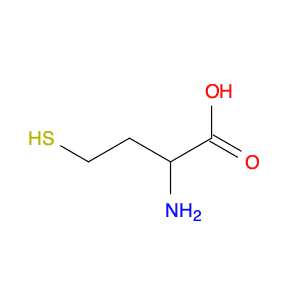
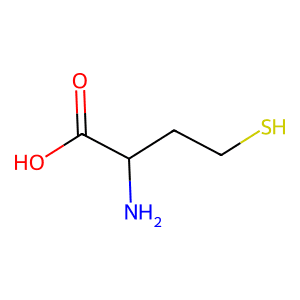
(±)-Homocystein ist eine schwefelhaltige Aminosäure, die eine entscheidende Rolle im Stoffwechsel von Methionin, einer essentiellen Aminosäure, spielt. Es ist eine nicht-proteinogene Aminosäure, was bedeutet, dass sie nicht in Proteine eingebaut wird, sondern an verschiedenen biochemischen Prozessen beteiligt ist. Homocystein existiert in mehreren Formen, einschließlich freiem Homocystein und seinen Derivaten, wie Homocystein-Thiolacton. Die Verbindung zeichnet sich durch ihre chirale Natur aus, da sie zwei Enantiomere hat, die ihre biologische Aktivität beeinflussen können. Erhöhte Homocysteinwerte im Blut sind mit einem erhöhten Risiko für Herz-Kreislauf-Erkrankungen verbunden, da sie zu endothelialer Dysfunktion führen und Atherosklerose fördern können. Homocystein ist auch am Methylierungszyklus beteiligt, wo es remethyliert werden kann, um Methionin zu bilden, oder durch Transsulfuration in Cystein umgewandelt werden kann. Sein Stoffwechsel hängt von verschiedenen Vitaminen ab, insbesondere B6, B12 und Folsäure. Die Überwachung der Homocysteinwerte kann in klinischen Umgebungen wichtig sein, insbesondere zur Beurteilung des kardiovaskulären Risikos und des Ernährungsstatus.
Formel:C4H9NO2S
InChl:InChI=1S/C4H9NO2S/c5-3(1-2-8)4(6)7/h3,8H,1-2,5H2,(H,6,7)
InChI Key:InChIKey=FFFHZYDWPBMWHY-UHFFFAOYSA-N
SMILES:C(CCS)(C(O)=O)N
Synonyme:- 2-Amino-4-mercaptobutanoic acid
- 2-Amino-4-mercaptobutyric acid
- 2-Amino-4-sulfanylbutanoic acid
- <span class="text-smallcaps">DL</span>-Homocysteine
- Butyric acid, 2-amino-4-mercapto-, <span class="text-smallcaps">DL</span>-
- D-homocysteine
- DL-Homocysteine 2-Amino-4-mercaptobuyric acid
- Homocysteine
- NSC 206252
- Butyric acid, 2-amino-4-mercapto-, DL-
- DL-Homocysteine
Sortieren nach
Reinheit (%)
0
100
|
0
|
50
|
90
|
95
|
100
11 Produkte.
DL-Homocysteine
CAS:Formel:C4H9NO2SReinheit:>90.0%(T)Farbe und Form:White to Almost white powder to crystalMolekulargewicht:135.18DL-Homocysteine
CAS:Formel:C4H9NO2SReinheit:(Titration) ≥ 95.0%Farbe und Form:White to off-white or pale pink powderMolekulargewicht:135.18DL-Homocysteine
CAS:DL-Homocysteine (2-Amino-4-mercaptobutyric acid) is a potential marker for tumor cell growth.Formel:C4H9NO2SReinheit:99.57% - ≥98%Farbe und Form:SolidMolekulargewicht:135.18DL-Homocysteine, 90%
CAS:Applications DL-Homocysteine is an allosteric antagonist at the dopamine d2 receptors. Mainly, L-Homocysteine (H591950) exists naturally and is recycled into methionine or converted into cysteine.
References Agnati, L. et al.: J. Proteome Res. 5, 3011 (2006); Stipanuk, M. et al.: Ann. Rev. Nutrition., 24, 539 (2004);Formel:C4H9NO2SReinheit:90%Farbe und Form:Off WhiteMolekulargewicht:135.192-Amino-4-mercaptobutanoic acid
CAS:Formel:C4H9NO2SReinheit:98%Farbe und Form:White powderMolekulargewicht:135.18DL-Homocysteine
CAS:DL-Homocysteine is a sulfur-containing amino acid that is essential for the synthesis of methionine, and is an intermediate in the metabolism of L-methionine. DL-homocysteine has been shown to cause cardiac infarction in rats by inhibiting mitochondrial functions. This amino acid also inhibits the activity of enzymes that regulate homocysteine levels, such as cystathione beta-synthase and cystathione gamma-lyase. DL-homocysteine can be used as a fluorescent probe for detecting proteins involved in apoptosis. It also has proapoptotic effects on cells, causing them to undergo apoptosis.Formel:C4H9NO2SReinheit:Min. 95%Farbe und Form:PowderMolekulargewicht:135.19 g/mol