![Benzoic acid,4-[[[2,3-dihydro-6-[(2-methylpropyl)[(4-methyl-2-thiazolyl)sulfonyl]amino]-1H-inden-5…](/_next/image/?url=https%3A%2Fstatic.cymitquimica.com%2Fcas-image%2Fthumb-webp%2F385611-benzoic-acid-4-23-dihydro-6-2-methylpropyl-4-methyl-2-thiazolyl-sulfonyl-amino-1h-inden-5-yl-oxy-methyl.webp&w=3840&q=75)
CAS 459841-96-4
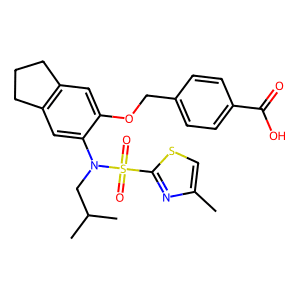
:Benzoesäure, 4-[[[2,3-dihydro-6-[(2-methylpropyl)[(4-methyl-2-thiazolyl)sulfonyl]amino]-1H-inden-5-yl]oxy]methyl]-
Beschreibung:
Benzoesäure, 4-[[[2,3-Dihydro-6-[(2-Methylpropyl)[(4-Methyl-2-Thiazolyl)sulfonyl]amino]-1H-Inden-5-yl]oxy]methyl]- ist eine komplexe organische Verbindung, die durch ihren Benzoesäurekern gekennzeichnet ist, der eine Carbonsäure ist, die für ihre antimikrobiellen Eigenschaften und ihre Verwendung als Lebensmittelkonservierungsmittel bekannt ist. Die Struktur weist eine substituierte Inden-Einheit auf, was auf eine potenzielle biologische Aktivität hinweist, sowie einen Thiazolring, der oft zu pharmakologischen Eigenschaften beiträgt. Das Vorhandensein einer Sulfonamidgruppe deutet darauf hin, dass diese Verbindung spezifische Wechselwirkungen mit biologischen Zielen aufweisen könnte, was sie in der medizinischen Chemie von Interesse macht. Darüber hinaus verbessert die verzweigte Alkylgruppe (2-Methylpropyl) die Lipophilie, was potenziell ihre Löslichkeit und Permeabilität in biologischen Systemen beeinflussen kann. Insgesamt können die einzigartigen strukturellen Merkmale dieser Verbindung spezifische Reaktivität und biologische Aktivität verleihen, was weitere Untersuchungen für Anwendungen in der Pharmazie oder Agrochemie rechtfertigt.
Formel:C25H28N2O5S2
Sortieren nach
Reinheit (%)
0
100
|
0
|
50
|
90
|
95
|
100
3 Produkte gefunden.
ONO-8130
CAS:ONO-8130 is an orally available antagonist of EP1 receptor.Formel:C25H28N2O5S2Reinheit:97.82%Farbe und Form:SolidMolekulargewicht:500.63ONO 8130
CAS:ONO-8130 is a new, potent and selective agonist of the prostanoid receptor EP2. It has been shown to have a concentration-dependent antinociceptive effect in both anesthetized and non-anesthetized animals. In functional studies, ONO-8130 inhibits the spontaneous firing of neurons from the dorsal root ganglia (DRG) in a dose-dependent manner, which may be mediated by an action on EP2 receptors. ONO-8130 also inhibits the release of nociceptive neurotransmitters such as histamine from rat peritoneal mast cells. The drug has been found to have antihistaminic activity in rats but not in guinea pigs or mice. This may be due to its ability to activate EP2 receptors in the bladder muscle and/or its affinity for vascular endothelial cells that express EP2 receptors. These actions may account for its antihistaminic effects observed in rats but not mice orFormel:C25H28N2O5S2Reinheit:Min. 95%Molekulargewicht:500.63 g/mol