CAS 4604-41-5
:3,3′-Diiod-L-thyronin
Beschreibung:
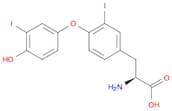
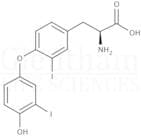
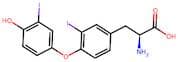
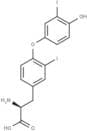
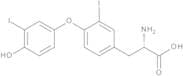
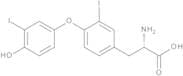
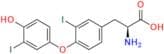
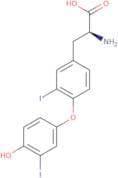
3,3′-Diiod-L-thyronin, auch bekannt als Diiodthyronin, ist ein Derivat des Schilddrüsenhormons Thyroxin (T4) und zeichnet sich durch das Vorhandensein von zwei Iodatomen an den Positionen 3 und 3' der phenolischen Ringe aus. Diese Verbindung spielt eine Rolle bei der Regulierung des Stoffwechsels und ist an verschiedenen physiologischen Prozessen beteiligt. Es handelt sich typischerweise um ein weißes bis off-white kristallines Pulver, das in organischen Lösungsmitteln löslich ist, aber eine begrenzte Löslichkeit in Wasser hat. Die molekulare Struktur von 3,3′-Diiod-L-thyronin trägt zu seiner biologischen Aktivität bei, beeinflusst die Genexpression und die Stoffwechselwege. Es ist wichtig im Kontext der Schilddrüsenfunktion und kann auf seine potenziellen therapeutischen Anwendungen untersucht werden, insbesondere bei Bedingungen, die mit Ungleichgewichten der Schilddrüsenhormone zusammenhängen. Wie bei vielen jodhaltigen Verbindungen ist es wichtig, es mit Vorsicht zu behandeln, aufgrund seiner biologischen Aktivität und potenziellen Auswirkungen auf die menschliche Gesundheit.
Formel:C15H13I2NO4
InChl:InChI=1S/C15H13I2NO4/c16-10-7-9(2-3-13(10)19)22-14-4-1-8(5-11(14)17)6-12(18)15(20)21/h1-5,7,12,19H,6,18H2,(H,20,21)/t12-/m0/s1
InChI Key:InChIKey=CPCJBZABTUOGNM-LBPRGKRZSA-N
SMILES:O(C1=C(I)C=C(C[C@@H](C(O)=O)N)C=C1)C2=CC(I)=C(O)C=C2
Synonyme:- 3,3'-Diiodo-L-thyronine
- 3,3′-Diiodo-<span class="text-smallcaps">L</span>-thyronine
- 3,5-Diiodo-L-tyrosinedihydrae
- <span class="text-smallcaps">L</span>-3,3′-Diiodothyronine
- <span class="text-smallcaps">L</span>-Tyrosine, O-(4-hydroxy-3-iodophenyl)-3-iodo-
- Alanine, 3-[4-(4-hydroxy-3-iodophenoxy)-3-iodophenyl]-, <span class="text-smallcaps">L</span>-
- O-(4-Hydroxy-3-iodophenyl)-3-iodo-<span class="text-smallcaps">L</span>-tyrosine
- L-Tyrosine, O-(4-hydroxy-3-iodophenyl)-3-iodo-
- L-3,3′-Diiodothyronine
- Alanine, 3-[4-(4-hydroxy-3-iodophenoxy)-3-iodophenyl]-, L-
- O-(4-Hydroxy-3-iodophenyl)-3-iodo-L-tyrosine
Sortieren nach
Reinheit (%)
0
100
|
0
|
50
|
90
|
95
|
100
10 Produkte.
3,3'-Diiodo-L-thyronine
CAS:Formel:C15H13I2NO4Reinheit:95%Farbe und Form:SolidMolekulargewicht:525.0770Levothyroxine EP Impurity J HCl (3,3'-L-Diiodothyronine HCl)
CAS:Formel:C15H13I2NO4·HClMolekulargewicht:525.08 36.463,3'-Diiodo-L-thyronine
CAS:3,3'-Diiodo-L-thyronine (3,3'-T2) is an endogenous thyroid hormone metabolite capable of enhancing mitochondrial COX activity in rat hepatocytes.Formel:C15H13I2NO4Reinheit:96.73%Farbe und Form:SolidMolekulargewicht:525.083,3’-Diiodo-L-thyronine (>97%)
CAS:Formel:C15H13I2NO4Reinheit:>97%Farbe und Form:NeatMolekulargewicht:525.083,3'-Diiodo-L-thyronine
CAS:3,3'-Diiodo-L-thyronine (T2) is a thyroid hormone that binds to the DNA response element in the promoter region of its target genes. It has been shown to decrease the transcription of genes encoding for proteins involved in energy metabolism and thus may play a role in weight loss. T2 also inhibits the production of hydrochloric acid by human gastric cells, which may lead to a reduction of stomach acidity. T2 is detectable in serum within 3 hours following ingestion and can be quantified using high performance liquid chromatography with electrochemical detection. The matrix effect is a phenomenon that occurs when samples are analyzed using different analytical methods and this must be taken into account when interpreting results. T2 has been shown to have pharmacological effects on experimental animals, including the stimulation of liver cell growth and an increase in metabolic rate.Formel:C15H13I2NO4Reinheit:Min. 95%Farbe und Form:PowderMolekulargewicht:525.08 g/mol