CAS 464-07-3
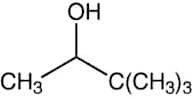
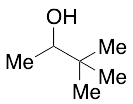
:3,3-Dimethyl-2-butanol
- (2R)-3,3-dimethylbutan-2-ol
- (2S)-3,3-dimethylbutan-2-ol
- 1,2,2-Trimethyl-1-propanol
- 1-Methyl-2,2-dimethylpropanol
- 1-tert-Butylethanol
- 2,2-Dimethyl-3-butanol
- 2-Butanol, 3,3-dimethyl-
- 3,3-Dimethyl-2-Butanol (2,2-3)
- 3,3-Dimethylbutan-2-Ol
- 3,3-Dymethyl-2butanol
- <span class="text-smallcaps">DL</span>-3,3-Dimethylbutan-2-ol
- Dymethylbutanol
- NSC 939
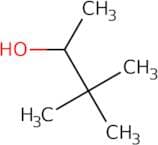
- Pinacolyl alcohol
- tert-Butyl methyl carbinol
- Weitere Synonyme anzeigen
3,3-Dimethyl-2-butanol, 98+%
CAS:3,3-Dimethyl-2-butanol was used in conversion of ribose- and glucose-binding proteins into receptors for pinacolyl methyl phosphonic acid. This Thermo Scientific Chemicals brand product was originally part of the Alfa Aesar product portfolio. Some documentation and label information may refer to the
Formel:C6H14OReinheit:98+%Farbe und Form:Colorless, LiquidMolekulargewicht:102.183,3-Dimethyl-2-butanol
CAS:Kontrolliertes ProduktApplications 3,3-Dimethyl-2-butanol is used as a reagent in the synthesis of 2,4-dicarboxy-pyrroles as selective non-competitive mGluR1 antagonists. 3,3-Dimethyl-2-butanol is also used in the preparation of dihydropyrrole derivatives containing N-sulfanyl, sulfinyl, and sulfonyl moieties which have insecticidal activity.
Not a dangerous good if item is equal to or less than 1g/ml and there is less than 100g/ml in the package
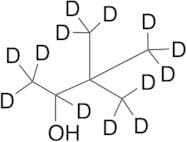
References Ito, M., et al.: Bioorg. Med. Chem., 11, 489 (2003); Micheli, F., et al.: Bioorg. Med. Chem., 11, 171 (2003)Formel:C6H14OFarbe und Form:NeatMolekulargewicht:102.1753,3-Dimethyl-2-butanol-d13
CAS:Kontrolliertes ProduktFormel:C6D13HOFarbe und Form:NeatMolekulargewicht:115.255Pinacolyl alcohol
CAS:Kontrolliertes ProduktPinacolyl alcohol is an organic compound with molecular weight of 186.25. It is a colorless liquid that is soluble in water and ether. Pinacolyl alcohol can be prepared by reacting chloral hydrate with acetaldehyde in the presence of a base, such as potassium carbonate or sodium bicarbonate. The reaction mechanism was studied using kinetic energy (KIE) values to determine the reaction rate order and equilibrium constants for the forward and reverse reactions. Pinacolyl alcohol has also been studied as a chemical substance that interacts with hydrochloric acid, chloride ions, and water vapor to form chloroform, hydrochloric acid, and water vapor respectively. These chemical reactions are reversible due to the presence of water vapor in the system.
Pinacolyl alcohol has been shown to be effective against inflammation in Sprague-Dawley rats by inhibiting cyclooxygenase enzymes which produce prostaglandins from arachidonic acid. ThisReinheit:Min. 95%