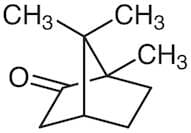
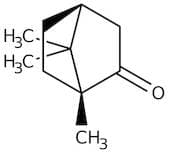
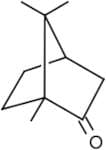
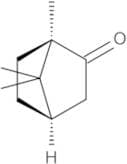
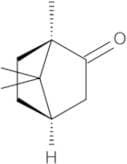
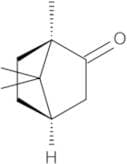
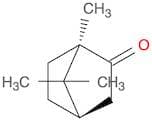
CAS 464-49-3
:(+)-Kampfer
Beschreibung:
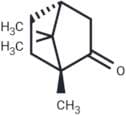
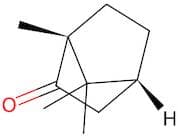
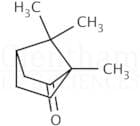
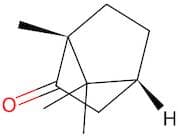
(+)-Kampfer, mit der CAS-Nummer 464-49-3, ist eine bicyclische Monoterpen-Ketone, die aus dem Holz des Kampferbaums (Cinnamomum camphora) gewonnen wird. Es handelt sich um einen farblosen oder weißen kristallinen Feststoff mit einem charakteristischen aromatischen Geruch. Die Verbindung ist bekannt für ihr ausgeprägtes Kühlempfinden und wird häufig in medizinischen und kosmetischen Produkten wie Salben und Cremes verwendet, aufgrund ihrer schmerzlindernden und entzündungshemmenden Eigenschaften. (+)-Kampfer ist in organischen Lösungsmitteln wie Ethanol und Ether löslich, hat jedoch eine begrenzte Löslichkeit in Wasser. Es zeigt einen Schmelzpunkt um Raumtemperatur und einen deutlich höheren Siedepunkt, was auf seine Flüchtigkeit hinweist. Die Verbindung ist optisch aktiv, mit einer spezifischen Drehung, die ihre chirale Natur widerspiegelt. Neben ihren Anwendungen in der traditionellen Medizin wird (+)-Kampfer auch in der Synthese verschiedener organischer Verbindungen und als Aromastoff in Lebensmitteln verwendet. Sicherheitsüberlegungen umfassen mögliche Hautreizungen und Toxizität bei hohen Dosen, was eine sorgfältige Handhabung und Nutzungshinweise erforderlich macht.
Formel:C10H16O
InChl:InChI=1S/C10H16O/c1-9(2)7-4-5-10(9,3)8(11)6-7/h7H,4-6H2,1-3H3/t7-,10+/m1/s1
InChI Key:InChIKey=DSSYKIVIOFKYAU-XCBNKYQSSA-N
SMILES:C[C@@]12C(C)(C)[C@@](CC1=O)(CC2)[H]
Synonyme:- (+)-2-Bornanone
- (+)-Bornan-2-Ona
- (+)-Bornan-2-on
- (+)-Bornan-2-one
- (+)-Bornane-2-One
- (1R)-(+)-amphor
- (1R)-1,7,7-trimethylbicyclo[2.2.1]heptan-2-one
- (1R)-Camphor
- (1R,4R)-(+)-Camphor
- (1R,4R)-1,7,7-Trimethylbicyclo(2.2.1)heptan-2-one
- (R)-Camphor
- <span class="text-smallcaps">D</span>-(+)-Camphor
- Ai3-01698
- Alcanfor
- Bicyclo(2.2.1)heptan-2-one, 1,7,7-trimethyl-, (1R)-
- Bicyclo(2.2.1)heptan-2-one, 1,7,7-trimethyl-, (1R,4R)-
- Bicyclo(2.2.1)heptan-2-one, 1,7,7-trimethyl-, (1theta)-
- Camphor USP
- Camphor, (+)-
- Camphor, (1R,4R)-(+)-
- Camphor, Camphor
- Camphor, D-
- Dextrocamphora
- FEMA No. 2230
- Formosa camphor
- Japanese camphor
- Laurel camphor
- Unii-N20Hl7Q941
- d-2-Bornanone
- d-2-Camphanone
- d-Camphor
- Weitere Synonyme anzeigen
Sortieren nach
Reinheit (%)
0
100
|
0
|
50
|
90
|
95
|
100
17 Produkte gefunden.
(+)-Camphor
CAS:Formel:C10H16OReinheit:>98.0%(GC)Farbe und Form:White or Colorless powder to lumpMolekulargewicht:152.24(1R)-(+)-Camphor, 98%
CAS:(1R)-(+)-Camphor is used as a chiral intermediate and auxiliary. It is also used as a skin antipruritic and as an anti-infective agent. This Thermo Scientific Chemicals brand product was originally part of the Alfa Aesar product portfolio. Some documentation and label information may refer to the leFormel:C10H16OReinheit:98%Farbe und Form:White, Crystals or powder or crystalline powder or lumps or fused solidMolekulargewicht:152.24(+)-Camphor
CAS:(+)-Camphor analytical standard provided with w/w absolute assay, to be used for quantitative titration.Formel:C10H16OReinheit:(GC) ≥97% (sum of enantiomers)Farbe und Form:SolidMolekulargewicht:152.24(+)-Camphor
CAS:(+)-Camphor (D-Camphor) is the oil extracted from the wood of the Camphor tree Cinnamomum Camphora with anti-inflammatory and analgesic properties.Formel:C10H16OReinheit:98.82%Farbe und Form:Less Or White Crystals Sublimes Flash Point 149°F Burns Readily With A Bright Smoky Flame Penetrating Aromatic Odor Pungent Aromatic Taste Followed By A Sensation OfMolekulargewicht:152.23(R)-(+)-Camphor
CAS:Applications (R)-(+)-Camphor is a terpenoid with a wide variety of use. (R)-(+)-Camphor has insecticidal activity and is also used as an antimicrobial agent. (R)-(+)-Camphor is used as a culinary flavouring agent in parts of asia.
Not a dangerous good if item is equal to or less than 1g/ml and there is less than 100g/ml in the package
References Abdelgaleil, S.A.M. Appl. Entomol. Zool., 45, 425 (2010); Tabanca, N. et al.: J. Agric. Food. Chem., 49, 4300 (2001);Formel:C10H16OFarbe und Form:NeatMolekulargewicht:152.23