


CAS 464-85-7
:Chinamin
Beschreibung:
Chinamin, mit der CAS-Nummer 464-85-7, ist eine organische Verbindung, die zur Klasse der Alkaloide gehört, speziell abgeleitet von Chinolin. Sie ist durch ihre bicyclische Struktur gekennzeichnet, die ein Chinolin-Motiv enthält. Chinamin ist typischerweise ein gelbliches kristallines Feststoff, das in organischen Lösungsmitteln löslich ist, aber eine begrenzte Löslichkeit in Wasser hat. Diese Verbindung zeigt basische Eigenschaften aufgrund des Vorhandenseins eines Stickstoffatoms in ihrer Struktur, was es ihr ermöglicht, Salze mit Säuren zu bilden. Chinamin wurde auf seine potenziellen pharmakologischen Wirkungen untersucht, einschließlich antimalarischer und antiparasitärer Aktivitäten, aufgrund seiner strukturellen Ähnlichkeit mit anderen biologisch aktiven Chinolinderivaten. Darüber hinaus kann es verschiedenen chemischen Reaktionen unterzogen werden, wie Oxidation und Substitution, die seine Eigenschaften und Reaktivität verändern können. Sicherheitsdaten zeigen, dass Chinamin, wie viele Alkaloide, mit Vorsicht behandelt werden sollte, da es potenzielle Toxizität und biologische Wirkungen aufweist. Insgesamt stellt Chinamin eine bedeutende Verbindung in der medizinischen Chemie und Pharmakologie dar, die eine weitere Untersuchung seiner Anwendungen und Wirkmechanismen rechtfertigt.
Formel:C19H24N2O2
InChl:InChI=1S/C19H24N2O2/c1-2-13-12-21-9-7-14(13)11-17(21)19-18(22,8-10-23-19)15-5-3-4-6-16(15)20-19/h2-6,13-14,17,20,22H,1,7-12H2/t13-,14-,17-,18+,19-/m0/s1
InChI Key:InChIKey=ALNKTVLUDWIWIH-HLQCWHFUSA-N
SMILES:O[C@@]12[C@@](NC=3C1=CC=CC3)(OCC2)[C@]4([N@@]5C[C@H](C=C)[C@](C4)(CC5)[H])[H]
Synonyme:- (3aR,8aS)-8a-[(1S,2S,4S,5R)-5-Ethenyl-1-azabicyclo[2.2.2]oct-2-yl]-2,3,8,8a-tetrahydro-3aH-furo[2,3-b]indol-3a-ol
- (3aR,8aS)-8a-[(2S,4S,5R)-5-ethenyl-1-azabicyclo[2.2.2]oct-2-yl]-2,3,8,8a-tetrahydro-3aH-furo[2,3-b]indol-3a-ol
- 3aH-Furo(2,3-b)indol-3a-ol, 8a-((1S,2S,4S,5R)-5-ethenyl-1-azabicyclo(2.2.2)oct-2-yl)-2,3,8,8a-tetrahydro-, (3aR,8aS)-
- 3aH-Furo[2,3-b]indol-3a-ol, 8a-(5-ethenyl-1-azabicyclo[2.2.2]oct-2-yl)-2,3,8,8a-tetrahydro-, [1S-[1α,2α(3aS*,8aR*),4α,5β]]-
- 8a-(5-Vinyl-1-azabicyclo(2.2.2)oct-2-yl)-2,3,8,8a-tetrahydro-3aH-furo(2,3-b)indol-3a-ol
- 8a-[(2S,4S,5R)-5-ethenyl-1-azabicyclo[2.2.2]oct-2-yl]-2,3,8,8a-tetrahydro-3aH-furo[2,3-b]indol-3a-ol
- Alkaloid B from Cinchonaledgeriana
- Quinamine
Sortieren nach
Reinheit (%)
0
100
|
0
|
50
|
90
|
95
|
100
4 Produkte.
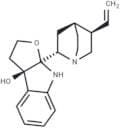
8a-(5-vinyl-1-azabicyclo[2.2.2]oct-2-yl)-2,3,8,8a-tetrahydro-3aH-furo[2,3-b]indol-3a-ol
CAS:Formel:C19H24N2O2Reinheit:97.5%Molekulargewicht:312.4061Quinamine
CAS:Quinamine is a natural product of Remijia, Rubiaceae.
Formel:C19H24N2O2Reinheit:98%Farbe und Form:SolidMolekulargewicht:312.4138a-(5-Vinyl-1-azabicyclo[2.2.2]oct-2-yl)-2,3,8,8a-tetrahydro-3aH-furo[2,3-b]indol-3a-ol
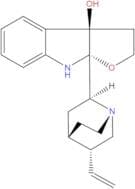
CAS:8a-(5-Vinyl-1-azabicyclo[2.2.2]oct-2-yl)-2,3,8,8a-tetrahydro-3aH-furo[2,3-b]indol-3a-ol is a synthetic organic compound, which is a derivative of indole alkaloids. These compounds are often synthesized in laboratories, leveraging advanced organic chemistry techniques to modify naturally occurring alkaloids for specific pharmacological purposes. The mechanism of action typically involves interaction with neural receptors, although the precise targets and pathways may vary depending on chemical modifications and desired outcomes.Formel:C19H24N2O2Reinheit:Min. 95%Molekulargewicht:312.4 g/mol
![8a-(5-vinyl-1-azabicyclo[2.2.2]oct-2-yl)-2,3,8,8a-tetrahydro-3aH-furo[2,3-b]indol-3a-ol](/_next/image/?url=https%3A%2Fstatic.cymitquimica.com%2Fproducts%2FIN%2Fthumb%2FDA00DK24.jpg&w=3840&q=75)



![8a-(5-Vinyl-1-azabicyclo[2.2.2]oct-2-yl)-2,3,8,8a-tetrahydro-3aH-furo[2,3-b]indol-3a-ol](/_next/image/?url=https%3A%2Fstatic.cymitquimica.com%2Fproducts%2F3D%2Fthumb%2FAAA46485.jpg&w=3840&q=75)
