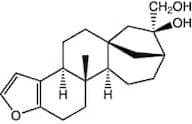
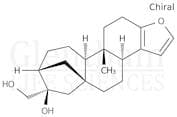
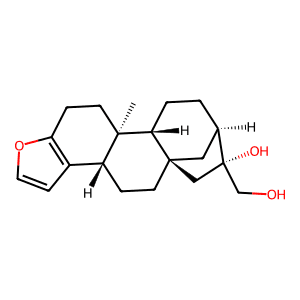
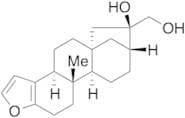
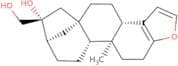
CAS 469-83-0
:Cafestol
Beschreibung:
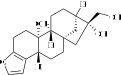
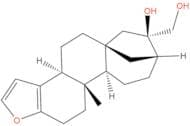
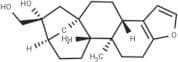
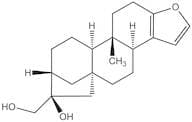
Cafestol ist eine natürliche Verbindung, die hauptsächlich im Kaffee vorkommt, insbesondere in unfiltrierten Kaffeezubereitungen. Es ist ein Diterpen, spezifisch eine Art von Labdan, und ist bekannt für seine lipidähnliche Struktur. Cafestol wird für seine potenziellen gesundheitlichen Auswirkungen anerkannt, einschließlich seiner Fähigkeit, die Cholesterinwerte im Blut zu erhöhen, was ein Forschungsthema im Zusammenhang mit dem Kaffeekonsum und der Herz-Kreislauf-Gesundheit war. Die Verbindung ist auch für ihre antioxidativen Eigenschaften bekannt, die zu den allgemeinen gesundheitlichen Vorteilen beitragen, die mit Kaffee verbunden sind. Cafestol ist in organischen Lösungsmitteln löslich, hat jedoch eine begrenzte Löslichkeit in Wasser, was für viele lipophile Verbindungen typisch ist. Sein Vorkommen im Kaffee variiert erheblich je nach Zubereitungsmethode; zum Beispiel behalten Methoden wie die French Press oder türkischer Kaffee mehr Cafestol im Vergleich zu gefiltertem Kaffee. Das Verständnis der Eigenschaften von Cafestol ist entscheidend, um seine Auswirkungen auf Gesundheit und Ernährung sowie seine Rolle in der komplexen Chemie des Kaffees zu bewerten.
Formel:C20H28O3
InChl:InChI=1/C20H28O3/c1-18-7-5-16-14(6-9-23-16)15(18)4-8-19-10-13(2-3-17(18)19)20(22,11-19)12-21/h6,9,13,15,17,21-22H,2-5,7-8,10-12H2,1H3/t13?,15-,17+,18-,19+,20+/m1/s1
InChI Key:InChIKey=DNJVYWXIDISQRD-HWUKTEKMSA-N
SMILES:C[C@]12[C@]3([C@]4(C[C@]([C@](CO)(O)C4)(CC3)[H])CC[C@@]1(C5=C(CC2)OC=C5)[H])[H]
Synonyme:- (3bS,5aS,7R,8R,10aR,10bS)-3b,4,5,6,7,8,9,10,10a,10b,11,12-Dodecahydro-7-hydroxy-10b-methyl-5a,8-methano-5aH-cyclohepta[5,6]naphtho[2,1-b]furan-7-methanol
- (3bS,5aS,7R,8R,10aR,10bS)-7-(hydroxymethyl)-10b-methyl-3b,4,5,6,7,8,9,10,10a,10b,11,12-dodecahydro-5a,8-methanocyclohepta[5,6]naphtho[2,1-b]furan-7-ol
- (3bS,5aS,7R,8S,10aR,10bS)-7-(hydroxymethyl)-10b-methyl-3b,4,5,6,7,8,9,10,10a,10b,11,12-dodecahydro-5a,8-methanocyclohepta[5,6]naphtho[2,1-b]furan-7-ol
- 5a,8-Methano-5aH-cyclohepta(5,6)naphtho(2,1-b)furan-7-methanol, 3b,4,5,6,7,8,9,10,10a,10b,11,12-dodecahydro-7-hydroxy-10b-methyl-, (3bS,5aS,7R,8R,10aR,10bS)-
- 5a,8-Methano-5aH-cyclohepta(5,6)naphtho(2,1-b)furan-7-methanol, 3b,4,5,6,7,8,9,10,10a,10b,11,12-dodecahydro-7-hydroxy-10b-methyl-, (3bS-(3balpha,5abeta,7beta,8beta,10aalpha,10bbeta))-
- 5a,8-Methano-5aH-cyclohepta[5,6]naphtho[2,1-b]furan-7-methanol, 3b,4,5,6,7,8,9,10,10a,10b,11,12-dodecahydro-7-hydroxy-10b-methyl-, [3bS-(3bα,5aβ,7β,8β,10aα,10bβ)]-
- Cafesterol
- Ccris 1518
- Cafestol
- 3bα,4,5,6,7,8,9,10,10aα,10b,11,12-Dodecahydro-7β-hydroxy-10bβ-methyl-5aβ,8β-methano-5aH-cyclohepta[5,6]naphtho[2,1-b]furan-7α-methanol
- Cafestol (>85%)
- Weitere Synonyme anzeigen
Sortieren nach
Reinheit (%)
0
100
|
0
|
50
|
90
|
95
|
100
10 Produkte gefunden.
Cafestol
CAS:Natural extract from coffee beans which induces glutathione S-transferaseFormel:C20H28O3Farbe und Form:White to off white, PowderMolekulargewicht:316.44Cafestol
CAS:Formel:C20H28O3Reinheit:≥ 98.0%Farbe und Form:White to off-white powderMolekulargewicht:316.44Cafestol
CAS:Cafestol has anticarcinogenic, peripheral antinociceptive and anti-inflammatory activities, it inhibits Cyclic-Strain-induced interleukin-8, intercellular adhesion molecule-1, and monocyte chemoattractant protein-1 production in vascular endothelial cells. Cafestol is a novel extracellular signal-regulated kinase inhibitor with AP-1-targeted inhibition of prostaglandin E2 production in lipopolysaccharide-activated macrophages. Cafestol acts as an agonist ligand for both FXR and PXR, and this may contribute to its impact on cholesterol homeostasis. Cafestol has protective effects against the CCl(4)-induced hepatotoxicity, which possibly involve mechanisms related to its ability to block the CYP2E1-mediated CCl(4) bioactivation and free radical scavenging effects. Cafestol has antidiabetic activity, it increases glucose-stimulated insulin secretion in vitro and increases glucose uptake in human skeletal muscle cells. Cafestol also has a weak inhibitory effect on osteoclastogenesis and promotes osteoblast differentiation.Formel:C20H28O3Reinheit:95%~99%Molekulargewicht:316.441CAFESTOL
CAS:Cafestol, an ERK inhibitor, suppresses PGE2 and COX-2 by blocking NF-kB in LPS-stimulated RAW264.7 cells.Formel:C20H28O3Reinheit:97.06% - 99.08%Farbe und Form:SolidMolekulargewicht:316.43Cafestol
CAS:Oxygen-heterocyclic compoundFormel:C20H28O3Reinheit:≥ 98.0 % (HPLC)Farbe und Form:PowderMolekulargewicht:316.44Cafestol (>85%)
CAS:Kontrolliertes ProduktApplications Cafestol is a diterpene molecule that displays anti-carcinogenic properties in studies.
References Higgins, L.G. et al.: Tox. App. Pharma., 226, 328 (2008); Schilter, B. et al.: Carcinogenesis, 17, 2377 (1996);Formel:C20H28O3Reinheit:>85%Farbe und Form:NeatMolekulargewicht:316.43Cafestol
CAS:Cafestol is a diterpene compound, which is primarily sourced from coffee beans. It is found in the oily fraction of coffee, particularly in unfiltered types like French press and Turkish coffee. Its mode of action involves influencing lipid metabolism in the liver. Specifically, cafestol acts as an agonist for certain nuclear receptors, including FXR and PXR, which play a role in bile acid regulation and lipid homeostasis.Cafestol is known to have a notable impact on cholesterol levels. It causes an increase in serum cholesterol by reducing the excretion of bile acids, consequently enhancing cholesterol reabsorption. Due to its pronounced effects on cholesterol metabolism, cafestol is a compound of interest in cardiovascular research, especially in the context of dietary factors influencing heart health. Scientists are exploring its broader implications on lipid-related diseases and how modifying coffee preparation methods can mitigate its impact on health.Formel:C20H28O3Reinheit:Min. 95%Farbe und Form:PowderMolekulargewicht:316.43 g/mol