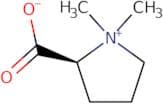
CAS 471-87-4
:(-)-Stachydrin
Beschreibung:
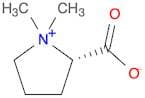
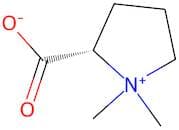
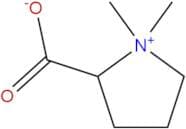
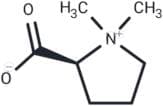
(-)-Stachydrin, mit der CAS-Nummer 471-87-4, ist ein natürlich vorkommendes Alkaloid, das hauptsächlich in verschiedenen Pflanzenarten, insbesondere in der Familie der Lamiaceae, vorkommt. Es ist durch seine chemische Struktur gekennzeichnet, die einen Pyridinring und eine quartäre Ammoniumgruppe umfasst, was zu seiner biologischen Aktivität beiträgt. Diese Verbindung ist bekannt für ihre potenziellen pharmakologischen Eigenschaften, einschließlich entzündungshemmender und neuroprotektiver Wirkungen. (-)-Stachydrin wird oft für seine Rolle in der traditionellen Medizin und seine potenziellen therapeutischen Anwendungen untersucht. In Bezug auf die physikalischen Eigenschaften ist es typischerweise ein weißes kristallines Feststoff, der in Wasser und Alkohol löslich ist, was seine Extraktion aus pflanzlichen Quellen erleichtert. Die Stereochemie von (-)-Stachydrin ist bedeutend, da die spezifische Konfiguration seine biologischen Interaktionen und die Wirksamkeit beeinflussen kann. Insgesamt stellt diese Verbindung ein interessantes Studienobjekt sowohl in der Naturstoffchemie als auch in der Pharmakologie dar und hebt die Bedeutung pflanzenbasierter Substanzen in der medizinischen Forschung hervor.
Formel:C7H14NO2
InChl:InChI=1/C7H13NO2/c1-8(2)5-3-4-6(8)7(9)10/h6H,3-5H2,1-2H3/t6-/m0/s1
InChI Key:InChIKey=CMUNUTVVOOHQPW-LURJTMIESA-N
SMILES:C([O-])(=O)[C@H]1[N+](C)(C)CCC1
Synonyme:- (2S)-1,1-Dimethylpyrrolidin-1-ium-2-carboxylate
- (S)-1,1-Dimethylpyrrolidin-1-ium-2-carboxylate
- (S)-2-Carboxy-1,1-dimethylpyrrolidinium hydroxide inner salt
- 1,1-Dimethylpyrrolidinium-2-Carboxylate
- 1-Methylproline methylbetaine
- <span class="text-smallcaps">L</span>-Stachydrine
- Cadabine
- Hygric acid, methylbetaine
- Methyl hygrate betaine
- N,N-Dimethyl-<span class="text-smallcaps">L</span>-proline
- Proline betaine
- Pyrrolidinium, 2-carboxy-1,1-dimethyl-, hydroxide, inner salt, (S)-
- Pyrrolidinium, 2-carboxy-1,1-dimethyl-, inner salt, (2S)-
- S-(-)-Stachydrine
- Stachydrin
- α-N-Dimethyl-<span class="text-smallcaps">L</span>-proline
- Stachydrine
- L-stachydrine
- N,N-Dimethyl-L-proline USP/EP/BP
- (Pyrrolidinium, 2-carboxy-1,1-dimethyl-, innersalt, (2S)-
- N-Dimethyl-L-proline
- (2S)-2-Carboxylato-1,1-dimethylpyrrolidin-1-ium
- (2s)-1,1-dimethylpyrrolidinium-2-carboxylate
- N,N-Dimethyl-L-Proline ( (-)-Stachydrine)
- (s)-2-carboxylato-1,1-dimethylpyrrolidinium
- Stachydrine, >98%
- (2S)-1,1-Dimethyl-2-carboxylatopyrrolidin-1-ium
- n,n-dimethyl-l-proline
- Weitere Synonyme anzeigen
Sortieren nach
Reinheit (%)
0
100
|
0
|
50
|
90
|
95
|
100
7 Produkte.
(S)-1,1-Dimethylpyrrolidin-1-ium-2-carboxylate
CAS:Formel:C7H13NO2Reinheit:98%Farbe und Form:SolidMolekulargewicht:143.1836N,N-Dimethyl-L-Proline Iodide ((-)-Stachydrine Iodide)
CAS:Formel:C7H14NO2·IMolekulargewicht:144.19 126.91Stachydrine
CAS:Stachydrine, found in leonurus herb, aids blood flow, blocks NF-κB pathway, and indicates citrus intake.
Formel:C7H13NO2Reinheit:99.94% - ≥95%Farbe und Form:SolidMolekulargewicht:143.18Stachydrine
CAS:Stachydrine is a naturally occurring alkaloid, primarily found in plants such as Leonurus japonicus and various species of the genus Stachys. This compound, classified as a pyrrolidine betaine, is derived from botanical sources with traditional medicinal use in several cultures. The mode of action of stachydrine includes modulating cardiovascular functions, potentially through vasodilatory effects and influencing platelet aggregation. These biochemical interactions suggest a role in improving blood circulation and exerting cardioprotective effects. As such, stachydrine is the focus of ongoing research regarding its application in managing cardiovascular disorders, particularly those involving impaired blood flow or clotting irregularities. Furthermore, its potential anti-inflammatory and anti-fibrotic properties are being explored, indicating broader therapeutic implications beyond the cardiovascular system.Formel:C7H13NO2Reinheit:Min. 95%Farbe und Form:PowderMolekulargewicht:143.18 g/mol(S)-1,1-Dimethylpyrrolidin-1-ium-2-carboxylate
CAS:Formel:C7H13NO2Reinheit:98%Farbe und Form:SolidMolekulargewicht:143.186