CAS 475-38-7
:Naphthazarin
Beschreibung:
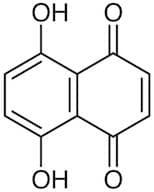
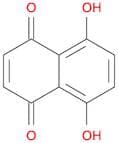
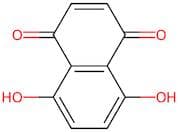
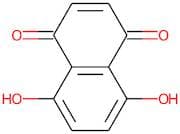
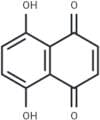
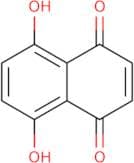
Naphthazarin, mit der CAS-Nummer 475-38-7, ist eine synthetische organische Verbindung, die zur Klasse der Naphthoquinone gehört. Sie zeichnet sich durch ihre tiefrote bis violette Farbe aus, die auf ihr konjugiertes Doppelbindungssystem zurückzuführen ist, das eine signifikante Lichtabsorption ermöglicht. Naphthazarin ist bekannt für seine potenziellen Anwendungen in verschiedenen Bereichen, einschließlich als Farbstoff und in der biologischen Forschung aufgrund seiner Fähigkeit, mit zellulären Komponenten zu interagieren. Die Verbindung zeigt eine moderate Löslichkeit in organischen Lösungsmitteln, während ihre Löslichkeit in Wasser begrenzt ist. Naphthazarin wird auch für seine Redox-Eigenschaften anerkannt, die es ihm ermöglichen, an Elektronentransferreaktionen teilzunehmen. Darüber hinaus wurde es auf seine potenziellen antimikrobiellen und krebsbekämpfenden Aktivitäten untersucht, obwohl weitere Forschungen erforderlich sind, um seine biologischen Wirkungen und Wirkmechanismen vollständig zu verstehen. Wie bei vielen chemischen Substanzen sind eine ordnungsgemäße Handhabung und Sicherheitsvorkehrungen aufgrund seiner potenziellen Toxizität und Umweltauswirkungen unerlässlich.
Formel:C10H6O4
InChl:InChI=1/C10H6O4/c11-5-1-2-6(12)10-8(14)4-3-7(13)9(5)10/h1-4,11-12H
InChI Key:InChIKey=RQNVIKXOOKXAJQ-UHFFFAOYSA-N
SMILES:O=C1C=2C(=C(O)C=CC2O)C(=O)C=C1
Synonyme:- 1,4-Naphthalenedione, 5,8-Dihydroxy-
- 1,4-Naphthoquinone, 5,8-dihydroxy-
- 475-38-7
- 5,8-Dihydroxy-1,4-naphthalenedione
- 5,8-Dihydroxy-1,4-naphthosemiquinone
- 5,8-Dihydroxynaphthalene-1,4-Dione
- 5,8-Dihydroxynaphthoquinone
- NSC 26647
- NSC 344555
- Naphthazarin
- Naphthazarine
- Naphthazarone
- 5,8-dihydroxy-4-naphthoquinone
- 5,8-Dihydroxy-1,4-n
- NAPHTHAZALINE
- 5,8-HYDROXY-1,4-NAPHTHOQUINONE
- 5,8-DIHYDROXY-1,4-NAPHTHOQUINONE, TECH.
- ,8-Dihydroxy-[1,4]naphthoquinone
- 5,8-Dihydroxy-1,4-naphthoquinone,tech.90%
- 2,3-Dihydro-1,4,5,8-naphthalenetetrone
- 5,8-DIHYDROXY-1,4-NAPHTHOQUINONE
- 5,8-dihydroxy-4-naphthalenedione
- ,8-Dihydroxy-1,4-naphthalenedione
- Weitere Synonyme anzeigen
Sortieren nach
Reinheit (%)
0
100
|
0
|
50
|
90
|
95
|
100
7 Produkte.
5,8-Dihydroxy-1,4-naphthoquinone
CAS:Formel:C10H6O4Reinheit:>85.0%(T)(HPLC)Farbe und Form:Dark red to Brown powder to crystalineMolekulargewicht:190.155,8-Dihydroxynaphthalene-1,4-dione
CAS:Formel:C10H6O4Reinheit:98%Farbe und Form:SolidMolekulargewicht:190.15225,8-Dihydroxy-1,4-naphthoquinone
CAS:5,8-Dihydroxy-1,4-naphthoquinoneFormel:C10H6O4Reinheit:techFarbe und Form: dark red to black powderMolekulargewicht:190.15g/molNaphthazarin
CAS:Naphthazarin triggers apoptosis, has anti-tumor effects via oxidative stress, mitochondrial AIF, microtubule depolymerization, and p53/p21 activation.Formel:C10H6O4Reinheit:98.12% - 99.87%Farbe und Form:Dark Purple To Brown-Black PowderMolekulargewicht:190.155,8-Dihydroxy-1,4-naphthoquinone
CAS:5,8-Dihydroxy-1,4-naphthoquinone is a natural compound that is found in the bark of "Nothofagus" species. It has been shown to inhibit the transcriptional activity of NF-κB and AP-1 through its ability to bind to the response element in these promoters. 5,8-Dihydroxy-1,4-naphthoquinone has been shown to be cytotoxic against HL60 cells in vitro. This cytotoxicity may be due to its ability to cause an increase in cytosolic Ca2+ levels by inhibiting the mitochondrial ATPase enzyme. 5,8-Dihydroxy-1,4-naphthoquinone has also been shown to induce apoptosis in fetal bovine retinal cells and neuronal death in rat cortical neurons. It is thought that this drug may have anticancer properties because it triggers DNA damage and inhibits cell proliferation.Formel:C10H6O4Reinheit:Min 85%Molekulargewicht:190.15 g/mol