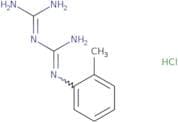
CAS 4751-99-9
:1-(diaminomethyliden)-2-(2-methylphenyl)guanidinhydrochlorid
Beschreibung:
1-(diaminomethyliden)-2-(2-methylphenyl)guanidinhydrochlorid, mit der CAS-Nummer 4751-99-9, ist eine chemische Verbindung, die zur Klasse der Guanidinderivate gehört. Sie ist gekennzeichnet durch das Vorhandensein einer Guanidin-Funktionalgruppe, die für ihre Basizität und Fähigkeit, Wasserstoffbrücken zu bilden, bekannt ist. Diese Verbindung erscheint typischerweise als weißer bis off-white kristalliner Feststoff und ist in Wasser löslich, was ein häufiges Merkmal vieler Guanidinderivate ist. Ihre Struktur umfasst zwei Aminogruppen und einen phenylischen Ring, der mit einer Methylgruppe substituiert ist, was zu ihren einzigartigen chemischen Eigenschaften beiträgt. Die Hydrochloridform zeigt an, dass es sich um ein Salz handelt, was seine Stabilität und Löslichkeit in wässrigen Lösungen verbessern kann. Diese Verbindung kann biologische Aktivität zeigen, was sie in der pharmazeutischen Forschung von Interesse macht, insbesondere bei der Entwicklung therapeutischer Mittel. Spezifische Anwendungen und Sicherheitsprofile erfordern jedoch weitere Untersuchungen und sollten mit Vorsicht in Laborumgebungen angegangen werden.
Formel:C9H14ClN5
InChl:InChI=1/C9H13N5.ClH/c1-6-4-2-3-5-7(6)13-9(12)14-8(10)11;/h2-5H,1H3,(H6,10,11,12,13,14);1H
SMILES:Cc1ccccc1NC(=N)NC(=N)N.Cl
Synonyme:- 1-{[{[Amino(Imino)Methyl]Amino}(Imino)Methyl]Amino}-2-Methylbenzene Hydrochloride
- imidodicarbonimidic diamide, N-(2-methylphenyl)-, hydrochloride (1:1)
- N-(2-methylphenyl)imidodicarbonimidic diamide hydrochloride
- N-(2-Methylphenyl)imidodicarbonimidic diamide hydrochloride (1:1)
Sortieren nach
Reinheit (%)
0
100
|
0
|
50
|
90
|
95
|
100
2 Produkte.
o-Tolylbiguanide hydrochloride
CAS:<p>o-Tolylbiguanide hydrochloride is a copper-containing antimicrobial agent that has been synthesised and used to treat Gram-negative bacteria. It is an anion, which means it can be reduced by agents such as formaldehyde and chloride. o-Tolylbiguanide hydrochloride binds to the anionic groups of the bacterial cell wall, which are found in proteins and lipids. This binding prevents the formation of a covalent bond between the copper ion and the bacterial cell wall, preventing further growth. The elimination of this compound in vivo is thought to be due to its organic ligands.</p>Formel:C9H14ClN5Reinheit:Min. 95%Molekulargewicht:227.69 g/mol