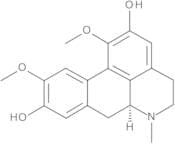
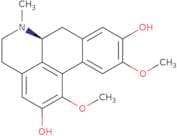
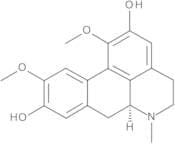
CAS 476-70-0
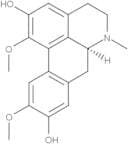
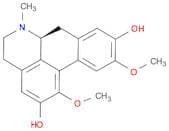
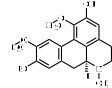
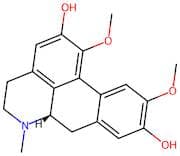
:(+)-Boldin
Beschreibung:
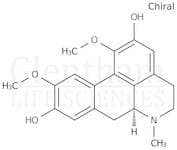
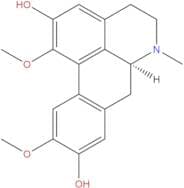
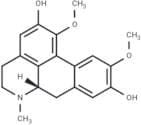
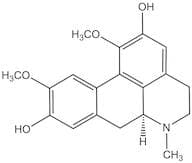
(+)-Boldin ist ein Alkaloid, das aus der Rinde des Boldo-Baums (Peumus boldus) gewonnen wird und für seine verschiedenen biologischen Aktivitäten bekannt ist. Es ist durch seine chemische Formel gekennzeichnet, die typischerweise Kohlenstoff-, Wasserstoff-, Stickstoff- und Sauerstoffatome umfasst und seine komplexe Struktur widerspiegelt. Diese Verbindung weist eine chirale Natur auf, wobei die (+)-Bezeichnung auf ihre spezifische optische Aktivität hinweist. (+)-Boldin ist bekannt für seine antioxidativen, entzündungshemmenden und leberschützenden Eigenschaften, was es für die pharmakologische Forschung von Interesse macht. Es wurde auf potenzielle therapeutische Anwendungen untersucht, insbesondere in Bezug auf die Lebergesundheit und Verdauungsstörungen. Darüber hinaus kann (+)-Boldin mit verschiedenen biologischen Wegen interagieren und die Enzymaktivität sowie zelluläre Prozesse beeinflussen. Seine Löslichkeitseigenschaften können variieren und sind oft in organischen Lösungsmitteln besser löslich als in Wasser, was ein häufiges Merkmal vieler Alkaloide ist. Insgesamt stellt (+)-Boldin eine bedeutende Verbindung in der Naturstoffchemie dar, mit laufenden Forschungen, die ihr volles Potenzial und ihre Wirkmechanismen in biologischen Systemen untersuchen.
Formel:C19H21NO4
InChl:InChI=1S/C19H21NO4/c1-20-5-4-10-7-15(22)19(24-3)18-12-9-16(23-2)14(21)8-11(12)6-13(20)17(10)18/h7-9,13,21-22H,4-6H2,1-3H3/t13-/m0/s1
InChI Key:InChIKey=LZJRNLRASBVRRX-ZDUSSCGKSA-N
SMILES:O(C)C1=C2C=3[C@](CC=4C2=CC(OC)=C(O)C4)(N(C)CCC3C=C1O)[H]
Synonyme:- (+)-(S)-Boldine
- (+)-2,9-Dihydroxy-1,10-dimethoxyaporphine
- (6aS)-1,10-dimethoxy-6-methyl-5,6,6a,7-tetrahydro-4H-dibenzo[de,g]quinoline-2,9-diol
- (6aS)-5,6,6a,7-Tetrahydro-1,10-dimethoxy-6-methyl-4H-dibenzo[de,g]quinoline-2,9-diol
- 1,10-Dimethoxy-6aα-aporphine-2,9-diol
- 1,10-dimethoxy-6-methyl-5,6,6a,7-tetrahydro-4H-dibenzo[de,g]quinoline-2,9-diol
- 4H-Dibenzo[de,g]quinoline-2,9-diol, 5,6,6a,7-tetrahydro-1,10-dimethoxy-6-methyl-, (6aS)-
- 4H-Dibenzo[de,g]quinoline-2,9-diol, 5,6,6a,7-tetrahydro-1,10-dimethoxy-6-methyl-, (S)-
- 6aα-Aporphine-2,9-diol, 1,10-dimethoxy-
- Boldin
- Boldina
- Boldine--Chloroform
- NSC 65689
- d-Boldine
- Weitere Synonyme anzeigen
Sortieren nach
Reinheit (%)
0
100
|
0
|
50
|
90
|
95
|
100
12 Produkte.
Boldine
CAS:Boldine analytical standard provided with chromatographic purity, to be used as reference material for qualitative determination.Formel:C19H21NO4Reinheit:(HPLC) ≥90%Farbe und Form:PowderMolekulargewicht:327.39BOLDINE CRS
CAS:BOLDINE CRSFormel:C19H21NO4Farbe und Form:Crystalline Powder. White. Powder.Molekulargewicht:327.3743Boldine
CAS:Boldine (1,10-Dimethoxy-2,9-dihydroxyaporphine) is a natual product .Boldine displays anti-cancer, cytoprotective , anti-oxidant and anti-inflammatoryFormel:C19H21NO4Reinheit:97.78% - 98%Farbe und Form:SolidMolekulargewicht:327.37Boldine
CAS:Natural alkaloidFormel:C19H21NO4Reinheit:≥ 95.0 % (HPLC)Farbe und Form:PowderMolekulargewicht:327.38Boldine
CAS:Kontrolliertes ProduktApplications Boldine has a high reactivity towards free radicals. A metabolite from the interaction of boldline with free radicals also exhibits antioxidant activity.
References Speisky, H., et. al.: Biochem. Pharmacol., 41, 1575 (1991)Formel:C19H21NO4Farbe und Form:NeatMolekulargewicht:327.37Boldine
CAS:Boldine is a natural compound that is an alkaloid derived from the Chinese herb 药材. It has been shown to have antioxidant properties and can inhibit lipid peroxidation in vitro. Boldine also has genotoxic activity, which means it can damage DNA. Boldine was found to be protective against neuronal death in an experimental model of Parkinson's disease and may act as a neuroprotective agent by enhancing the activities of enzymes such as polymerase chain reaction, DNA ligase, and RNA polymerase II. Boldine has been shown to inhibit receptor activity for both genistein and daidzein, which are phytoestrogens found in soy products.Formel:C19H21NO4Reinheit:Min. 95%Farbe und Form:PowderMolekulargewicht:327.37 g/mol