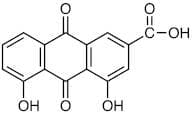
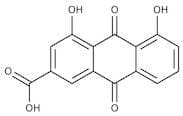
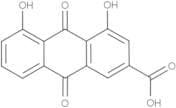
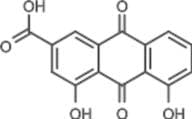
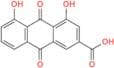
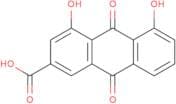
CAS 478-43-3
:Rhein
Beschreibung:
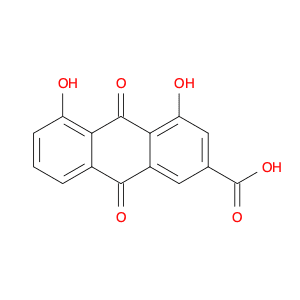
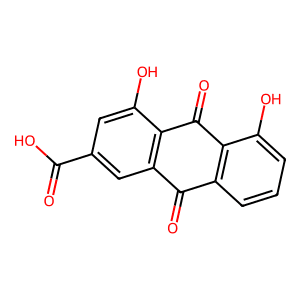
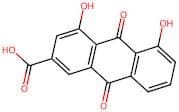
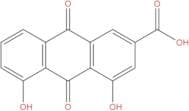
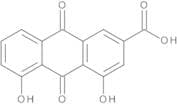
Rhein, mit der CAS-Nummer 478-43-3, ist eine natürlich vorkommende Anthrachinonverbindung, die hauptsächlich in verschiedenen Pflanzen, insbesondere in Rhabarberarten, vorkommt. Sie zeichnet sich durch ihr gelbes kristallines Aussehen aus und ist bekannt für ihre potenziellen medizinischen Eigenschaften, einschließlich entzündungshemmender, antioxidativer und abführender Wirkungen. Rhein zeigt Löslichkeit in organischen Lösungsmitteln wie Ethanol und Dimethylsulfoxid, ist jedoch weniger löslich in Wasser. Die Verbindung hat in der pharmakologischen Forschung Interesse geweckt, da sie in der Lage ist, verschiedene biologische Wege zu modulieren, einschließlich derjenigen, die an der Zellsignalisierung und Apoptose beteiligt sind. Darüber hinaus wurde Rhein auf seine potenziellen Anwendungen bei der Behandlung von Erkrankungen wie Diabetes und bestimmten Krebsarten untersucht. Seine chemische Struktur weist mehrere Hydroxylgruppen auf, die zu seiner Reaktivität und biologischen Aktivität beitragen. Wie bei vielen natürlichen Verbindungen erfordern die Sicherheit und Wirksamkeit von Rhein in therapeutischen Kontexten weitere Untersuchungen durch klinische Studien.
Formel:C15H8O6
InChl:InChI=1S/C15H8O6/c16-9-3-1-2-7-11(9)14(19)12-8(13(7)18)4-6(15(20)21)5-10(12)17/h1-5,16-17H,(H,20,21)
InChI Key:InChIKey=FCDLCPWAQCPTKC-UHFFFAOYSA-N
SMILES:O=C1C=2C(C(=O)C=3C1=C(O)C=CC3)=CC(C(O)=O)=CC2O
Synonyme:- 1,8-Dihydroxy-3-Carboxy anthraquinone
- 1,8-Dihydroxy-3-carboxyanthraquinone
- 1,8-Dihydroxyanthraquinone-3-carboxylic acid
- 2-Anthracenecarboxylic acid, 9,10-dihydro-4,5-dihydroxy-9,10-dioxo-
- 2-Anthraquinonecarboxylic acid, 4,5-dihydroxy-
- 2-Anthroic acid, 9,10-dihydro-4,5-dihydroxy-9,10-dioxo-
- 4,5-Dihydroxy-2-anthraquinonecarboxylic acid
- 4,5-Dihydroxy-9,10-Dioxo-9,10-Dihydroanthracene-2-Carboxylate
- 4,5-Dihydroxy-9,10-Dioxo-9,10-Dihydroanthracene-2-Carboxylic Acid
- 9,10-Dihydro-4,5-dihydroxy-9,10-dioxo-2-anthracenecarboxylic acid
- Cassic acid
- Chrysazin-3-carboxylic acid
- Monorhein
- NSC 38629
- Rheic acid
- Rheinic acid
- Weitere Synonyme anzeigen
Sortieren nach
Reinheit (%)
0
100
|
0
|
50
|
90
|
95
|
100
19 Produkte.
4,5-Dihydroxyanthraquinone-2-carboxylic Acid
CAS:Formel:C15H8O6Reinheit:>95.0%(T)(HPLC)Farbe und Form:Light yellow to Brown powder to crystalMolekulargewicht:284.22Rhein, 97%
CAS:Rhein is used to inhibit growth factor beta-1 induced plasminogen activator inhibitor-1 in endothelial cells. It acts as an antibacterial agent against Staphylococcus aureus. It is also used as a laxative. Further, it is employed as a pharmaceutical intermediate. This Thermo Scientific Chemicals braFormel:C15H8O6Reinheit:97%Molekulargewicht:284.22Rhein
CAS:Rhein analytical standard provided with w/w absolute assay, to be used for quantitative titration.Formel:C15H8O6Reinheit:(HPLC) ≥99%Farbe und Form:PowderMolekulargewicht:284.23DIACEREIN IMPURITY MIXTURE CRS
CAS:DIACEREIN IMPURITY MIXTURE CRSFormel:C19H12O8Molekulargewicht:368.2938Rhein
CAS:Rhein (NSC 38629) is an anthraquinone compound extracted from Polygonaceae Rheum Officinale with anti-inflammation and antitumor activities.Formel:C15H8O6Reinheit:99.04% - 99.72%Farbe und Form:Physical Description Yellow Needles (From Methanol) Or Yellow-Brown Powder (Ntp 1992)Molekulargewicht:284.221,8-DIHYDROXY-3-CARBOXYANTHRAQUINONE
CAS:Formel:C15H8O6Reinheit:98%Farbe und Form:SolidMolekulargewicht:284.2204Rhein
CAS:Formel:C15H8O6Reinheit:≥ 98.0%Farbe und Form:Yellow to orange powderMolekulargewicht:284.22Rhein
CAS:Rhein, an anthraquinone compound isolated from rhubarb, has been proved effective in treatment of experimental diabetic nephropathy (DN), one of the mechanism is the Inhibition of the hexosamine pathway.Formel:C15H8O6Reinheit:95%~99%Farbe und Form:PowderMolekulargewicht:284.223Rhein
CAS:Impurity Diacerein Impurity C
Stability Hygroscopic
Applications Found in the free state and as glucoside in Rheum spp, Polygonaceae (rhubarb) and in Senna leaves.A potential antioxidant resource: endophytic fungi from medicinal plants . Diacerein Impurity C
References Wanitschke, Pharmacology, 20, Suppl. 1, 21 (1980), Raimondi, L., et al.: Pharmacol. Res. Commun., 14, 103 (1982), Franchi-Micheli, S., et al.: J. Pharm. Pharmacol., 35, 262 (1983),Formel:C15H8O6Farbe und Form:NeatMolekulargewicht:284.22Rhein
CAS:Rhein is an anthraquinone compound, which is derived from the plant rhubarb (Rheum species) with a range of unique biological activities. It functions primarily by inhibiting the activity of various enzymes and pathways involved in inflammation, oxidative stress, and cellular proliferation. Rhein is known for its ability to modulate the production of cytokines and other inflammatory mediators, offering potential therapeutic benefits in the treatment of inflammatory diseases.Formel:C15H8O6Reinheit:Min. 98.0 Area-%Farbe und Form:PowderMolekulargewicht:284.22 g/mol1,8-Dihydroxy-3-carboxyanthraquinone
CAS:Formel:C15H8O6Reinheit:98%Farbe und Form:SolidMolekulargewicht:284.223