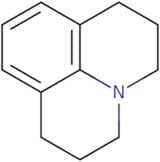
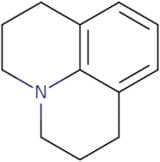
![2,3,6,7-Tetrahydro-1H,5H-benzo[ij]quinolizine](/_next/image/?url=https%3A%2Fstatic.cymitquimica.com%2Fcas-image%2Fthumb-webp%2F46682-2367-tetrahydro-1h-5h-benzo-ij-quinolizine.webp&w=3840&q=75)
CAS 479-59-4
:2,3,6,7-Tetrahydro-1H,5H-benzo[ij]chinolizin
Beschreibung:
2,3,6,7-Tetrahydro-1H,5H-benzo[ij]chinolizin, mit der CAS-Nummer 479-59-4, ist eine bicyclische organische Verbindung, die durch ihre verschmolzene Ringstruktur gekennzeichnet ist, die ein Quinolizin-Gerüst umfasst. Diese Verbindung zeigt typischerweise ein blassgelbes bis bräunliches Aussehen und ist bekannt für ihre potenzielle biologische Aktivität, insbesondere in der medizinischen Chemie. Es handelt sich um einen stickstoffhaltigen Heterozyklus, der zu seiner Reaktivität und Interaktion mit biologischen Systemen beiträgt. Die Anwesenheit mehrerer Wasserstoffatome in seiner Struktur weist darauf hin, dass es sich um eine gesättigte Verbindung handelt, was seine Löslichkeit und Stabilität beeinflussen kann. 2,3,6,7-Tetrahydro-1H,5H-benzo[ij]chinolizin kann in verschiedenen Anwendungen eingesetzt werden, einschließlich Pharmazeutika und Agrochemikalien, aufgrund seiner Fähigkeit, mit biologischen Zielen zu interagieren. Seine Synthese umfasst oft mehrstufige organische Reaktionen, und es kann mit Techniken wie NMR und Massenspektrometrie analysiert werden, um seine Struktur und Reinheit zu bestätigen. Insgesamt stellt diese Verbindung ein erhebliches Interesse im Bereich der organischen und medizinischen Chemie dar.
Formel:C12H15N
InChl:InChI=1S/C12H15N/c1-4-10-6-2-8-13-9-3-7-11(5-1)12(10)13/h1,4-5H,2-3,6-9H2
InChI Key:InChIKey=DZFWNZJKBJOGFQ-UHFFFAOYSA-N
SMILES:C1=2C=3CCCN1CCCC2C=CC3
Synonyme:- 1H,5H-Benzo[ij]quinolizine, 2,3,6,7-tetrahydro-
- 2,3,6,7-Tetrahydro-1H,5H-benzo(i,j)quinolizine
- 2,3,6,7-Tetrahydro-1H,5H-benzo[ij]quinolizine
- 2,3,6,7-tetrahydro-1H,5H-pyrido[3,2,1-ij]quinoline
- NSC 82354
- Julolidine
Sortieren nach
Reinheit (%)
0
100
|
0
|
50
|
90
|
95
|
100
7 Produkte.
Julolidine
CAS:Formel:C12H15NReinheit:>97.0%(GC)(T)Farbe und Form:White or colorless to Brown powder to lump to clear liquidMolekulargewicht:173.26Julolidine, 98%
CAS:Julolidine used as amine building block and in chemoluminescent dye. Also used in photoconductive materials, chemiluminescence substances, chromogenic substrates in analytical redox reactions, dye intermediates, potential antidepressants and tranquilizers, nonlinear optical materials, high sensitiviFormel:C12H15NReinheit:98%Farbe und Form:White/colorless to pink, yellow or cream, Crystalline or fused solid, lumps or powderMolekulargewicht:173.262,3,6,7-Tetrahydro-1H,5H-benzo[ij]quinolizine
CAS:Formel:C12H15NReinheit:97%Farbe und Form:SolidMolekulargewicht:173.25422,3,6,7-Tetrahydro-1H,5H-pyrido[3,2,1-ij]quinoline
CAS:2,3,6,7-Tetrahydro-1H,5H-pyrido[3,2,1-ij]quinolineReinheit:98%Molekulargewicht:173.26g/mol1,2,3,5,6,7-Hexahydropyrido[3,2,1-ij]quinoline
CAS:Reinheit:95.0%Farbe und Form:SolidMolekulargewicht:173.25900268554688Julolidine
CAS:Julolidine is a high quality, reagent, and useful intermediate. It is also a fine chemical that is used as a reaction component in the synthesis of speciality chemicals, research chemicals, and versatile building blocks. This compound has an CAS number of 479-59-4 and can be found on the Chemical Abstracts Service database. Julolidine is useful in the synthesis of complex compounds. It can be used as an effective building block for synthesizing other compounds with similar functional groups.Formel:C12H15NReinheit:Min. 95 Area-%Molekulargewicht:173.25 g/molJulolidine
CAS:Julolidine is a coumarin derivative with two hydroxyl groups. It has also been found to have a carbonyl group, which is the result of an intramolecular hydrogen bond between the oxygen atom and the carbon atom. The nitrogen atoms in julolidine are associated with signal detection. Julolidine has been shown to bind cations, including polymers, by forming hydrogen bonds. This chemical has low energy and can be detected using NMR spectroscopy at 5 ppm in deuterated chloroform at room temperature. This compound is an inhibitor of glutamate dehydrogenase and can function as a competitive inhibitor of this enzyme in vitro.Formel:C12H15NReinheit:Min. 95%Molekulargewicht:173.25 g/mol
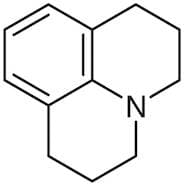

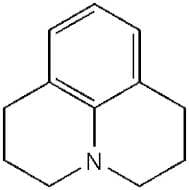

![2,3,6,7-Tetrahydro-1H,5H-benzo[ij]quinolizine](/_next/image/?url=https%3A%2Fstatic.cymitquimica.com%2Fproducts%2FIN%2Fthumb%2FDA00352J.jpg&w=3840&q=75)

![2,3,6,7-Tetrahydro-1H,5H-pyrido[3,2,1-ij]quinoline](/_next/image/?url=https%3A%2Fstatic.cymitquimica.com%2Fproducts%2F54%2Fthumb%2FOR73401.jpg&w=3840&q=75)

![1,2,3,5,6,7-Hexahydropyrido[3,2,1-ij]quinoline](/_next/image/?url=https%3A%2Fstatic.cymitquimica.com%2Fproducts%2F10%2Fthumb%2FF325062.jpg&w=3840&q=75)