CAS 47931-85-1
:Calcitonin (Lachs)
- Calcitonin (salmon I)
- Thyrocalcitonin Salmon
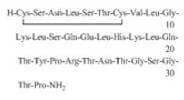
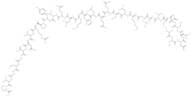
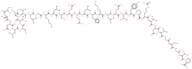
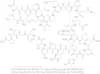
- H-Cys-Ser-Asn-Leu-Ser-Thr-Cys-Val-Leu-Gly-Lys-Leu-Ser-Gln-Glu-Leu-His-Lys-Leu-Gln-Thr-Tyr-Pro-Arg-Thr-Asn-Thr-Gly-Ser-Gly-Thr-Pro-NH2 (Disulfide bond)
- Thyrocalcitonin
- Salmon calcitonin
- Salcitonin
- Salmon Calcitonin acetate
- Salmon
- Calcitonin salmon Acetate
- Calciben
- Calcimar
- Calcitonin (Lachs)
- Calcitonin (salmon reduced) cyclic (1→7)-disulfide
- Calcitonina (Salmon)
- Calcitonine (Saumon)
- Calsyn
- Calsynar
- Catonin
- Karil
- L-Prolinamide, L-cysteinyl-L-seryl-L-asparaginyl-L-leucyl-L-seryl-L-threonyl-L-cysteinyl-L-valyl-L-leucylglycyl-L-lysyl-L-leucyl-L-seryl-L-glutaminyl-L-α-glutamyl-L-leucyl-L-histidyl-L-lysyl-L-leucyl-L-glutaminyl-L-threonyl-L-tyrosyl-L-prolyl-L-arginyl-L-threonyl-L-asparaginyl-L-threonylglycyl-L-serylglycyl-L-threonyl-, cyclic (1→7)-disulfide
- Miacalcic
- Miacalcin
- Miadenil
- Prontocalcin
- Rulicalcin
- Salcatonin
- Salmon calcitonin I
- Salmon calcitonin-(1-32)
- Salmon Thyrocalcitonin
- Salmotonin
- Stalcin
- Tonocalcin
- Calcitonin(Salmone) Acetate
- Weitere Synonyme anzeigen
Calcitonin Salmon
CAS:Polypeptide, protein and glycoprotein hormones, their derivatives and structural analogues, nesoiFormel:C145H240N44O48S2Farbe und Form:White Off-White PowderMolekulargewicht:3429.71331Calcitonin Acetate(Salmon)
CAS:Formel:C145H240N44O48S2Reinheit:95%~99%Farbe und Form:White to Off-white PowderMolekulargewicht:3431.85Calcitonin (salmon)
CAS:Calcitonin (salmon), a calcium regulating hormone, is used to treat osteoporosis in women who are at least 5 years past menopause.Formel:C145H240N44O48S2Reinheit:99.41% - 99.80%Farbe und Form:PowderMolekulargewicht:3431.85Calcitonin Salmon
CAS:Formel:C145H240N44O48S2Reinheit:>95.0%(HPLC)Farbe und Form:White to Almost white powder to crystalMolekulargewicht:3,431.90Calcitonin, Salmon
CAS:Applications Calcitonin, Salmon is a calcium regulating hormone which exhibits hypocalcaemic and hypophosphatemic properties.
Formel:C145H240N44O48S2Farbe und Form:NeatMolekulargewicht:3431.85Calcitonin (salmon) xAcetate
CAS:Kontrolliertes ProduktApplications Calcitonin (salmon), is a 32-amino acid linear polypeptide hormone that is produced in thyroid in humans. It acts to reduce blood calcium (Ca2+), opposing the effects of parathyroid hormone (PTH).
References Boron, WF. et al.: Med. Phys., A Cellular and Molecular Approach (2004); Andreotti, G. et al.: J. Bio. Chem., 281, 24193 (2006);Formel:C145H240N44O48S2·x(CH3CO2H)Farbe und Form:NeatMolekulargewicht:3431.856005N-Acetyl-cys(1)-calcitonin Salmon Trifluoroacetic Acid Salt
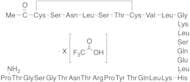
CAS:Kontrolliertes ProduktApplications N-Acetyl-cys(1)-calcitonin Salmon is a derivative of Calcitonin (salmon), is a 32-amino acid linear polypeptide hormone that is produced in thyroid in humans. It acts to reduce blood calcium (Ca2+), opposing the effects of parathyroid hormone (PTH).
References Boron, WF., et al.: Med. Physi., A Cellular and Molecular Approach (2004); Andreotti, G. et al.: J. Bio. Chem., 281, 24193 (2006);Formel:C147H243N44O49S2·x(C2HF3O2)Farbe und Form:NeatMolekulargewicht:3475.5911402Calcitonin
CAS:Calcitonin is a peptide hormone that inhibits the release of calcium from bone, and decreases the blood level of calcium. Calcitonin is not active in the absence of parathyroid hormone (PTH) or vitamin D. It has been shown to inhibit the development of experimental myocardial infarcts in rats by inhibiting the release of calcium from bone, and has also been shown to have a protective effect on brain function. The calcitonin receptor is activated by binding with calcitonin, which then activates adenylyl cyclase and increases intracellular cAMP levels. This leads to increased activity at ATP-sensitive potassium channels, which causes hyperpolarisation of neurons. Caudate putamen neurons are particularly sensitive to calcitonin activity because they are rich in voltage-gated K+ channels that are sensitive to ATP-sensitive potassium channel activation. Calcitonin also plays a role in regulating serum Ca2+ concentration by inhib
Formel:C145H240N44O48S2Reinheit:Min. 95%Molekulargewicht:3,431.86 g/molCalcitonin (salmon I)
CAS:Calcitonin inhibits osteoclast activity, lowers the blood calcium level, and positively influences bone mass density. Salmon calcitonin (sCT) is more potent than the human analog. sCT may act as an amylin agonist (Wielinga et al.). In animal studies, administration of sCT was shown to reduce food intake.Formel:C145H240N44O48S2Reinheit:99.3%Farbe und Form:White LyophilisateMolekulargewicht:3431.9