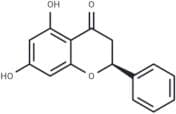
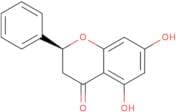
CAS 480-39-7
:(+)-Pinocembrin
Beschreibung:
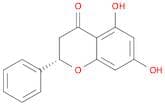
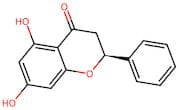
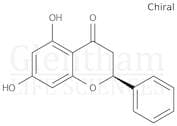
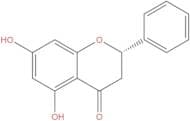
(+)-Pinocembrin, mit der CAS-Nummer 480-39-7, ist eine Flavonoidverbindung, die hauptsächlich in verschiedenen Pflanzen vorkommt, insbesondere im von Bienen produzierten Propolis. Sie zeichnet sich durch ihr gelblich-kristallines Aussehen aus und hat eine chemische Formel, die ihre komplexe Struktur widerspiegelt, die mehrere Hydroxylgruppen umfasst, die zu ihrer Löslichkeit in organischen Lösungsmitteln beitragen. Diese Verbindung zeigt eine Reihe biologischer Aktivitäten, einschließlich antioxidativer, entzündungshemmender und antimikrobieller Eigenschaften, was sie sowohl für pharmakologische als auch für ernährungswissenschaftliche Studien von Interesse macht. Es ist bekannt, dass (+)-Pinocembrin mit verschiedenen biologischen Wegen interagiert und potenziell schützende Effekte gegen oxidativen Stress und Entzündungen bietet. Ihre Stereochemie, die durch die (+)-Bezeichnung angezeigt wird, bezieht sich auf ihre spezifische räumliche Anordnung, die ihre biologische Aktivität und Interaktion mit anderen Molekülen beeinflussen kann. Darüber hinaus wird sie häufig auf ihre potenziellen therapeutischen Anwendungen untersucht, einschließlich neuroprotektiver Effekte und ihrer Rolle in der traditionellen Medizin. Insgesamt stellt (+)-Pinocembrin eine bedeutende Verbindung im Bereich der Naturstoffe und der medizinischen Chemie dar.
Formel:C15H12O4
InChl:InChI=1S/C15H12O4/c16-10-6-11(17)15-12(18)8-13(19-14(15)7-10)9-4-2-1-3-5-9/h1-7,13,16-17H,8H2/t13-/m0/s1
InChI Key:InChIKey=URFCJEUYXNAHFI-ZDUSSCGKSA-N
SMILES:O=C1C=2C(O[C@@H](C1)C3=CC=CC=C3)=CC(O)=CC2O
Synonyme:- (+)-Pinocoembrin
- (2S)-2,3-Dihydro-5,7-dihydroxy-2-phenyl-4H-1-benzopyran-4-one
- (2S)-5,7-Dihydroxy-2-phenyl-2,3-dihydrochromen-4-one
- (2S)-Pinocembrin
- 4H-1-Benzopyran-4-one, 2,3-dihydro-5,7-dihydroxy-2-phenyl-
- 4H-1-Benzopyran-4-one, 2,3-dihydro-5,7-dihydroxy-2-phenyl-, (2S)-
- 4H-1-Benzopyran-4-one, 2,3-dihydro-5,7-dihydroxy-2-phenyl-, (S)-
- 5,7-Dihydroxy-2-Phenyl-Chroman-3-One
- 5,7-Dihydroxy-2-phenyl-2,3-dihydro-4H-chromen-4-on
- 5,7-Dihydroxyflavanone
- Dihydrochrysin
- Galangin flavanone
- NSC 279005
- Pinocembrin
- Weitere Synonyme anzeigen
Sortieren nach
Reinheit (%)
0
100
|
0
|
50
|
90
|
95
|
100
6 Produkte.
Pinocembrin
CAS:Formel:C15H12O4Reinheit:≥ 98.0%Farbe und Form:White to pale-yellow or yellow crystalline powderMolekulargewicht:256.26Pinocembrin
CAS:Pinocembrin is a major flavonoid molecule incorporated as multifunctional in the pharmaceutical industry. Its vast range of pharmacological activities has been well researched including antimicrobial, neuroprotective, anti-inflammatory, antioxidant, and anticancer activities. Pinocembrin inhibited LPS-induced inflammatory mediators production by suppressing PI3K/Akt/NF-κB signaling pathway, it also inhibited TGF-β1-induced epithelial-mesenchymal transition (EMT) and metastasis of Y-79 cells by inactivating the αvβ3 integrin/FAK/p38α signaling pathway.Formel:C15H12O4Reinheit:95%~99%Molekulargewicht:256.257Pinocembrin
CAS:Pinocembrin (5,7-Dihydroxyflavanone) is a flavanone, a type of flavonoid. It is an antioxidant found in damiana, honey, fingerroot, and propolis.Formel:C15H12O4Reinheit:99.61% - >99.99%Farbe und Form:SolidMolekulargewicht:256.25(+)-Pinocembrin
CAS:(+)-Pinocembrin is a flavonoid compound, which is a naturally occurring phytochemical. It is predominantly sourced from propolis, a resinous substance produced by bees, and also found in various plants such as honey and ginger root. The mode of action of (+)-Pinocembrin involves its potent antioxidant and antimicrobial properties. It acts by scavenging free radicals, thereby protecting cells from oxidative stress, and it also interferes with microbial cell membranes, leading to antimicrobial effects.Formel:C15H12O4Reinheit:Min. 98 Area-%Farbe und Form:PowderMolekulargewicht:256.25 g/mol