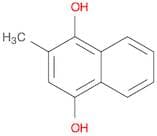
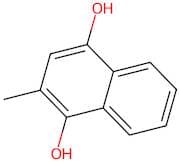
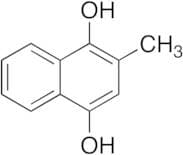
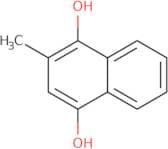
CAS 481-85-6
:2-Methyl-1,4-naphthalindiol
- 1,4-Dihydroxy-2-Methylnaphthalene
- 1,4-Naphthalenediol, 2-methyl-
- 2-Methyl-1,4-dihydroxynaphthalene
- 2-Methyl-1,4-naphthalenediol
- 2-Methyl-1,4-naphthohydroquinone
- 2-Methyl-1,4-naphthoquinol
- 2-Methylhydronaphthoquinone
- 4-Hydroxy-3-methyl-α-naphthol
- Dihydrovitamin K<sub>3</sub>
- Menadiol
- Menadiol Acetate
- Reduced menadione
- Reduced vitamin K<sub>3</sub>
- Vitamin K<sub>3</sub>H<sub>2</sub>
- Weitere Synonyme anzeigen
2-Methyl-1,4-naphthalenediol
CAS:Kontrolliertes ProduktApplications Vitamin K3 (V676130) derivative. Menaquinol analog. Induces mutations in Escherichia coli nitrate reductase A.
References Zhao, Z. et al., Biochem., 42, 14225 (2003); Zhao, Z. et al., Biochem., 42, 5403 (2003)Formel:C11H10O2Farbe und Form:NeatMolekulargewicht:174.22-Methyl-1,4-naphthohydroquinone
CAS:2-Methyl-1,4-naphthohydroquinone is an additive that is used in the production of dyes and other chemicals. It has been shown to be toxic to murine hepatoma cells at high concentrations. The redox potentials of 2-methyl-1,4-naphthohydroquinone are reported to be -0.22 V (vs Hg/HgO) and +0.27 V (vs Na/NaSO). 2-Methyl-1,4-naphthohydroquinone also possesses affinity for cytochrome P450 enzymes, which are involved in the metabolism of xenobiotics. 2-Methyl-1,4-naphthohydroquinone is an effective reducing agent that can reduce menadione and vitamin K3 to the corresponding quinones; it also catalyzes transfer reactions with diphosphate (-P(=O)(OH)) as a substrate
Formel:C11H10O2Reinheit:Min. 95 Area-%Farbe und Form:PowderMolekulargewicht:174.2 g/mol2-METHYL-1,4-NAPHTHOHYDROQUINONE
CAS:Formel:C11H10O2Reinheit:97%Farbe und Form:SolidMolekulargewicht:174.199