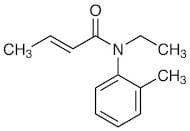
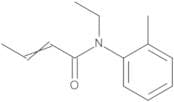
CAS 483-63-6
:Crotamiton
Beschreibung:
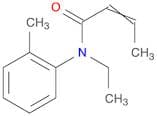
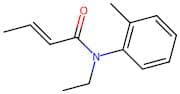
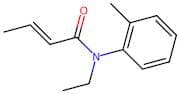
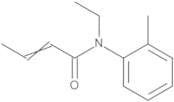
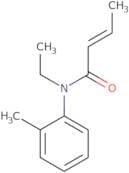
Crotamiton ist eine organische Verbindung, die hauptsächlich als topisches Medikament zur Behandlung von Krätze und anderen Hauterkrankungen verwendet wird. Es wird als Sulfonamid klassifiziert und hat sowohl antipruritische (juckreizlindernde) als auch scabizide Eigenschaften. Die chemische Struktur von Crotamiton umfasst eine 4-Ethyl-2-Methylphenol-Gruppe, die zu seinen pharmakologischen Effekten beiträgt. Es wird typischerweise als Creme oder Lotion zur direkten Anwendung auf die betroffenen Hautstellen formuliert. Crotamiton ist bekannt für seine relativ geringe Toxizität und wird im Allgemeinen gut vertragen, obwohl einige Personen Hautreizungen oder allergische Reaktionen erfahren können. Der Wirkmechanismus besteht darin, das Nervensystem der Krätzmilbe zu stören, was zu ihrer Eliminierung führt. Darüber hinaus wird Crotamiton häufig in Kombination mit anderen Behandlungen verwendet, um die Wirksamkeit zu erhöhen. Es ist wichtig, die medizinischen Anweisungen bei der Anwendung von Crotamiton zu befolgen, um eine ordnungsgemäße Anwendung sicherzustellen und potenzielle Nebenwirkungen zu minimieren. Wie bei jedem Medikament sollten auch die Kontraindikationen und Wechselwirkungen mit anderen Arzneimitteln berücksichtigt werden.
Formel:C13H17NO
InChl:InChI=1S/C13H17NO/c1-4-8-13(15)14(5-2)12-10-7-6-9-11(12)3/h4,6-10H,5H2,1-3H3
InChI Key:InChIKey=DNTGGZPQPQTDQF-UHFFFAOYSA-N
SMILES:N(C(C=CC)=O)(CC)C1=C(C)C=CC=C1
Synonyme:- (2E)-N-ethyl-N-(2-methylphenyl)but-2-enamide
- 2-(acetyloxy)-N,N,N-trimethylethanaminium chloride
- 2-Butenamide, N-ethyl-N-(2-methylphenyl)-
- Crotalgin
- Crotamitex
- Crotamitone
- Crotonyl N-ethyl-o-toluidine
- Eurax
- Euraxil
- N-Crotonyl-N-ethyl-o-toluidine
- N-Ethyl-N-(2-methylphenyl)-2-butenamide
- N-Ethyl-O-Crotonotoluidine
- N-Ethyl-o-crotonotoluidide
- N-Ethyl-o-crotonotoluidide,predominantly trans
- N-ethyl-N-(2-methylphenyl)but-2-enamide
- N-ethyl-N-crotonoyl-2-toluidine
- N-ethylcroton-o-toluidide
- Veteusan
- o-Crotonotoluidide, N-ethyl-
- Weitere Synonyme anzeigen
Sortieren nach
Reinheit (%)
0
100
|
0
|
50
|
90
|
95
|
100
17 Produkte.
Crotamiton
CAS:CrotamitonFormel:C13H17NOReinheit:99.0%Farbe und Form:Yellow OilyMolekulargewicht:203.13101Crotamiton
CAS:Aromatic cyclic amides (including cyclic carbamates) and their derivatives; salts thereofFormel:C13H17NOFarbe und Form:Pale Yellow LiquidMolekulargewicht:203.131012-Butenamide, N-ethyl-N-(2-methylphenyl)-
CAS:Formel:C13H17NOReinheit:%Farbe und Form:LiquidMolekulargewicht:203.2802Crotamiton
CAS:Crotamiton (Eurax) is an antipruritic and a scabicidal agent available as a lotion or cream for topical use only.Formel:C13H17NOReinheit:99.38%Farbe und Form:LiquidMolekulargewicht:203.28N-Ethyl-o-Crotonotoluidine (Crotamiton)
CAS:N-Ethyl-o-Crotonotoluidine (Crotamiton)Reinheit:95%Molekulargewicht:203.28g/molCrotamiton
CAS:Formel:C13H17NOReinheit:≥ 97.0%Farbe und Form:Clear, colourless to pale yellow liquidMolekulargewicht:203.28Crotamiton
CAS:N-Ethyl-o-crotonotoluidide is a new drug for the treatment of infectious diseases. It inhibits cox-2 and has been shown to be effective in the treatment of chronic skin infections, such as erythrasma and intertrigo. N-Ethyl-o-crotonotoluidide is also effective against other types of bacteria, including methicillin resistant Staphylococcus aureus (MRSA) and Pseudomonas aeruginosa. The long term efficacy of N-Ethyl-o-crotonotoluidide in patients with chronic skin infections has not yet been established.Formel:C13H17NOReinheit:Min. 95%Farbe und Form:Clear LiquidMolekulargewicht:203.28 g/molN-Ethyl-o-crotonotoluidide
CAS:Formel:C13H17NOReinheit:>95.0%(GC)Farbe und Form:Colorless to Light yellow to Light orange clear liquidMolekulargewicht:203.29N-Ethyl-N-(o-tolyl)but-2-enamide
CAS:Formel:C13H17NOReinheit:95.0%Farbe und Form:SolidMolekulargewicht:203.285Crotamiton (Cis/Trans Mixture)
CAS:Kontrolliertes ProduktStability Light Sensitive
Applications Crotamiton is an anti-parasitic agent. Crotamiton is used both as a scabicidal (for treating scabies) and as a general antipruritic.
References Buffet, M. et al.: Fund. Clin. Pharmacol., 17, 217 (2003); Lemke, T.L.: Foye’s Prin. Med. Chem., 6, 1084 (2008); Dika, E. et al.: Cutan. Ocular Toxicol., 25, 211 (2006);Formel:C13H17NOFarbe und Form:NeatMolekulargewicht:203.28