CAS 484-78-6
:3-Hydroxykynurenin
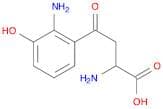
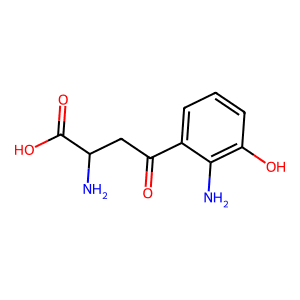
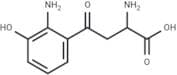
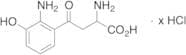
- 2-Amino-4-(2-amino-3-hydroxyphenyl)-4-oxobutanoicacid
- 3-Hydroxy-<span class="text-smallcaps">DL</span>-kynurenine
- 3-Hydroxykynurenine
- 484-78-6
- <span class="text-smallcaps">DL</span>-3-Hydroxykynurenine
- Alanine, 3-(3-hydroxyanthraniloyl)-
- Benzenebutanoic acid, α,2-diamino-3-hydroxy-γ-oxo-
- Hydroxykynurenine
- α,2-Diamino-3-hydroxy-γ-oxobenzenebutanoic acid
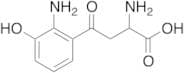
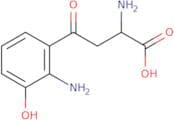
2-Amino-4-(2-amino-3-hydroxyphenyl)-4-oxobutanoic acid
CAS:Formel:C10H12N2O4Reinheit:97%Farbe und Form:SolidMolekulargewicht:224.21333-Hydroxykynurenine
CAS:3-Hydroxykynurenine (3-hydroxy-DL-Kynurenine) is an active metabolite of tryptophan and inhibits yeast and rat liver aldehyde dehydrogenase by 97 and 69%.
Formel:C10H12N2O4Reinheit:98.83% - 99.69%Farbe und Form:SolidMolekulargewicht:224.21rac 3-Hydroxy Kynurenine Hydrochloride Salt
CAS:Kontrolliertes ProduktApplications 3-Hydroxykynurenine is a metabolite of tryptophan. 3-Hydroxykynurenine filters UV light in the human lens. Studies suggest that Hydroxykynurenine is an endogenous oxidative stress generator and a potential endogenous neurotoxin.
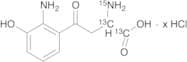
References Malina, H.Z. et al.: Graefes. Arch. Clin. Exp. Ophthalmol., 233, 38 (1995); Okuda, S. et al.: J. Neurochem., 70, 299 (1998);Formel:C10H12N2O4·xHClFarbe und Form:NeatMolekulargewicht:224.213646rac 3-Hydroxy Kynurenine-13C2,15N Hydrochloride Salt
CAS:Kontrolliertes ProduktStability Hygroscopic
Applications Labelled analogue of 3-Hydroxykynurenine is a metabolite of tryptophan. 3-Hydroxykynurenine filters UV light in the human lens. Studies suggest that Hydroxykynurenine is an endogenous oxidative stress generator and a potential endogenous neurotoxin.
References Malina, H.Z. et al.: Graefes. Arch. Clin. Exp. Ophthalmol., 233, 38 (1995); Okuda, S. et al.: J. Neurochem., 70, 299 (1998);Formel:C813C2H12N15NO4·xHClFarbe und Form:Dark Green To Dark YellowMolekulargewicht:227.1936463-Hydroxy-DL-kynurenine
CAS:Stability Hygroscopic
Applications 3-Hydroxy-DL-kynurenine is a tryptophan metabolite. Could be associated with symptoms in Parkinson's disease.
References Heilman, P. L., et al.: Movement Disorders, 35, 2028 (2020)Formel:C10H12N2O4Farbe und Form:NeatMolekulargewicht:224.213-Hydroxy-DL-kynurenine
CAS:3-Hydroxy-DL-kynurenine is a biochemical compound, which is an intermediate in the kynurenine pathway. This pathway is a major route of tryptophan degradation in the body, highlighting its role in various physiological processes. 3-Hydroxy-DL-kynurenine exerts its effects by participating in redox reactions and influencing cellular oxidative stress. It serves both antioxidant and prooxidant functions, depending on its concentration and specific biological context.
Formel:C10H12N2O4Reinheit:Min. 98 Area-%Farbe und Form:Brown Yellow PowderMolekulargewicht:224.21 g/mol