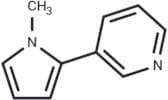
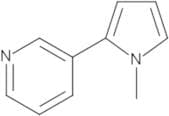
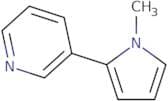
CAS 487-19-4
:Nicotyrin
Beschreibung:
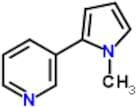
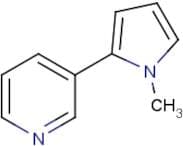
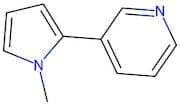
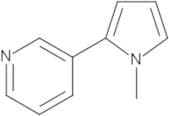
Nicotyrin, mit der CAS-Nummer 487-19-4, ist ein aus Tabakpflanzen abgeleiteter Alkaloid, der speziell mit Nikotin verwandt ist. Er zeichnet sich durch seine strukturelle Ähnlichkeit mit Nikotin aus und weist einen Pyridinring und eine Pyrrolidin-Gruppe auf. Nicotyrin ist bekannt für seine potenziellen pharmakologischen Eigenschaften, obwohl er im Vergleich zu Nikotin weniger untersucht wurde. Er zeigt milde stimulierende Effekte und kann die Neurotransmittersysteme beeinflussen, aber seine genaue biologische Aktivität und Mechanismen sind nicht vollständig verstanden. Die Verbindung kommt typischerweise in Spuren im Tabak und in Tabakprodukten vor. In Bezug auf die physikalischen Eigenschaften ist Nicotyrin eine farblose bis blassgelbe Flüssigkeit mit einem charakteristischen Geruch. Er ist in organischen Lösungsmitteln löslich, hat jedoch eine begrenzte Löslichkeit in Wasser. Wie viele Alkaloide kann Nicotyrin Gesundheitsrisiken darstellen, und seine Auswirkungen auf die menschliche Gesundheit sind ein Bereich laufender Forschung. Insgesamt, obwohl Nicotyrin einige Eigenschaften mit Nikotin teilt, bleiben seine spezifischen Effekte und Anwendungen in der wissenschaftlichen Literatur weniger definiert.
Formel:C10H10N2
InChl:InChI=1S/C10H10N2/c1-12-7-3-5-10(12)9-4-2-6-11-8-9/h2-8H,1H3
InChI Key:InChIKey=RYFOJXFXERAMLS-UHFFFAOYSA-N
SMILES:CN1C(=CC=C1)C=2C=CC=NC2
Synonyme:- 1-Methyl-2-(3-pyridyl)pyrrole
- 3,2′-Nicotyrine
- 3-(1-Methyl-2-pyrrolyl)pyridine
- 3-(1-methyl-1H-pyrrol-2-yl)pyridine
- NSC 127943
- NSC 407276
- Nicotyrine
- Pyridine, 3-(1-methyl-1H-pyrrol-2-yl)-
- Pyridine, 3-(1-methylpyrrol-2-yl)-
- beta-Nicotyrine = 3-(1-Methylpyrrol-2-yl)pyridine
- β-Nicotyrine
Sortieren nach
Reinheit (%)
0
100
|
0
|
50
|
90
|
95
|
100
12 Produkte.
Nicotine Related Compound B (3-(1-methyl-1H-pyrrol-2-yl)pyridine)
CAS:Other alkaloids,natural or reproduced by synthesis, and their salts, ethers,esters&other derivatives, nesoiFormel:C10H10N2Farbe und Form:Colorless Light Yellow Oily LiquidMolekulargewicht:158.0844(3-(1-Methyl-1H-pyrrol-2-yl)pyridine
CAS:(3-(1-Methyl-1H-pyrrol-2-yl)pyridineFormel:C10H10N2Reinheit:92%Farbe und Form: brown liquidMolekulargewicht:158.20g/molNicotine EP Impurity B (β-Nicotyrine)
CAS:Formel:C10H10N2Farbe und Form:Pale Yellow LiquidMolekulargewicht:158.203-(1-Methyl-1H-pyrrol-2-yl)pyridine (β-Nicotyrine)
CAS:Kontrolliertes ProduktFormel:C10H10N2Farbe und Form:NeatMolekulargewicht:158.20β-Nicotyrine
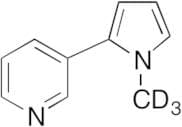
CAS:beta-Nicotyrine is a tobacco alkaloids Metabolite in the liver.Formel:C10H10N2Reinheit:97.79%Farbe und Form:SolidMolekulargewicht:158.2Beta-Nicotyrine-d3
CAS:Kontrolliertes ProduktStability Hygroscopic
Applications β-Nicotyrine-d3, is the labeled analogue of β-Nicotyrine (N445002), which is an alkaloid derived from the dehydrogenation of nicotine and its analog, nornicotine. An alkaloid occurring in cigaret smoke.
References Swain, M.L., et al.: J. Am. Chem. Soc., 71, 1341 (1949);Formel:C10H7D3N2Farbe und Form:Dark OrangeMolekulargewicht:161.22beta-Nicotyrine
CAS:Beta-Nicotyrine is a pyridine alkaloid, which is a naturally occurring compound found in certain species of Nicotiana, primarily derived from tobacco plants. This compound is known for its intriguing mode of action that involves influencing nicotinic acetylcholine receptors, although its precise biological interactions continue to be studied for more detailed elucidation.
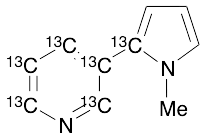
Formel:C10H10N2Farbe und Form:Clear LiquidMolekulargewicht:158.2 g/molβ-Nicotyrine-13C6
CAS:Kontrolliertes ProduktFormel:C6C4H6N2Farbe und Form:NeatMolekulargewicht:160.1243-(1-Methylpyrrol-2-yl)pyridine
CAS:3-(1-Methylpyrrol-2-yl)pyridine is a heterocyclic compound, which is a synthetic chemical structure notable for its potential applications in pharmaceutical research and development. This compound is derived from the combination of pyridine and pyrrole rings, with a methyl group attached to the pyrrole nitrogen, creating a unique structural framework that provides diverse chemical functionalities.Formel:C10H10N2Molekulargewicht:158.2 g/mol