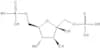
CAS 488-69-7
:Fructose-1,6-bisphosphat
Beschreibung:
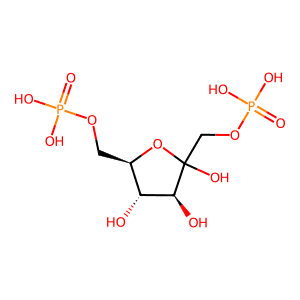
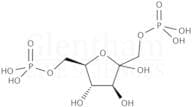
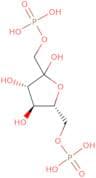
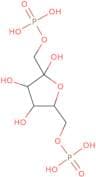
Fructose-1,6-bisphosphat (FBP) ist ein entscheidendes Zwischenprodukt im glykolytischen Weg und spielt eine bedeutende Rolle im Zellstoffwechsel. Es ist ein phosphoryliertes Zucker, spezifisch ein Hexose, abgeleitet von Fructose. Die Verbindung weist zwei Phosphatgruppen auf, die an den ersten und sechsten Kohlenstoffatomen angebracht sind, die für ihre Funktion in der Energieproduktion unerlässlich sind. FBP ist eine farblose, wasserlösliche Verbindung, und seine Struktur ermöglicht es ihm, an verschiedenen enzymatischen Reaktionen teilzunehmen, insbesondere an denen, die von Aldolase und Fructose-1,6-bisphosphatase katalysiert werden. Es wirkt als allosterischer Regulator, der die Aktivität wichtiger Enzyme in Stoffwechselwegen beeinflusst und somit eine Rolle bei der Regulation der Gluconeogenese und Glykolyse spielt. Die Anwesenheit der Phosphatgruppen trägt zu seinen energiegeladenen Eigenschaften bei, was es zu einem wichtigen Molekül in den Energieübertragungsprozessen innerhalb der Zellen macht. Darüber hinaus ist FBP an der Regulierung des metabolischen Flusses beteiligt und spielt eine Schlüsselrolle im Gleichgewicht zwischen Energieproduktion und -verbrauch in lebenden Organismen.
Formel:C6H14O12P2
InChl:InChI=1S/C6H14O12P2/c7-3(1-17-19(11,12)13)5(9)6(10)4(8)2-18-20(14,15)16/h3,5-7,9-10H,1-2H2,(H2,11,12,13)(H2,14,15,16)/t3-,5-,6-/m1/s1
InChI Key:InChIKey=XPYBSIWDXQFNMH-UYFOZJQFSA-N
SMILES:[C@H]([C@@H](C(COP(=O)(O)O)=O)O)([C@@H](COP(=O)(O)O)O)O
Synonyme:- 1,6-Bis(dihydrogenophosphate) de D-fructose
- 1,6-bis(dihidrogenofosfato) de D-fructosa
- 1,6-di-O-phosphono-D-fructofuranose
- 1,6-di-O-phosphono-D-fructose
- 1,6-di-O-phosphono-beta-D-fructofuranose
- 1,6-di-O-phosphonohex-2-ulofuranose
- 2,5-anhydro-1,6-di-O-phosphono-D-glucitol
- <span class="text-smallcaps">D</span>-Fructose 1,6-biphosphate
- <span class="text-smallcaps">D</span>-Fructose 1,6-bisphosphate
- <span class="text-smallcaps">D</span>-Fructose 1,6-diphosphate
- <span class="text-smallcaps">D</span>-Fructose, 1,6-bis(dihydrogen phosphate)
- D-Fructose 1,6-biphosphate
- D-Fructose 2,6-Diphosphate Di-Sodium Salt
- D-Fructose-1,6-bis(dihydrogenphosphat)
- D-fructose 1,6-bis(dihydrogen phosphate)
- D-fructose 1,6-bisphosphate
- Diphosphofructose
- Esafosfan
- Esafosfina
- F1,6diP
- FDP
- Fosfructose
- Fructose 1,6-bis(dihydrogen phosphate)
- Fructose 1,6-diphosphate
- Fructose Diphosphate
- Fructose, 1,6-bis(dihydrogen phosphate), <span class="text-smallcaps">D</span>-
- Fructose, 1,6-bis(dihydrogen phosphate), D-
- Fructose-1,6-Bisphosphate
- Harden-Young ester
- beta-D-fructofuranose-1,6-diphosphate
- Weitere Synonyme anzeigen
Sortieren nach
Reinheit (%)
0
100
|
0
|
50
|
90
|
95
|
100
10 Produkte.
{[(3S,4S,5R)-2,3,4-trihydroxy-5-[(phosphonooxy)methyl]oxolan-2-yl]methoxy}phosphonic acid
CAS:Formel:C6H14O12P2Reinheit:98.0%Farbe und Form:SolidMolekulargewicht:340.1157D-Fructose-1,6-diphosphate
CAS:D-Fructose-1,6-diphosphateFormel:C6H14O12P2Reinheit:95%Farbe und Form: cream solidMolekulargewicht:340.12g/molFosfructose
CAS:D-fructose-1,6-diphosphate (D-fructose-1,6-diphosphate), also known as Fosfructose, is a cytoprotective natural sugar phosphate.Formel:C6H14O12P2Reinheit:99.84%Farbe und Form:SolidMolekulargewicht:340.12D-Fructose-13C6 1,6-Bisphosphate Sodium Salt Hydrate
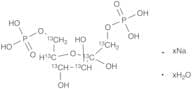
CAS:Kontrolliertes ProduktApplications Isotope labelled Fructose1,6-bisphosphate is an intermediate that lies within the glycolysis metabolic pathway and is also an allosteric activator of pyruvate kinase.
References Hinder, L.M., et al.: J. Endocriol., 216, 1 (2013); Takubo, K., et al.: Cell. Stem. Cell., 12, 49 (2013); Kalam, Y., et al.: Clin. Toxciol., 50, 546 (2012);Formel:C6H14O12P2•xH2O•xNaFarbe und Form:NeatMolekulargewicht:346.06D-Fructose-1,6-diphosphate
CAS:D-Fructose-1,6-diphosphate is a chemical that is found in the cytosol of cells. It is an intermediate in the metabolism of fructose and also has an important role in the synthesis of fatty acids and phospholipids. D-Fructose-1,6-diphosphate is an effective inhibitor of sodium succinate dehydrogenase, which converts succinate to fumarate. D-Fructose-1,6-diphosphate has a neutral pH profile and is not affected by changes in pH levels. The optimum pH for this compound is between 6.5 and 7.5. D-Fructose-1,6-diphosphate binds to proteins with unsaturated alkyl chains such as creatine kinase and glutamate dehydrogenase. It has been shown to have hemolytic effects on erythrocytes (red blood cells) at high concentrations, which may be due to its ability to bindFormel:C6H14O12P2Reinheit:(¹H-Nmr) Min. 95 Area-%Farbe und Form:White PowderMolekulargewicht:340.12 g/molD-FRUCTOFURANOSE 1,6-BISPHOSPHATE
CAS:Formel:C6H14O12P2Reinheit:≥98.0%Farbe und Form:Liquid, No data available.Molekulargewicht:339.996D-Fructose-2-13C2 1,6-Bisphosphate Tetrasodium Salt Hydrate
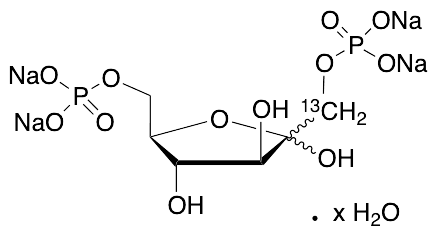
CAS:Kontrolliertes ProduktApplications Isotope labelled Fructose1,6-bisphosphate is an intermediate that lies within the glycolysis metabolic pathway and is also an allosteric activator of pyruvate kinase.
References Hinder, L.M., et al.: J. Endocriol., 216, 1 (2013); Takubo, K., et al.: Cell. Stem. Cell., 12, 49 (2013); Kalam, Y., et al.: Clin. Toxciol., 50, 546 (2012);Formel:C513CH10Na4O12P2•xH2OFarbe und Form:NeatMolekulargewicht:429.03D-Fructose-13C6-1,6-diphosphate sodium salt
CAS:D-Fructose-13C6-1,6-diphosphate sodium salt is a reactive compound used as a model in studies of metabolic disorders. It has been shown to have an inhibitory effect on the enzymes that catalyze the conversion of D-fructose 1,6 diphosphate to D-fructose 6 phosphate in the cytosol. The compound is also useful for determining the binding of calcium ions to proteins and for measuring the activity of carbon source enzymes.Formel:C6H10Na4O12P2·xH2OReinheit:Min. 95%Farbe und Form:PowderMolekulargewicht:434 g/mol
![{[(3S,4S,5R)-2,3,4-trihydroxy-5-[(phosphonooxy)methyl]oxolan-2-yl]methoxy}phosphonic acid](/_next/image/?url=https%3A%2Fstatic.cymitquimica.com%2Fproducts%2FIN%2Fthumb%2FDA00393R.jpg&w=3840&q=75)