CAS 489-84-9
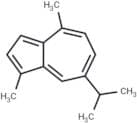
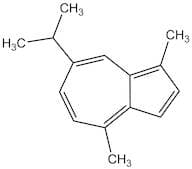
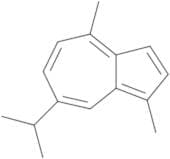
:Guajazulen
Beschreibung:
Guajazulen ist eine natürlich vorkommende organische Verbindung, die als Sesquiterpen klassifiziert ist und durch ihre charakteristische blaue Farbe gekennzeichnet ist. Sie wird hauptsächlich aus den ätherischen Ölen bestimmter Pflanzen, insbesondere aus der Familie der Asteraceae, gewonnen. Guajazulen hat eine molekulare Formel von C15H18 und weist eine bicyclische Struktur auf, die zu ihren einzigartigen Eigenschaften beiträgt. Diese Verbindung ist bekannt für ihre entzündungshemmenden, antioxidativen und antimikrobiellen Aktivitäten, was sie in kosmetischen und pharmazeutischen Anwendungen wertvoll macht. Neben ihren biologischen Eigenschaften wird Guajazulen häufig als Farbstoff in verschiedenen Formulierungen aufgrund ihres lebhaften Farbtons verwendet. Sie ist unter normalen Bedingungen relativ stabil, kann jedoch bei Kontakt mit starken Oxidationsmitteln oder extremen Temperaturen abgebaut werden. Ihre Löslichkeit ist in der Regel höher in organischen Lösungsmitteln als in Wasser, was eine häufige Eigenschaft vieler organischer Verbindungen ist. Insgesamt ist Guajazulen sowohl für seine ästhetische Anziehungskraft als auch für seine funktionalen Vorteile in verschiedenen Branchen bemerkenswert.
Formel:C15H18
InChl:InChI=1/C15H18/c1-10(2)13-7-5-11(3)14-8-6-12(4)15(14)9-13/h5-10H,1-4H3
InChI Key:InChIKey=FWKQNCXZGNBPFD-UHFFFAOYSA-N
SMILES:CC=1C=2C(C(C)=CC=C(C(C)C)C2)=CC1
Synonyme:- 1,4-Dimethyl-7-(1-methylethyl)Azulene
- 1,4-Dimethyl-7-(Propan-2-Yl)Azulene
- 1,4-Dimethyl-7-isopropylazulene
- 1,4-Dimethyl-7-propan-2-ylazulene
- 3,8-Dimethyl-5-(2-propyl)azulene
- 7-Isopropil-1,4-Dimetilazuleno
- 7-Isopropyl-1,4-Dimethylazulene
- 7-Isopropyl-1,4-dimethylazulen
- AZ 8 Beris
- Az 8
- Azulen-Beris
- Azulene, 1,4-Dimethyl-7-Isopropyl-
- Azulene, 1,4-dimethyl-7-(1-methylethyl)-
- Azulene, 7-isopropyl-1,4-dimethyl-
- Azulon
- Azunol
- Cuteazul
- Eucazulen
- Guaiazulene blue
- Kessazulen
- Nsc 4714
- Purazulen
- S-Guaiazulene
- Silazulon
- Uroazulen
- Vaumigan
- Vetivazulen
- Guaiazulene
- GUAJAZULEN
- LABOTEST-BB LT00244815
- 1,4-dimethyl-7-isopropyl-azulen
- Azulol
- Weitere Synonyme anzeigen
Sortieren nach
Reinheit (%)
0
100
|
0
|
50
|
90
|
95
|
100
15 Produkte.
Guaiazulene
CAS:Formel:C15H18Reinheit:>99.0%(GC)Farbe und Form:Dark green to Dark blue to Black powder to crystalMolekulargewicht:198.31Guaiazulene
CAS:Guaiazulene analytical standard provided with chromatographic purity, to be used as reference material for qualitative determination.Formel:C15H18Reinheit:(GC) ≥90%Farbe und Form:SolidMolekulargewicht:198.311,4-Dimethyl-7-isopropylazulene
CAS:Formel:C15H18Reinheit:97%Farbe und Form:SolidMolekulargewicht:198.30341,4-Dimethyl-7-isopropylazulene
CAS:1,4-Dimethyl-7-isopropylazuleneFormel:C15H18Reinheit:97%Farbe und Form: very dark blue fused solidMolekulargewicht:198.30g/molGuaiazulene
CAS:Guaiazulene (azulon) belongs to the class of organic compounds known as guaianes.Formel:C15H18Reinheit:99.35%Farbe und Form:Dark Blue Semi-SolidMolekulargewicht:198.30Guaiazulene
CAS:Formel:C15H18Reinheit:(GC) ≥ 98.5%Farbe und Form:Dark blue to dark purple solid or liquidMolekulargewicht:198.31Guaiazulene
CAS:Aromatic hydrocarbonFormel:C15H18Reinheit:≥ 98.0 % (GC)Farbe und Form:SolidMolekulargewicht:198.31Guaiazulene
CAS:Kontrolliertes ProduktApplications Guaiazulene is a lipophilic azulene that is commonly used as a skin conditioning agent in cosmetic, beauty and body care products. It is photomutagenic in Salmonella and also causes DNA damage in human cells.
References Chiang, H., et al.: J. Photochem. Photobiol. A: Chem., 211, 123 (2010); Fiori, J., et al.: Toxicol. Vitro, Kourounakis, A., et al.: J. Pharm. Pharmacol., 49, 938 (1997); Wang, L., et al.: Mut. Res., 530, 19 (2003)Formel:C15H18Farbe und Form:NeatMolekulargewicht:198.3Guaiazulene
CAS:Guaiazulene is a natural compound with antimicrobial and antiinflammatory activity. It has been shown to inhibit the growth of bacteria and fungi, including Staphylococcus aureus, Candida albicans, Aspergillus niger, Escherichia coli, Pseudomonas aeruginosa, and Klebsiella pneumoniae. Guaiazulene also inhibits the production of growth factor-β1 in human lung fibroblast cells (HL-60) at an optimum concentration of 10 μM. Additionally, guaiazulene has been shown to reduce the expression of inflammatory cytokines in vitro. Guaiazulene is structurally similar to azulene, but lacks a double bond between carbons 5 and 6.Formel:C15H18Reinheit:(Gc) Min. 99.00%Farbe und Form:PowderMolekulargewicht:198.3 g/mol