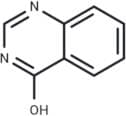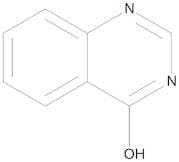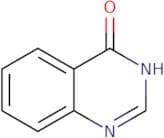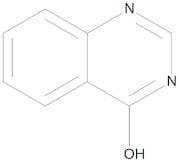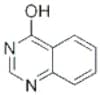
CAS 491-36-1
:4(1H)-Chinazolinon
Beschreibung:
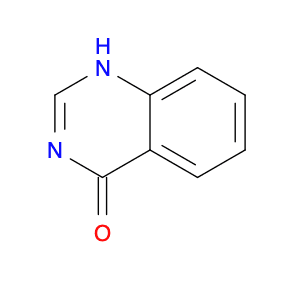
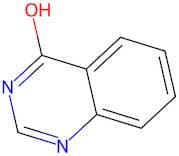
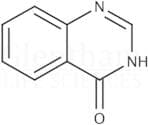
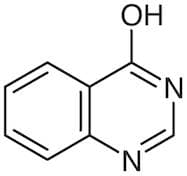
4(1H)-Chinazolinon, mit der CAS-Nummer 491-36-1, ist eine heterocyclische organische Verbindung, die durch eine fusionierte bicyclische Struktur mit einem Quinazolin-Ringsystem gekennzeichnet ist. Diese Verbindung weist eine Carbonylgruppe an der Position 4 des Quinazolinrings auf, was zu ihrer Reaktivität und potenziellen biologischen Aktivität beiträgt. Sie ist typischerweise ein weißer bis off-white kristalliner Feststoff, der eine moderate Löslichkeit in polaren Lösungsmitteln wie Wasser und Alkoholen aufweist. 4(1H)-Chinazolinon ist bekannt für seine vielfältigen pharmakologischen Eigenschaften, einschließlich antimikrobieller, entzündungshemmender und krebsbekämpfender Aktivitäten, was es zu einem interessanten Thema in der medizinischen Chemie macht. Die Verbindung kann an verschiedenen chemischen Reaktionen teilnehmen, wie nucleophilen Substitutionen und Cyclisierungen, aufgrund der Anwesenheit von Stickstoffatomen in ihrer Struktur. Ihre Derivate werden häufig synthetisiert, um die biologische Aktivität zu verbessern oder neue therapeutische Anwendungen zu erkunden. Insgesamt dient 4(1H)-Chinazolinon als wertvolle Struktur im Arzneimittelentdeckungs- und Entwicklungsprozess.
Formel:C8H6N2O
InChl:InChI=1S/C8H6N2O/c11-8-6-3-1-2-4-7(6)9-5-10-8/h1-5H,(H,9,10,11)
InChI Key:InChIKey=QMNUDYFKZYBWQX-UHFFFAOYSA-N
SMILES:O=C1C=2C(NC=N1)=CC=CC2
Synonyme:- 1H-Quinazolin-4-one
- 3,4-Dihydroquinazolin-4-One
- 4(1H)-Quinazolinone
- 4(3H)-Quinazolinone
- 4(3H)-Quinazolone
- 4-Hydroxy Quinazoline
- 4-Oxo-3,4-dihydroquinazoline
- 4-Oxoquinazoline
- 4-Quinazolinol
- 4-Quinazolinone
- 4-Quinazolone
- C 201-0583
- Hydroxyquinazoline
- NSC 5863
- Weitere Synonyme anzeigen
Sortieren nach
Reinheit (%)
0
100
|
0
|
50
|
90
|
95
|
100
12 Produkte.
4-Hydroxyquinazoline, 98%
CAS:4-Hydroxyquinazoline is been used to inhibit PARP (poly(ADP-ribose) synthetase) which catalyzes covalent attachment of the ADP-ribose moiety of NAD+ to various proteins. This compound specifically and potently inhibits PARP-1. 4-HQN demonstrates the ability to decrease activation of transcription fFormel:C8H6N2OReinheit:98%Farbe und Form:White to cream, Crystals or crystalline powder or needles or flakes or chunksMolekulargewicht:146.154-Hydroxyquinazoline
CAS:Formel:C8H6N2OReinheit:>98.0%(GC)(T)Farbe und Form:White to Light yellow to Light orange powder to crystalMolekulargewicht:146.154(3H)-Quinazolinone
CAS:4(3H)-Quinazolinone (4-Hydroxyquinazoline) is a chemically synthesized masonry block, a biologically active nitrogen heterocyclic compound.Formel:C8H6N2OReinheit:99.23%Farbe und Form:White SolidMolekulargewicht:146.154-Hydroxyquinazoline
CAS:Kontrolliertes ProduktApplications 4-Hydroxyquinazoline shows anti-microbial and anti-carcinogenic activity as seen in studies due to the quinazoline moiety.
References Kavitha, H.P. et al.: J. Pharm. Res., 4, 4694 (2011); He, J. et al.: Eur. J. Med. Chem., 54, 925 (2012);Formel:C8H6N2OFarbe und Form:NeatMolekulargewicht:146.154-Hydroxyquinazoline
CAS:Formel:C8H6N2OReinheit:98%Farbe und Form:Off-white powderMolekulargewicht:146.1494-Hydroxyquinazoline
CAS:4-Hydroxyquinazoline is a molecule that has been synthesized by an asymmetric synthesis. It has been shown to protect against oxidative injury in hl-60 cells and heart tissue, which may be due to the inhibition of mitochondrial ATP levels. 4-Hydroxyquinazoline has also been shown to suppress necrotic cell death, most likely through its ability to inhibit the generation of reactive oxygen species (ROS). This compound binds to the hydroxyl group on the cardiac myofilament, inhibiting binding of ATPase and leading to lack of energy production. 4-Hydroxyquinazoline also inhibits the activity of multi-walled carbon nanotubes, which are responsible for ROS production.Formel:C8H6N2OReinheit:Min 98%Farbe und Form:PowderMolekulargewicht:146.15 g/mol