CAS 491-70-3
:Luteolin
Beschreibung:
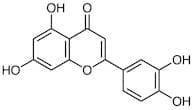
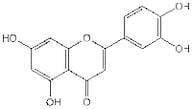
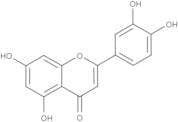
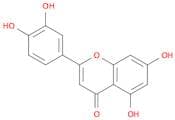
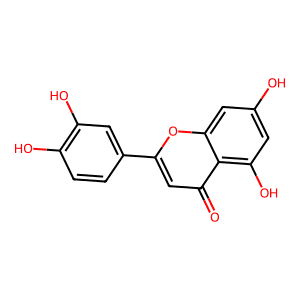
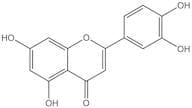
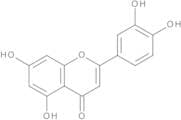
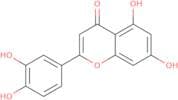
Luteolin ist ein Flavonoid, eine Art von polyphenolischem Verbindung, die häufig in verschiedenen Pflanzen vorkommt, einschließlich Früchten, Gemüse und Kräutern. Es ist bekannt für seine gelbe Farbe, die zur Pigmentierung vieler Blumen und Früchte beiträgt. Luteolin hat eine chemische Formel von C15H10O6 und ein Molekulargewicht von etwa 286,24 g/mol. Diese Verbindung zeigt eine Reihe biologischer Aktivitäten, einschließlich antioxidativer, entzündungshemmender und krebsbekämpfender Eigenschaften, was sie von Interesse in der pharmakologischen Forschung macht. Es ist bekannt, dass Luteolin bestimmte Enzyme und Signalwege hemmt, was zu seinen therapeutischen Wirkungen beitragen kann. Es ist in organischen Lösungsmitteln löslich, hat jedoch eine begrenzte Löslichkeit in Wasser. Darüber hinaus kann Luteolin in verschiedenen Nahrungsquellen gefunden werden, wie Sellerie, Petersilie und Kamillentee, und wird oft auf seine potenziellen gesundheitlichen Vorteile untersucht, einschließlich seiner Rolle bei der Reduzierung von oxidativem Stress und Entzündungen im Körper. Sein Sicherheitsprofil wird im Allgemeinen als günstig angesehen, obwohl weitere Forschungen im Gange sind, um seine Mechanismen und Wirkungen auf die menschliche Gesundheit vollständig zu verstehen.
Formel:C15H10O6
InChl:InChI=1/C15H10O6/c16-8-4-11(19)15-12(20)6-13(21-14(15)5-8)7-1-2-9(17)10(18)3-7/h1-6,16-19H
InChI Key:InChIKey=IQPNAANSBPBGFQ-UHFFFAOYSA-N
SMILES:O=C1C=2C(OC(=C1)C3=CC(O)=C(O)C=C3)=CC(O)=CC2O
Synonyme:- 2-(3,4-Dihidroxifenil)-5,7-Dihidroxi-4-Benzopirona
- 2-(3,4-Dihydroxy-phenyl)-5,7-dihydroxy-chromen-4-one
- 2-(3,4-Dihydroxyphenyl)-5,7-Dihydroxy-4-Benzopyrone
- 2-(3,4-Dihydroxyphenyl)-5,7-dihydroxy-4-benzopyron
- 2-(3,4-Dihydroxyphenyl)-5,7-dihydroxy-4H-1-benzopyran-4-one
- 2-(3,4-Dihydroxyphenyl)-5,7-dihydroxy-4H-benzopyran-4-one
- 2-(3,4-Dihydroxyphenyl)-5,7-dihydroxychromen-4-one
- 2-(3,4-dihydroxyphenyl)-5,7-dihydroxy-4H-chromen-4-one
- 3',4',5,7-Tetrahydroxyflavone
- 3,4,5,7-Tetrahydroxyflavone
- 4H-1-Benzopyran-4-one, 2-(3,4-dihydroxyphenyl)-5,7-dihydroxy-
- 5,7,3',4'-Tetrahydroxyflavone
- 5,7,3′,4′-Tetrahydroxyflavone
- Cyanidenon
- Cyanidenon 1470
- Digitoflavone
- Flacitran
- Flavone, 3',4',5,7-tetrahydroxy-
- Flavone, 3′,4′,5,7-tetrahydroxy-
- Luteoline
- Luteolol
- Salifazide
- St 024703
- Weld lake
- Yama Kariyasu
- C.I. Natural Yellow 2
- C.I. 75590
- Luteolin
- 2-(3,4-dihydroxyphenyl)-5,7-dihydroxy-4h-1-benzopyran-4-on
- 3’,4’,5,7-tetrahydroxy-flavon
- Luteolin(PeanutShellPe)98%ByHplc
- weldlake
- LUTEOLIN-3',7-O-DIGLUCURONIDE
- cyanidenon1470
- RARECHEM AB DU K001
- c.i.naturalyellow2
- LUTEOLIN 98+% BY HPLC
- Weitere Synonyme anzeigen
Sortieren nach
Reinheit (%)
0
100
|
0
|
50
|
90
|
95
|
100
17 Produkte.
3',4',5,7-Tetrahydroxyflavone
CAS:Formel:C15H10O6Reinheit:>98.0%(HPLC)Farbe und Form:Light yellow to Amber to Dark green powder to crystalMolekulargewicht:286.243',4',5,7-Tetrahydroxyflavone, 97%
CAS:3',4',5,7-Tetrahydroxyflavone is used as an apoptosis inducer. This Thermo Scientific Chemicals brand product was originally part of the Alfa Aesar product portfolio. Some documentation and label information may refer to the legacy brand. The original Alfa Aesar product / item code or SKU referenceFormel:C15H10O6Reinheit:97%Farbe und Form:Powder, Cream to yellow to brownMolekulargewicht:286.24Luteolin
CAS:Luteolin analytical standard provided with w/w absolute assay, to be used for quantitative titration.Formel:C15H10O6Reinheit:(HPLC) ≥99%Farbe und Form:PowderMolekulargewicht:286.253',4',5,7-Tetrahydroxyflavone
CAS:Formel:C15H10O6Reinheit:97%Farbe und Form:SolidMolekulargewicht:286.2363Ref: IN-DA00713A
1kgNachfragen1g29,00€5g37,00€10g56,00€25g73,00€50g132,00€100g196,00€250g310,00€500g526,00€Luteolin
CAS:Luteolin (Luteolol) belongs to the flavonoid group of natural products and is a Nrf2 inhibitor, PDE inhibitor.Formel:C15H10O6Reinheit:96.61% - 99.71%Farbe und Form:SolidMolekulargewicht:286.24Luteolin
CAS:Formel:C15H10O6Reinheit:≥ 95.0% (anhydrous basis)Farbe und Form:Off-white or yellow-green powderMolekulargewicht:286.24Luteolin
CAS:Luteolin, is a common flavonoid that exists in many types of plants including fruits, vegetables, and medicinal herbs, has anti-oxidant, anti-inflammation, anti-allergy and anticancer, has been used in Chinese traditional medicine for treating various diseases such as hypertension, inflammatory disorders, and cancer.Formel:C15H10O6Reinheit:95%~99%Farbe und Form:Yellow powderMolekulargewicht:286.239Luteolin
CAS:Oxygen-heterocyclic compoundFormel:C15H10O6Reinheit:≥ 95.0 % (HPLC)Farbe und Form:PowderMolekulargewicht:286.24Luteolin
CAS:Applications Hydroxylated flavone derivative with strong anti-oxidant and radical scavenging properties. Suggested to play a role in cancer prevention.
References Shimoi, L., et al.: Carcinogenesis, 15, 2669 (1994), Bors, W., et al.: Meth. Enzymol., 234, 420 (1994)Merck Index 12th ed. 5641Formel:C15H10O6Farbe und Form:NeatMolekulargewicht:286.24Luteolin
CAS:Luteolin is a flavonoid compound, which is a naturally occurring substance found predominantly in various fruits, vegetables, and medicinal herbs. Its sources are diverse, including parsley, artichokes, celery, and chamomile tea, where it is accumulated as a secondary metabolite. The mode of action of luteolin primarily involves the inhibition of key enzymes and pathways that lead to oxidative stress and inflammation, including but not limited to the cyclooxygenase and lipoxygenase pathways. This inhibition results in its strong antioxidant and anti-inflammatory properties.Formel:C15H10O6Reinheit:Min. 95 Area-%Farbe und Form:White Yellow Green PowderMolekulargewicht:286.24 g/mol2-(3,4-Dihydroxyphenyl)-5,7-dihydroxy-4H-chromen-4-one
CAS:Formel:C15H10O6Reinheit:97%Farbe und Form:Solid, Yellow to green powderMolekulargewicht:286.239