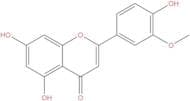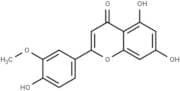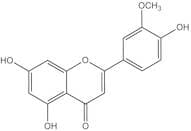
CAS 491-71-4
:Chrysoeriol
Beschreibung:
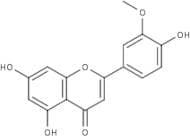
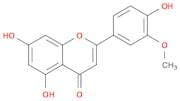
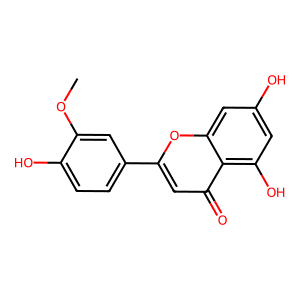
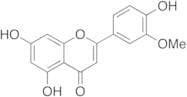
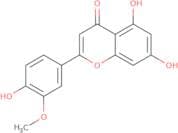
Chrysoeriol, mit der CAS-Nummer 491-71-4, ist ein natürlich vorkommendes Flavonoid, das zur Klasse der Flavone gehört. Es zeichnet sich durch sein gelbes Pigment aus und kommt häufig in verschiedenen Pflanzen vor, insbesondere in den Blättern und Blüten bestimmter Arten. Chrysoeriol weist antioxidative Eigenschaften auf, die zu seinen potenziellen gesundheitlichen Vorteilen beitragen, einschließlich entzündungshemmender und krebsbekämpfender Wirkungen. Die Verbindung hat eine molekulare Formel, die ihre Struktur widerspiegelt, die mehrere Hydroxylgruppen umfasst, die ihre Reaktivität und Löslichkeit in polaren Lösungsmitteln erhöhen. Chrysoeriol ist auch bekannt für seine Rolle bei der Pflanzenpigmentierung und kann zur Farbe bestimmter Früchte und Blumen beitragen. Neben seinen biologischen Aktivitäten hat es in der Lebensmittel- und Pharmaindustrie Interesse geweckt aufgrund seiner potenziellen Anwendungen. Insgesamt ist Chrysoeriol eine bedeutende Verbindung sowohl in der Chemie natürlicher Produkte als auch in der medizinischen Forschung, was die Bedeutung von Flavonoiden für Gesundheit und Ernährung unterstreicht.
Formel:C16H12O6
InChl:InChI=1S/C16H12O6/c1-21-14-4-8(2-3-10(14)18)13-7-12(20)16-11(19)5-9(17)6-15(16)22-13/h2-7,17-19H,1H3
InChI Key:InChIKey=SCZVLDHREVKTSH-UHFFFAOYSA-N
SMILES:O=C1C=2C(OC(=C1)C3=CC(OC)=C(O)C=C3)=CC(O)=CC2O
Synonyme:- 3'-Methoxyapigenin
- 3'-O-Methyluteolin
- 3′-Methoxy-4′,5,7-trihydroxyflavone
- 3′-O-Methylluteolin
- 4',5,7-Trihydroxy-3'-Methoxyflavone
- 4H-1-Benzopyran-4-one, 5,7-dihydroxy-2-(4-hydroxy-3-methoxyphenyl)-
- 5,7,4′-Trihydroxy-3′-methoxyflavone
- 5,7-Dihydroxy-2-(4-hydroxy-3-methoxyphenyl)-4H-1-benzopyran-4-one
- 5,7-dihydroxy-2-(4-hydroxy-3-methoxyphenyl)-4H-chromen-4-one
- Brn 0295004
- Chryseriol
- Chrysoeriol
- Chrysoriol
- Flavone, 4',5,7-trihydroxy-3'-methoxy-
- Flavone, 4′,5,7-trihydroxy-3′-methoxy-
- Luteolin 3'-methyl ether
- 5-18-05-00296 (Beilstein Handbook Reference)
- Weitere Synonyme anzeigen
Sortieren nach
Reinheit (%)
0
100
|
0
|
50
|
90
|
95
|
100
11 Produkte.
Chrysoeriol
CAS:Chrysoeriol analytical standard provided with w/w absolute assay, to be used for quantitative titration.Formel:C16H12O6Reinheit:(HPLC) ≥99%Farbe und Form:PowderMolekulargewicht:300.28Chrysoeriol
CAS:Chrysoeriol has antioxidant, antiinflammatory, antitumor, antimicrobial, antiviral, and free radical scavenging activities, it also shows selectiveFormel:C16H12O6Reinheit:97.32% - 99.805%Farbe und Form:SolidMolekulargewicht:300.26Chrysoeriol
CAS:Oxygen-heterocyclic compoundFormel:C16H12O6Reinheit:≥ 90.0 % (HPLC)Farbe und Form:PowderMolekulargewicht:300.26Chrysoeriol (>90%)
CAS:Kontrolliertes ProduktApplications Chrysoeriol is a methoxyflavonoid that selectively inhibits the formation of a carcinogenic estrogen metabolite in MCF-7 breast cancer cells. A metabolite of Luteolin (L475000).
References Takemura, H. et al.: J. Steroid Biochem. Mol. Biol., 118, 70 (2010); Petroianu, G. et al.: Open Med. Chem. J., 3, 1 (2009); Takemura, H. et al.: Toxicology, 274, 42 (2010);Formel:C16H12O6Reinheit:>90%Farbe und Form:NeatMolekulargewicht:300.26Chrysoeriol
CAS:Chrysoeriol is a flavonoid compound, which is derived from various plant sources, including many herbs and flowers such as chamomile and tarragon. It functions through inhibition of certain cellular pathways that lead to inflammation, such as the suppression of NF-kB and cyclooxygenase activity. Additionally, chrysoeriol exhibits antioxidative effects by scavenging free radicals and enhancing the body's natural antioxidant enzyme systems.Formel:C16H12O6Reinheit:Min. 95%Farbe und Form:Yellow PowderMolekulargewicht:300.26 g/mol