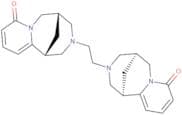
![(1R,5S)-1,2,3,4,5,6-Hexahydro-3-[2-[(1R,5S)-1,5,6,8-tetrahydro-8-oxo-1,5-methano-2H-pyrido[1,2-a][…](/_next/image/?url=https%3A%2Fstatic.cymitquimica.com%2Fcas-image%2Fthumb-webp%2F311531-12-bisn-cytisinylethane.webp&w=3840&q=75)
CAS 492-02-4
:(1R,5S)-1,2,3,4,5,6-Hexahydro-3-[2-[(1R,5S)-1,5,6,8-tetrahydro-8-oxo-1,5-methano-2H-pyrido[1,2-a][1,5]diazocin-3(4H)-yl]ethyl]-1,5-methano-8H-pyrido[1,2-a][1,5]diazocin-8-on
Beschreibung:
Die chemische Substanz mit dem Namen "(1R,5S)-1,2,3,4,5,6-Hexahydro-3-[2-[(1R,5S)-1,5,6,8-tetrahydro-8-oxo-1,5-methano-2H-pyrido[1,2-a][1,5]diazocin-3(4H)-yl]ethyl]-1,5-methano-8H-pyrido[1,2-a][1,5]diazocin-8-on" und der CAS-Nummer 492-02-4 ist eine komplexe organische Verbindung, die durch ihre komplizierte bicyclische Struktur gekennzeichnet ist, die mehrere fusionierte Ringe und verschiedene funktionelle Gruppen umfasst. Diese Verbindung weist Chiralität auf, die durch die spezifische Stereochemie an den bezeichneten Kohlenstoffzentren angezeigt wird, was ihre biologische Aktivität und Interaktionen erheblich beeinflussen kann. Die Anwesenheit von Stickstoffatomen in den Diazocin-Ringen deutet auf potenzielle pharmakologische Eigenschaften hin, da stickstoffhaltige Heterocyclen häufig mit bioaktiven Verbindungen assoziiert sind. Darüber hinaus tragen die Oxogruppe und die Methanbrücken zu ihrer Reaktivität und Stabilität bei. Solche Verbindungen könnten in der medizinischen Chemie von Interesse sein, insbesondere bei der Entwicklung von Arzneimitteln, aufgrund ihrer potenziellen therapeutischen Wirkungen. Insgesamt macht die strukturelle Komplexität und die einzigartigen Merkmale dieser Substanz sie zu einem interessanten Thema für weitere Forschung und Anwendung in verschiedenen chemischen und biologischen Bereichen.
Formel:C24H30N4O2
InChl:InChI=1S/C24H30N4O2/c29-23-5-1-3-21-19-9-17(13-27(21)23)11-25(15-19)7-8-26-12-18-10-20(16-26)22-4-2-6-24(30)28(22)14-18/h1-6,17-20H,7-16H2/t17-,18-,19+,20+/m0/s1
InChI Key:InChIKey=LEXDAVFCJPDCNA-VNTMZGSJSA-N
SMILES:C(CN1C[C@@]2(C=3N(C[C@](C1)(C2)[H])C(=O)C=CC3)[H])N4C[C@@]5(C=6N(C[C@@](C5)(C4)[H])C(=O)C=CC6)[H]
Synonyme:- 1,5-Methano-8H-pyrido[1,2-a][1,5]diazocin-8-one, 3,3′-(1,2-ethanediyl)bis[1,2,3,4,5,6-hexahydro-, (1R,1′R,5S,5′S)-
- Cytisine, ethylenedi-
- 1,5-Methano-8H-pyrido[1,2-a][1,5]diazocin-8-one, 3,3′-(1,2-ethanediyl)bis[1,2,3,4,5,6-hexahydro-, [1R-[1α,3(1R*,5S*),5α]]-
- Alternine
- 1,5-Methano-8H-pyrido[1,2-a][1,5]diazocin-8-one, 1,2,3,4,5,6-hexahydro-3-[2-[(1R,5S)-1,5,6,8-tetrahydro-8-oxo-1,5-methano-2H-pyrido[1,2-a][1,5]diazocin-3(4H)-yl]ethyl]-, (1R,5S)-
- 1,2-BisN-cytisinylethane
- Thermopsidine
- (1R,5S)-1,2,3,4,5,6-Hexahydro-3-[2-[(1R,5S)-1,5,6,8-tetrahydro-8-oxo-1,5-methano-2H-pyrido[1,2-a][1,5]diazocin-3(4H)-yl]ethyl]-1,5-Methano-8H-pyrido[1,2-a][1,5]diazocin-8-one
- CC4 >=98% (HPLC)
- CC4
Sortieren nach
Reinheit (%)
0
100
|
0
|
50
|
90
|
95
|
100
2 Produkte.
CC4
CAS:CC4 is an antimicrobial agent that belongs to the group of antimicrobial peptides. It is a cationic peptide that has been shown to inhibit the growth of bacteria, fungi, and viruses. CC4 has also been shown to have anti-inflammatory properties in mice with autoimmune diseases. CC4 binds to glutamate receptors on the surface of cells and blocks glutamate from binding, preventing activation of the receptor and subsequent cell death. CC4 has also been shown to bind specifically to DNA in vitro assays, which may be related to its ability to prevent mitochondrial functions and enzyme activities by blocking ATP production. CC4 also binds selectively to mitochondria in vivo, suggesting that it may also have therapeutic potential as a treatment for colorectal adenocarcinoma or other cancers caused by mitochondrial dysfunction.Formel:C24H30N4O2Reinheit:Min. 95%Molekulargewicht:406.52 g/molCC4
CAS:Selective α6β2/α4β2 partial agonist; Ki: 12/26nM (rat); poor α3β4/α7 affinity; stimulates dopamine release; reduces nicotine self-admin in rats.Formel:C24H30N4O2Farbe und Form:SolidMolekulargewicht:406.52