CAS 495-18-1
:Benzohydroxamsäure
Beschreibung:
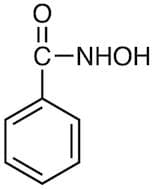
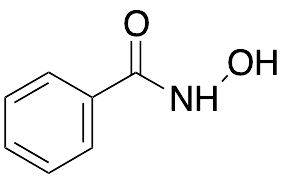
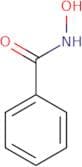
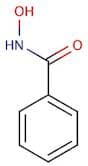
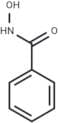
Benzohydroxamsäure, mit der CAS-Nummer 495-18-1, ist eine organische Verbindung, die durch das Vorhandensein sowohl einer Hydroxamsäure-Funktionalgruppe als auch eines Benzolrings gekennzeichnet ist. Sie erscheint typischerweise als weißes bis schmutzig-weißes kristallines Feststoff und ist in polaren Lösungsmitteln wie Wasser und Alkoholen löslich. Die Verbindung weist eine Hydroxylamin-Gruppe (-NHOH) auf, die an eine Benzoylgruppe gebunden ist, was zu ihrer Reaktivität und potenziellen Anwendungen beiträgt. Benzohydroxamsäure ist bekannt für seine Fähigkeit, Metallionen zu chelatisieren, was es in verschiedenen Bereichen, einschließlich der analytischen Chemie und Biochemie, nützlich macht. Es wurde auf sein Potenzial als Inhibitor bestimmter Enzyme untersucht, insbesondere im Kontext der Arzneimittelentwicklung und therapeutischen Anwendungen. Darüber hinaus zeigt es Eigenschaften, die in der Synthese anderer chemischer Verbindungen genutzt werden können. Wie viele organische Säuren sollte es mit Vorsicht behandelt werden, da es reizend für Haut und Augen sein kann. Es sollten geeignete Sicherheitsprotokolle befolgt werden, wenn mit dieser Substanz gearbeitet wird.
Formel:C7H7NO2
InChl:InChI=1S/C7H7NO2/c9-7(8-10)6-4-2-1-3-5-6/h1-5,10H,(H,8,9)
InChI Key:InChIKey=VDEUYMSGMPQMIK-UHFFFAOYSA-N
SMILES:C(NO)(=O)C1=CC=CC=C1
Synonyme:- Benzamide, N-hydroxy-
- Benzenehydroxamic acid
- Benzhydroxamic acid
- Benzohydroximic acid
- Benzoylhydroxylamine
- Bham
- Brd 3493
- Hydroxybenzamide, n-
- Hydroxylamine, N-benzoyl-
- N-Benzohydroxamic acid
- N-Benzoylhydroxylamine
- N-Hydroxybenzamid
- N-hidroxibenzamida
- N-hydroxybenzamide
- Nsc 147248
- Nsc 3136
- Phenylhydroxamic acid
- Weitere Synonyme anzeigen
Sortieren nach
Reinheit (%)
0
100
|
0
|
50
|
90
|
95
|
100
13 Produkte.
Benzohydroxamic Acid
CAS:Formel:C7H7NO2Reinheit:>98.0%(T)Farbe und Form:White to Almost white powder to crystalMolekulargewicht:137.14Benzohydroxamic acid, 98%
CAS:Benzhydroxamic acid is used as precursor in the synthesis of novel mono-anionic and di-anionic hydroxamato complexes by reacting with BiPh3 and Bi(O(t)Bu)3, which has anti-bacterial activity against helicobacter pylori. It is used in the photometric determination of trace amounts of vanadium in alloFormel:C7H7NO2Reinheit:98%Farbe und Form:White or pink to pale brown, Crystalline powder or flakesMolekulargewicht:137.14Benzhydroxamic acid
CAS:Formel:C7H7NO2Reinheit:≥ 98.0%Farbe und Form:White to light yellow crystalline powderMolekulargewicht:137.14Benzohydroxamic Acid
CAS:Kontrolliertes ProduktStability Moisture and Temperature Sensitive
Applications Benzohydroxamic Acid (cas# 495-18-1) is a compound useful in organic synthesis.
References Siliphaivanh, P., et al.: Bioorg. Med. Chem. Lett., 17, 4619 (2007), Serafimova, R., et al.: Chem. Res. Toxicol., 20, 1225 (2007), Fielding, A., et al.: Biochem., 47, 9781 (2008),Formel:C7H7NO2Farbe und Form:White To BeigeMolekulargewicht:137.14Benzohydroxamic acid
CAS:Benzohydroxamic acid is a weak organic acid that is formed from the condensation of two molecules of benzoic acid. The thermodynamic data for this compound are available in the form of an equation and an enthalpy change. Benzohydroxamic acid interacts with metal hydroxides by forming metal complexes, which can be used as catalysts in transfer reactions. In addition, benzohydroxamic acid has been shown to inhibit HIV infection by inhibiting reverse transcriptase activity. This compound also undergoes hydrogen bonding interactions with other molecules due to its hydroxyl group and fatty acid moieties.Formel:C7H7NO2Reinheit:Min. 95%Farbe und Form:PowderMolekulargewicht:137.14 g/molBenzohydroxamic Acid extrapure, 99%
CAS:Formel:C7H7NO2Reinheit:min. 99%Farbe und Form:White, Crystalline powder, Clear, ColourlessMolekulargewicht:137.14Benzohydroxamic acid
CAS:Benzohydroxamic acid (BHA) is a chitin deacetylase (CDA) inhibitor with notable antifungal properties. It displays Ki values of 8.31 μM against Verticillium dahliae CDA and 9.83 μM against Puccinia striiformis f. sp. tritici CDA. BHA can restore the defense responses in infected host plants by upregulating the expression of defense-related genes, thereby reducing fungal growth and proliferation within the plants. It is applicable in the research of agricultural fungal diseases, such as cotton wilt and wheat stripe rust, caused by pathogens like Verticillium dahliae and Puccinia striiformis.Formel:C7H7NO2Farbe und Form:SolidMolekulargewicht:137.136Benzhydroxamic acid
CAS:Formel:C6H5CONHOHReinheit:99.0 min. %Farbe und Form:White solidMolekulargewicht:137.14