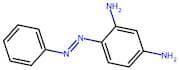
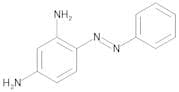
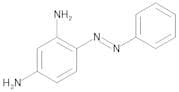
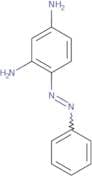
CAS 495-54-5
:2,4-Diaminoazobenzol
- 1,3-Benzenediamine, 4-(2-phenyldiazenyl)-
- 1,3-Benzenediamine, 4-(phenylazo)-
- 2,2'-(E)-diazene-1,2-diyldianiline
- 2,4-Diaminoazobenzene
- 4-(2-Phenyldiazenyl)-1,3-benzenediamine
- 4-(Fenilazo)Benceno-1,3-Diamina
- 4-(Phenylazo)-1,3-benzenediamine
- 4-(Phenylazo)-1,3-phenylenediamine
- 4-(Phenylazo)benzene-1,3-diamine
- 4-(Phenylazo)benzol-1,3-diamin
- 4-[(E)-phenyldiazenyl]benzene-1,3-diamine
- 4-[(E)-phenyldiazenyl]benzene-1,3-diamine hydrochloride (1:1)
- Azobenzene-2,4-diamine
- Chrysoidine Base
- Chrysoidine Base A
- Chrysoidine Base B
- Chrysoidine G Base
- Chrysoidine J Base
- Chrysoidine Y Base New
- Chrysoidine Y base
- Chrysoidine YD Base
- Chrysoidine free base
- Fat Brown GG
- Grasan Chrysoidine
- Neptune Orange Base 206
- Nsc 3273
- Waxoline Orange Y
- m-Phenylenediamine, 4-(phenylazo)-
- Weitere Synonyme anzeigen
C.I.Solvent Orange 3
CAS:Kontrolliertes ProduktApplications C.I.Solvent Orange 3 (CAS# 495-54-5) is a useful research chemical compound.
Formel:C12H12N4Farbe und Form:OrangeMolekulargewicht:212.25C.I.Solvent Orange 3
CAS:C.I. Solvent Orange 3 is a fluorescent dye that is used as a tracer in analytical chemistry to measure the water permeability of a sample by measuring the rate of diffusion of the dye. It is also used for sample preparation and kinetic studies when performing dispersive solid-phase extraction or surface methodology. The results show that C.I. Solvent Orange 3 has high water solubility and good stability, but can be decomposed by radiation, such as ultraviolet light and gamma rays, with an activation energy of around 100-150 kJ/mol and an induction time of 5-10 minutes. The compound has been detected in oroxylum indicum and curcuma aromatica plants, as well as angelicae dahuricae, titration calorimetry, and human serum samples from China. The compound is able to form hydrogen bonding interactions with other molecules such as glycol ethers, which are commonly found in Chinese herbs such as Angelica Dah
Formel:C12H12N4Reinheit:Min. 95%Farbe und Form:PowderMolekulargewicht:212.25 g/mol