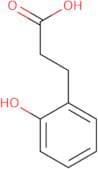
CAS 495-78-3
:Melilotinsäure
Beschreibung:
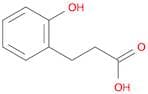
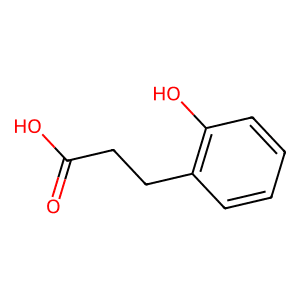
Melilotinsäure, mit der CAS-Nummer 495-78-3, ist eine natürlich vorkommende organische Verbindung, die als phenolisches Acid klassifiziert wird. Es stammt hauptsächlich von der Pflanzenart Melilotus, die allgemein als süßer Klee bekannt ist. Diese Verbindung zeichnet sich durch ihre aromatische Struktur aus, die eine Hydroxylgruppe (-OH) enthält, die an einen Benzolring gebunden ist, was zu ihren phenolischen Eigenschaften beiträgt. Melilotinsäure zeigt verschiedene biologische Aktivitäten, einschließlich potenzieller entzündungshemmender und antioxidativer Wirkungen, was es für die pharmakologische Forschung von Interesse macht. Es ist in polaren Lösungsmitteln löslich, was seine Bioverfügbarkeit in biologischen Systemen erhöht. Darüber hinaus kann Melilotinsäure eine Rolle in den Abwehrmechanismen von Pflanzen spielen und wurde auf seine potenziellen Anwendungen in der Lebensmittelkonservierung und der Synthese von Naturstoffen untersucht. Sein chemisches Verhalten wird durch das Vorhandensein funktioneller Gruppen beeinflusst, was verschiedene Reaktionen ermöglicht, die für phenolische Verbindungen typisch sind, wie Esterifizierung und Oxidation. Insgesamt stellt Melilotinsäure eine bedeutende Verbindung sowohl in der Chemie natürlicher Produkte als auch in potenziellen therapeutischen Anwendungen dar.
Formel:C9H10O3
InChl:InChI=1S/C9H10O3/c10-8-4-2-1-3-7(8)5-6-9(11)12/h1-4,10H,5-6H2,(H,11,12)
InChI Key:InChIKey=CJBDUOMQLFKVQC-UHFFFAOYSA-N
SMILES:C(CC(O)=O)C1=C(O)C=CC=C1
Synonyme:- 2-Hydroxybenzenepropanoic acid
- 2-Hydroxyhydrocinnamic acid
- 3-(2-Hydroxyphenyl)Propanoate
- 3-(2-Hydroxyphenyl)propanoic acid
- Benzenepropanoic acid, 2-hydroxy-
- Hydro-o-coumaric acid
- Hydrocinnamic acid, o-hydroxy-
- Hydrocoumaric acid
- Melilotic acid
- Salicylacetic acid
- o-Hydroxyhydrocinnamic acid
- Weitere Synonyme anzeigen
Sortieren nach
Reinheit (%)
0
100
|
0
|
50
|
90
|
95
|
100
7 Produkte.
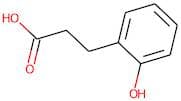
3-(2-hydroxyphenyl)propanoic acid
CAS:Formel:C9H10O3Reinheit:98%Farbe und Form:SolidMolekulargewicht:166.1739Melilotic acid, 10mM (in DMSO)
CAS:Melilotic acid, 10mM (in DMSO)Reinheit:≥98%Molekulargewicht:166.17g/mol3-(2-hydroxyphenyl)propanoic acid
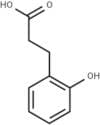
CAS:3-(2-hydroxyphenyl)propanoic acidReinheit:98%Molekulargewicht:166.17389g/molMelilotic acid
CAS:3-(2-Hydroxyphenyl)propanoic acid, aka melilotic acid, found in cytoplasm, in foods like herbs, beetroot, cinnamon.Formel:C9H10O3Reinheit:99.65% - 99.83%Farbe und Form:SolidMolekulargewicht:166.173-(2-Hydroxyphenyl)propionic Acid
CAS:Kontrolliertes ProduktApplications 3-(2-Hydroxyphenyl)Propionic Acid (cas# 495-78-3) is a useful research chemical.
Formel:C9H10O3Farbe und Form:NeatMolekulargewicht:166.173-(2-Hydroxyphenyl)propionic acid
CAS:3-(2-Hydroxyphenyl)propionic acid (HPPA) is an inorganic acid that is found in microbial metabolism. HPPA has been shown to inhibit the growth of bacteria by reacting with the hydroxyl group on the enzyme's active site, thus irreversibly inhibiting enzymatic activity. HPPA can be used as an alternative to other inorganic acids such as p-hydroxybenzoic acid and malonic acid due to its ability to scavenge anion radicals. This inhibition of enzyme activity can be used in wastewater treatment to remove organic compounds from industrial waste streams. It also has been shown to have anti-cancer properties against human breast cancer cells, which may be due to its ability to induce cell death through apoptosis and/or necrosis.Formel:C9H10O3Reinheit:Min. 95%Farbe und Form:White PowderMolekulargewicht:166.17 g/mol3-(2-Hydroxyphenyl)propionic acid
CAS:Formel:C9H10O3Reinheit:95%Farbe und Form:SolidMolekulargewicht:166.176