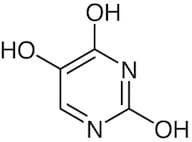
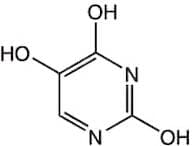
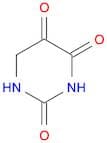
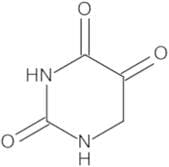
CAS 496-76-4
:Isobarbitursäure
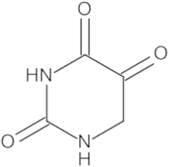
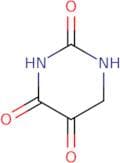
- 1,3-Diazinane-2,4,5-trione
- 2,4,5(3H)-Pyrimidinetrione, dihydro-
- 5-Hydroxyuracil
- 5-hydroxypyrimidine-2,4(1H,3H)-dione
- Dihydro-2,4,5(3H)-pyrimidinetrione
- Isobarbituric acid
- NSC 95958
- dihydropyrimidine-2,4,5(3H)-trione
Isobarbituric Acid
CAS:Formel:C4H4N2O3Reinheit:>97.0%(GC)Farbe und Form:White to Yellow to Orange powder to crystalMolekulargewicht:128.092,4,5-Trihydroxypyrimidine, 98%
CAS:2,4,5-Trihydroxypyrimidine studies show that it can form stable base pairs with all four bases in a DNA duplex. It has been used as oxidative DNA damage biomarker in tissue engineered skin. It acts as an antagonist of uracil in the growth of Lactobacillus casei. This Thermo Scientific Chemicals branFormel:C4H4N2O3Reinheit:98%Farbe und Form:Powder, White to pale creamMolekulargewicht:128.09Fluorouracil Related Compound B (Dihydropyrimidine-2,4,5(3H)-trione)
CAS:Compounds containing a pyrimidine ring (whether or not hydrogenated) or piperazine ring in the structure, nesoiFormel:C4H4N2O3Farbe und Form:White PowderMolekulargewicht:128.02219Isobarbituric Acid
CAS:Impurity Fluorouracil EP Impurity B; Fluorouracil USP Related Compound B
Applications A 5-hydroxy derivative of the nucleobase Uracil (U801000) and an isomer of Barbituric Acid (B118650). Studies show that it can form stable base pairs with all four bases in a DNA duplex. It has been used as oxidative DNA damage biomarker in tissue engineered skin. Fluorouracil EP Impurity B. Fluorouracil USP Related Compound B
References Varatharasa T. et al.: Chem. Comm., 3, 400 (2005); Jaruga, P. et al.: Nucleic Acid Res., 24, 1389 (1996); Rodriguez, H. et al.: Adv. Exp. Med. Biol., 534, 129 (2003);Formel:C4H4N2O3Farbe und Form:NeatMolekulargewicht:128.09Isobarbituric acid
CAS:Isobarbituric acid is a glycosylase that cleaves the bond between the amino group and the hydroxyl group of uridine in DNA. It has been shown to react with nucleophilic groups at neutral pH, such as an amine or hydroxyl group. Isobarbituric acid can be used to measure oxidative damage to DNA. This compound is reactive and sensitive to UV light, which makes it useful for detecting damaged DNA. Isobarbituric acid has been shown to induce neuronal death in rodents by interfering with dendritic spine formation.
Formel:C4H4N2O3Reinheit:Min. 95%Farbe und Form:White PowderMolekulargewicht:128.09 g/mol