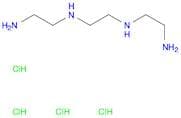
CAS 4961-40-4
:1,2-Ethandiamin, N1,N2-bis(2-aminoethyl)-, Hydrochlorid (1:4)
Beschreibung:
1,2-Ethandiamin, N1,N2-bis(2-aminoethyl)-, Hydrochlorid (1:4), allgemein als ein Derivat von Ethylendiamin bezeichnet, ist eine organische Verbindung, die durch ihre aminischen funktionellen Gruppen gekennzeichnet ist. Sie weist zwei primäre Aminogruppen auf und wird typischerweise als Hydrochloridsalz angetroffen, was ihre Löslichkeit in Wasser verbessert. Diese Verbindung wird häufig in verschiedenen Anwendungen eingesetzt, einschließlich als Chelatbildner, in der Pharmazie und in der Synthese anderer organischer Verbindungen. Ihre Struktur ermöglicht multiple Wasserstoffbindungsinteraktionen, die zu ihrer Reaktivität und potenziellen biologischen Aktivität beitragen. Die Anwesenheit mehrerer Aminogruppen macht sie zu einem vielseitigen Baustein in der organischen Synthese und zu einem Kandidaten für verschiedene chemische Reaktionen, einschließlich Acylierung und Alkylierung. Darüber hinaus kann sie aufgrund ihrer basischen Natur mit Säuren interagieren, um stabile Salze zu bilden, die in Laborumgebungen oft leichter zu handhaben sind. Sicherheitsüberlegungen sollten berücksichtigt werden, da Amine Reizstoffe sein können und Gesundheitsrisiken bei Exposition darstellen können.
Formel:C6H18N4·4ClH
InChl:InChI=1S/C6H18N4.4ClH/c7-1-3-9-5-6-10-4-2-8;;;;/h9-10H,1-8H2;4*1H
InChI Key:InChIKey=OKHMDSCYUWAQPT-UHFFFAOYSA-N
SMILES:C(CNCCN)NCCN.Cl
Synonyme:- Cuprior
- Triethylenetetramine, tetrahydrochloride
- Trientine tetrahydrochloride
- 1,2-Ethanediamine, N,N′-bis(2-aminoethyl)-, tetrahydrochloride
- 1,2-Ethanediamine, N1,N2-bis(2-aminoethyl)-, hydrochloride (1:4)
Sortieren nach
Reinheit (%)
0
100
|
0
|
50
|
90
|
95
|
100
9 Produkte gefunden.
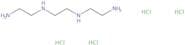
Triethylenetetramine Tetrahydrochloride
CAS:Formel:C6H18N4·4HClReinheit:>60.0%(GC)Farbe und Form:White to Light yellow powder to crystalMolekulargewicht:292.07N1,N1-(Ethane-1,2-Diyl)Bis(Ethane-1,2-Diamine) Tetrahydrochloride
CAS:N1,N1-(Ethane-1,2-Diyl)Bis(Ethane-1,2-Diamine) TetrahydrochlorideFormel:C6H22Cl4N4Reinheit:97%Molekulargewicht:292.08Triethylenetetramine tetrahydrochloride
CAS:Formel:C6H22Cl4N4Reinheit:97%Farbe und Form:SolidMolekulargewicht:292.0777Trientine TetraHCl (Triethylenetetramine TetraHCl)
CAS:Formel:C6H18N4·4HClMolekulargewicht:146.24 4*36.46Trientine-d4 TetraHCl (Triethylenetetramine-d4 TetraHCl)
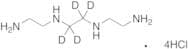
CAS:Formel:C6H14D4N4·4HClFarbe und Form:White To Off-White SolidMolekulargewicht:150.26 4*36.46Triethylenetetramine-d4 Tetrahydrochoride
CAS:Kontrolliertes ProduktStability Hygroscopic
Applications Labelled analogue of Triethylenetetramine, a crosslinking agent.It is the labeled form of Triethylenetetramine Tetrahydrochoride (CAS#: 4961-40-4) used in preparation of Motuporamine derivatives, Cyclopentadecyl Polyamines and Cholic Acid derivatives as membrane-active antibiotic enhancers active against Gram-neg. multidrug-resistant species.
References Phanstiel, O., et al.: U.S. Pat. Appl. Publ., (2017);Formel:C6H14D4N4•4(HCl)Farbe und Form:NeatMolekulargewicht:150.2643646TRIETHYLENETETRAMINE TETRAHCL
CAS:Formel:C6H22Cl4N4Reinheit:60.0%Farbe und Form:SolidMolekulargewicht:292.07Triethylenetetramine Tetrahydrochloride
CAS:Triethylenetetramine tetrahydrochloride (TETA) is a drug that has been shown to have the ability to enhance the immune system. It was first synthesized in 1894 by German chemist Emil Fischer, and has been used as an immunomodulator in the treatment of autoimmune diseases. TETA enhances the immune system by inhibiting an enzyme that is responsible for destroying lymphocytes, which are a type of white blood cell. The drug inhibits hydrochloric acid production in the stomach, which can be beneficial for people with cancer or ulcers. TETA binds to human serum proteins and inhibits uv absorption, binding constants, and human serum protein-dependent enzymes. This drug also inhibits hepatic function and pancreatic function due to its effects on liver cells and pancreatic cells respectively. TETA is classified as a non-competitive inhibitor because it does not compete with other substrates for access to an enzyme’s active site but rather binds at some distanceFormel:C6H18N4·4HClReinheit:Min. 95%Molekulargewicht:292.07 g/mol