CAS 499-83-2
:2,6-Pyridindicarbonsäure
Beschreibung:
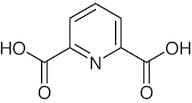
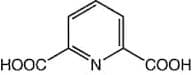
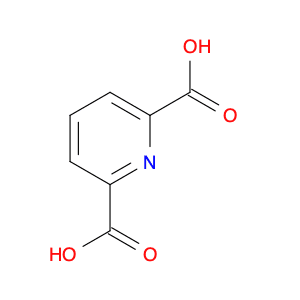
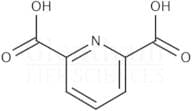
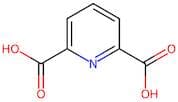
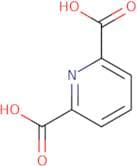
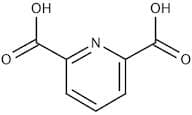
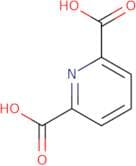
2,6-Pyridindicarbonsäure, auch bekannt als Dipicolinsäure, ist eine organische Verbindung mit der chemischen Formel C₆H₆N₂O₄. Sie weist einen Pyridinring auf, der an den Positionen 2 und 6 mit zwei Carbonsäuregruppen substituiert ist. Diese Verbindung ist ein weißes kristallines Feststoff, das in Wasser und polaren organischen Lösungsmitteln löslich ist. Sie zeigt saure Eigenschaften aufgrund der Anwesenheit der Carbonsäuregruppen, die Protonen in Lösung abgeben können. Dipicolinsäure ist bekannt für ihre Rolle in biologischen Systemen, insbesondere bei der Bildung von Bakteriensporen, wo sie zur Wärmebeständigkeit und Stabilität beiträgt. Darüber hinaus kann sie Chelate mit Metallionen bilden, was sie in verschiedenen analytischen und industriellen Anwendungen nützlich macht. Die Verbindung wird auch auf ihr Potenzial in der Koordinationschemie und als Ligand in Metallkomplexen untersucht. Insgesamt ist 2,6-Pyridindicarbonsäure eine vielseitige Verbindung mit erheblicher Relevanz sowohl in biologischen als auch in chemischen Kontexten.
Formel:C7H5NO4
InChl:InChI=1S/C7H5NO4/c9-6(10)4-2-1-3-5(8-4)7(11)12/h1-3H,(H,9,10)(H,11,12)
InChI Key:InChIKey=WJJMNDUMQPNECX-UHFFFAOYSA-N
SMILES:C(O)(=O)C=1N=C(C(O)=O)C=CC1
Synonyme:- 2,6-Dicarboxypyridine
- 2,6-Dipicolinic acid
- 2,6-Pyridine Dicarboxylic Acid
- 2.6-Pyridine Carboxylic Acid
- 6-Carboxypicolinic acid
- Acide pyridine-2,6-dicarboxylique
- Acido Piridina-2,6-Dicarboxilico
- DPA
- DPAc
- Dipicoline acid
- Dipicolinic acid
- Nsc 176
- Pyridin-2,6-dicarbonsaure
- Pyridine-2,6-Dicarboxylate
- Pyridine-2,6-Dicarboxylic Acid
- Pyridine-2,6-diformic acid
- Weitere Synonyme anzeigen
Sortieren nach
Reinheit (%)
0
100
|
0
|
50
|
90
|
95
|
100
9 Produkte.
2,6-Pyridinedicarboxylic Acid
CAS:Formel:C7H5NO4Reinheit:>98.0%(GC)(T)Farbe und Form:White to Almost white powder to crystalineMolekulargewicht:167.12Pyridine-2,6-dicarboxylic acid, 98%
CAS:Pyridine-2,6-dicarboxylic acid is used in the preparation of dipicolinato ligated lanthanide and transition metal complexes. It acts as a chelating agent for chromium, zinc, manganese, copper, iron and molybdenum. Its calcium-dipcolinic acid complex is used to protect deoxyribonucleic acid (DNA) frFormel:C7H5NO4Reinheit:98%Farbe und Form:White to pale cream, Crystals or powder or crystalline powderMolekulargewicht:167.122,6-Pyridinedicarboxylic acid
CAS:Formel:C7H5NO4Reinheit:95%Farbe und Form:SolidMolekulargewicht:167.1189Ref: IN-DA0035JT
25kgNachfragen50kgNachfragen10g20,00€25g29,00€50g31,00€100g42,00€250g64,00€500g124,00€1kg181,00€2,6-Pyridinedicarboxylic acid
CAS:Formel:C7H5NO4Reinheit:≥ 98.0%Farbe und Form:White powderMolekulargewicht:167.12Pyridine-2,6-dicarboxylic acid
CAS:Pyridine-2,6-dicarboxylic acidFormel:C7H5NO4Reinheit:98%Farbe und Form: white crystalline powderMolekulargewicht:167.12g/mol2,6-Dipicolinic Acid
CAS:Formel:C7H5NO4Reinheit:95%Farbe und Form:Solid, Crystalline Powder or PowderMolekulargewicht:167.122,6-Pyridinedicarboxylic acid
CAS:2,6-Pyridinedicarboxylic acid is a chemical compound that is mainly used as an antimicrobial agent. It binds to DNA by hydrogen bonding interactions and alters the polymerase chain reaction (PCR) process. This leads to inhibition of DNA synthesis and cell death. 2,6-Pyridinedicarboxylic acid has been shown to have synergistic effects when combined with sodium salts. It also inhibits transfer reactions in bacteria, which may be due to its ability to bind to picolinic acid. The structural analysis of 2,6-pyridinedicarboxylic acid showed that it contains a pyridine ring fused with two carboxyl groups. 2,6-Pyridinedicarboxylic acid reacts with picolinic acid in the presence of sodium salts and undergoes a series of reactions leading to the formation of picolinamide, which may explain its inhibitory properties.Formel:C7H5NO4Reinheit:Min. 95%Farbe und Form:PowderMolekulargewicht:167.12 g/molPyridine-2,6-Dicarboxylic Acid extrapure, 99%
CAS:Formel:C7H5NO4Reinheit:min. 99%Farbe und Form:White to pale pink, Powder, Clear, Colourless to pale pinkMolekulargewicht:167.122,6-Pyridinedicarboxylic acid
CAS:2,6-Pyridinedicarboxylic acid is a synthetic building block that can be used in the synthesis of many organic compounds. It has been shown to be a useful intermediate in the synthesis of complex compounds and is also a versatile building block for the synthesis of speciality chemicals. This chemical has been shown to have a high quality and is also a reagent or research chemical. 2,6-Pyridinedicarboxylic acid can be used as an intermediate for the production of other chemicals, such as pharmaceuticals, food additives, and dyes.This compound belongs to CAS No. 499-83-2.
Formel:C7H5NO4Molekulargewicht:167.12 g/molRef: 3D-W-105996
Ausgelaufenes produkt