CAS 499231-24-2
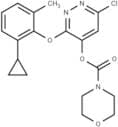
:4-Morpholincarbonsäure, 6-chlor-3-(2-cyclopropyl-6-methylphenoxy)-4-pyridazinylester
Beschreibung:
Die 4-Morpholinocarbonsäure, 6-Chloro-3-(2-Cyclopropyl-6-methylphenoxy)-4-pyridazinyler, identifiziert durch die CAS-Nummer 499231-24-2, ist eine synthetische organische Verbindung, die durch ihre komplexe molekulare Struktur gekennzeichnet ist. Sie weist einen Morpholiring auf, der zu ihrem Potenzial als pharmakologisches Mittel beiträgt, und eine Pyridazin-Gruppe, die ihre biologische Aktivität verbessern kann. Das Vorhandensein eines Chlorsubstituenten und einer Cyclopropylgruppe deutet darauf hin, dass die Verbindung einzigartige sterische und elektronische Eigenschaften aufweisen könnte, die möglicherweise ihre Reaktivität und Wechselwirkung mit biologischen Zielen beeinflussen. Diese Verbindung ist wahrscheinlich in organischen Lösungsmitteln löslich, und ihre Stabilität kann je nach Umweltbedingungen wie pH und Temperatur variieren. Angesichts ihrer strukturellen Komponenten könnte sie von Interesse in der medizinischen Chemie sein, insbesondere bei der Entwicklung neuer therapeutischer Mittel. Spezifische biologische Aktivität, Toxizität und pharmakokinetische Eigenschaften würden jedoch weitere Untersuchungen durch experimentelle Studien erfordern.
Formel:C19H20ClN3O4
Sortieren nach
Reinheit (%)
0
100
|
0
|
50
|
90
|
95
|
100
4 Produkte.
6-Chloro-3-(2-cyclopropyl-6-methylphenoxy)pyridazin-4-yl morpholine-4-carboxylate
CAS:6-Chloro-3-(2-cyclopropyl-6-methylphenoxy)pyridazin-4-yl morpholine-4-carboxylateReinheit:98%Molekulargewicht:389.84g/molCyclopyrimorate
CAS:Cyclopyrimorate is a highly effective bleaching herbicide for weed control in rice fields.Formel:C19H20ClN3O4Farbe und Form:SolidMolekulargewicht:389.833Cyclopyrimorate
CAS:Cyclopyrimorate is a small molecule that has been shown to inhibit the activity of protein kinase C (PKC). Cyclopyrimorate is a potent activator of PKC, and it has been shown to interact with both the ligand binding domain and the activation domain. This inhibitor binds to the ATP binding site on PKC, blocking access by ATP and inhibiting phosphorylation. Cyclopyrimorate has also been shown to have effects on ion channels, including voltage-gated potassium channels, calcium activated potassium channels, and nicotinic acetylcholine receptors. Cyclopyrimorate is a research tool for studying protein interactions in cells. It can be used as an antibody against PKC for immunocytochemistry or Western blotting experiments.
Formel:C19H20ClN3O4Reinheit:Min. 95%Molekulargewicht:389.8 g/mol