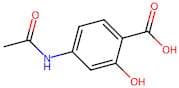
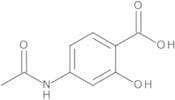
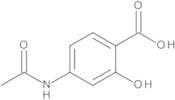
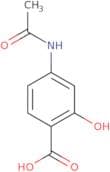
CAS 50-86-2
:4-Acetamidosalicylsäure
- 2-Hydroxy-4-acetamidobenzoic acid
- 3-Hydroxy-4-carboxyacetanilide
- 4-(Acetylamino)-2-hydroxybenzoic acid
- 4-Acetamido-2-hydroxybenzoic acid
- 4-Acetamidosalicylic acid
- 4-Acetaminosalicylic acid
- 4-Azetaminosalizylsaeure
- 4-Azetaminosalizylsaeure [German]
- Acide 4-acetaminosalicylique
- Acide 4-acetaminosalicylique [French]
- Benzoic acid, 4-(acetylamino)-2-hydroxy-
- Benzoic acid, 4-(acetylamino)-2-hydroxy- (9CI)
- Benzoic acid, 4-acetamido-2-hydroxy-
- Brn 0395899
- N-Acetyl-4-aminosalicyclic acid
- N-Acetyl-4-aminosalicylic acid
- N-Acetyl-p-aminosalicylic acid
- N-Acetyl-pas
- Nsc 54182
- Salicylic acid, 4-acetamido-
- Ws 176
- p-(Acetylamino)salicylic acid
- p-Acetamidosalicylic acid
- Weitere Synonyme anzeigen
4-Acetamidosalicylic acid
CAS:Formel:C9H9NO4Reinheit:97%Farbe und Form:SolidMolekulargewicht:195.17214-Acetamido-2-hydroxybenzoic acid
CAS:4-Acetamido-2-hydroxybenzoic acid
Reinheit:≥95%Molekulargewicht:195.17g/mol4-(Acetylamino)-2-hydroxybenzoic Acid
CAS:Kontrolliertes ProduktFormel:C9H9NO4Farbe und Form:NeatMolekulargewicht:195.17N-Acetyl-4-aminosalicylic Acid
CAS:Kontrolliertes ProduktImpurity Metoclopramide EP Impurity H
Applications N-Acetyl-4-aminosalicylic Acid (Metoclopramide EP Impurity H) is hydroxybenzoic acid that is a versatile reactant used in the preparation of salicylanilide derivatives as inhibitors of the protein tyrosine kinase epidermal growth factor receptor.
References Liechti, C., et al.: Eur. J. Med. Chem., 39, 11 (2004);Formel:C9H9NO4Farbe und Form:Off WhiteMolekulargewicht:195.17N-Acetyl-4-aminosalicylic acid
CAS:N-Acetyl-4-aminosalicylic acid is an active site directed probe for the detection of salicylic acid. It has a fluorescence emission maximum at 370 nm and a fluorescence quantum yield of 0.93. N-Acetyl-4-aminosalicylic acid can be used to analyze samples, such as wastewater and human urine, which contain salicylic acid. The probe is protonated in the presence of salicylic acid and then binds to the acceptor in the sample with a bimodal distribution. The fluorescence resonance energy transfer (FRET) process between the donor and acceptor leads to an increase in fluorescence intensity that can be detected by electrophoresis methods. This probe also has a conformational change when it binds to its target, which allows for easy separation from other components in the sample by size exclusion chromatography.
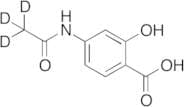
Formel:C9H9NO4Reinheit:Min. 95%Farbe und Form:Slightly Brown PowderMolekulargewicht:195.17 g/molN-Acetyl-4-aminosalicylic Acid-d3
CAS:Kontrolliertes ProduktFormel:C9D3H6NO4Farbe und Form:NeatMolekulargewicht:198.19