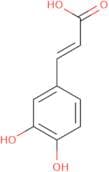
CAS 501-16-6
:Kaffeesäure
Beschreibung:
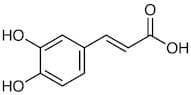
Kaffeesäure, mit der CAS-Nummer 501-16-6, ist eine natürlich vorkommende phenolische Verbindung, die zur Klasse der Hydroxycinnamsäuren gehört. Sie zeichnet sich durch ihre trans-Konfiguration aus, die sich auf die Anordnung ihrer Doppelbindung zwischen den Kohlenstoffatomen in der Seitenkette bezieht. Diese Verbindung kommt häufig in verschiedenen Pflanzen vor, insbesondere in Kaffee, Früchten und Gemüse, und ist bekannt für ihre antioxidativen Eigenschaften. Kaffeesäure zeigt eine gelblich-braune Farbe und ist in Wasser sowie in organischen Lösungsmitteln wie Ethanol und Methanol löslich. Ihre molekulare Formel ist C9H8O4, und sie hat ein Molekulargewicht von etwa 180,17 g/mol. Die Verbindung spielt eine bedeutende Rolle im Pflanzenstoffwechsel und wurde auf ihre potenziellen gesundheitlichen Vorteile untersucht, einschließlich entzündungshemmender und antimikrobieller Wirkungen. Darüber hinaus wird Kaffeesäure häufig in der Lebensmittel- und Kosmetikindustrie aufgrund seiner konservierenden Eigenschaften und seiner Fähigkeit zur Verbesserung der Stabilität von Produkten verwendet.
Formel:C9H8O4
InChl:InChI=1S/C9H8O4/c10-7-3-1-6(5-8(7)11)2-4-9(12)13/h1-5,10-11H,(H,12,13)/b4-2+
InChI Key:InChIKey=QAIPRVGONGVQAS-DUXPYHPUSA-N
SMILES:C(=C/C(O)=O)\C1=CC(O)=C(O)C=C1
Synonyme:- (2E)-(3,4-Dihydroxyphenyl)-2-propenoic acid
- (2E)-3-(3,4-Dihydroxyphenyl)-2-propenoic acid
- (E)-3,4-Dihydroxycinnamic acid
- (E)-3-(3,4-Dihydroxyphenyl)-2-propenoic acid
- (E)-3-(3,4-Dihydroxyphenyl)acrylic acid
- (E)-Caffeic acid
- 2-Propenoic acid, 3-(3,4-dihydroxyphenyl)-, (E)-
- 2-Propenoicacid, 3-(3,4-dihydroxyphenyl)-, (E)-
- 3,4-Dihydroxy-trans-cinnamic acid
- Cinnamic acid, 3,4-dihydroxy-, (E)-
- Cinnamic acid, 3,4-dihydroxy-, (E)-(8CI)
- Cinnamic acid, 3,4-dihydroxy-, trans-
- Cinnamic acid, 3,4-dihydroxy-, trans- (7CI)
- Zinc 00058172
- trans-3,4-Dihydroxycinnamic acid
- trans-Caffeic acid
- 2-Propenoic acid, 3-(3,4-dihydroxyphenyl)-, (2E)-
- AKOS B004050
- 3,4-Dihydroxy-trans-cinnamate
- 3-(3,4-DIHYDROXYPHENYL)ACRYLIC ACID
- 3-(3,4-DIHYDROXYPHENYL)-2-PROPENOIC ACID
- TIMTEC-BB SBB006475
- CAFFEIC ACID
- LABOTEST-BB LT00233168
- 3,4-DIHYDROXYCINNAMIC ACID
- RARECHEM BK HC T335
- Weitere Synonyme anzeigen
Sortieren nach
Reinheit (%)
0
100
|
0
|
50
|
90
|
95
|
100
8 Produkte.
Caffeic Acid
CAS:Formel:C9H8O4Reinheit:>98.0%(T)(HPLC)Farbe und Form:White to Orange to Green powder to crystalMolekulargewicht:180.16Trans-caffeic acid
CAS:Trans-caffeic acid can be used as a highly sensitive fluorescent probe for the detection of laccase in food and can also stimulate the growth of germ tissue.Formel:C9H8O4Reinheit:98.37%Farbe und Form:SolidMolekulargewicht:180.16(E)-3-(3,4-Dihydroxyphenyl)Acrylic Acid
CAS:(E)-3-(3,4-Dihydroxyphenyl)Acrylic AcidReinheit:95%Molekulargewicht:180.16g/molTrans-caffeic acid
CAS:Carboxylic acid with phenol functionFormel:C9H8O4Reinheit:≥ 98.0 % (HPLC)Farbe und Form:PowderMolekulargewicht:180.16trans-Caffeic Acid
CAS:Applications trans-Caffeic Acid is a useful synthetic intermediate. It was used as a reactant to synthesize N-caffeoylphenalkylamide derivatives as bacterial efflux pump inhibitors. It is also used to prepare caffeic acid phenethyl ester analogs with antitumor structures.
References Michalet, S., et al.: Bioorg. Med. Chem. Lett., 17, 1755 (2007); Nagaoka, T., et al.: Bioorg. Med. Chem., 10, 3351 (2002)Formel:C9H8O4Farbe und Form:NeatMolekulargewicht:180.16trans-Caffeic acid
CAS:Caffeic acid is a phenolic compound that belongs to the hydroxybenzoic acid family. It is found in many plants, including coffee beans, green tea leaves, and white tea. Caffeic acid is an intermediate in the synthesis of other phenolic compounds such as p-coumaric acid, ferulic acid, 3-o-caffeoylquinic acid, and 4-o-caffeoylquinic acid. Caffeic acid has been shown to have biological properties that are related to melanogenesis, acetate extract sesquiterpene lactones (taraxasterol acetate), camp levels (protocatechuic acid), and phenolic acids (chromatographic).Formel:C9H8O4Reinheit:Min. 95%Molekulargewicht:180.16 g/mol