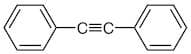
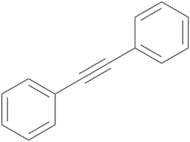
CAS 501-65-5
:Diphenylacetylen
- (2-Phenylethynyl)benzene
- (Phenylethynyl)Benzene
- 1,1'-(1,2-Ethanediyl)bisbenzene
- 1,1'-(1,2-Ethynediyl)bis[benzene]
- 1,1'-Ethyne-1,2-Diyldibenzene
- 1,1’-(1,2-Ethynediyl)Bis-Benzen
- 1,1’-(1,2-Ethynediyl)bisbenzene
- 1,2-Diphenyl Ethyne
- 1,2-Diphenylacetylene
- 1,2-Diphenylethyne
- 2-Phenylethynylbenzene
- Acetylene, Diphenyl-
- Benzene, 1,1'-(1,2-ethynediyl)bis-
- Difenilacetileno
- Diphenyl acetylene (Tolan)
- Diphenylacetylen
- Diphenylethyne
- Ethyne, diphenyl-
- Nsc 5185
- Tolan
- Tolane
- Weitere Synonyme anzeigen
Diphenylacetylene
CAS:Formel:C14H10Reinheit:>98.0%(GC)Farbe und Form:White to Light yellow powder to crystalMolekulargewicht:178.23Diphenylacetylene, 99%
CAS:Diphenylacetylene is often used as a building block in organic and organometallic chemistry. It acts as dienophile and under goes Diels-Alder reaction with tetraphenylcyclopentadienone to prepare hexaphenylbenzene. It acts as a precursor in the preparation of 3-alkoxycyclopropene by reacting with beFormel:C14H10Reinheit:99%Farbe und Form:White to cream, Crystals or powder or crystalline powderMolekulargewicht:178.23Diphenylacetylene
CAS:Kontrolliertes ProduktApplications Diphenylacetylene is a reagent used in the preparation of polysubstituded pyrroles via oxidative nitrene transfer. Also used in the aerobic coupling of salicyaldehydes with alkynes.
References Dewan, A. et al.: ACS Omega, 3, 5327 (2018); Yamane, S. et al.: Chem. A Eur. J., 24, 7852 (2018);Formel:C14H10Farbe und Form:ColourlessMolekulargewicht:178.23sym-Diphenylacetylene
CAS:Sym-Diphenylacetylene is a compound that belongs to the class of organic compounds known as heterocycles. It is a derivative of picolinic acid, which has been shown to be involved in the biosynthesis of nicotinic acid. Sym-Diphenylacetylene has been used as a model system for picolinic acid and dimethyl fumarate reactions, with thermal expansion properties that are similar to those of anhydrous sodium. The phase transition temperature for this compound is around 130°C and it undergoes transfer reactions with other substances such as hydrogen bonding interactions.
Formel:C14H10Reinheit:Min. 95%Farbe und Form:PowderMolekulargewicht:178.23 g/molDiphenylacetylene, 99%
CAS:Diphenylacetylene, 99%
Formel:C6H5CCC6H5Reinheit:99%Farbe und Form:white pwdr.Molekulargewicht:178.23