CAS 501938-01-8
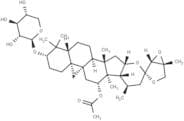
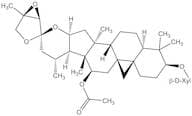
:(1'R,2S,4aR,5'R,5aR,7R,7aR,7bR,8R,10R,11aS,12aS,12bS,14aR)-1,1,5',7a,8,12a-hexamethyl-2-(beta-D-xylopyranosyloxy)hexadecahydro-2H-spiro[cyclopropa[1',8a']naphtho[2',1':4,5]indeno[2,1-b]pyran-10,2'-[3,6]dioxabicyclo[3.1.0]hexan]-7-yl acetat
Beschreibung:
Die chemische Substanz mit dem Namen "(1'R,2S,4aR,5'R,5aR,7R,7aR,7bR,8R,10R,11aS,12aS,12bS,14aR)-1,1,5',7a,8,12a-hexamethyl-2-(beta-D-xylopyranosyloxy)hexadecahydro-2H-spiro[cyclopropa[1',8a']naphtho[2',1':4,5]indeno[2,1-b]pyran-10,2'-[3,6]dioxabicyclo[3.1.0]hexan]-7-yl acetat" und der CAS-Nummer "501938-01-8" ist eine komplexe organische Verbindung, die durch ihre komplizierte Stereochemie und mehrere funktionelle Gruppen gekennzeichnet ist. Sie weist eine spirocyclische Struktur auf, die zu ihrer einzigartigen dreidimensionalen Konformation beiträgt. Das Vorhandensein einer beta-D-Xylopyranosylgruppe deutet darauf hin, dass es sich um ein Glykosid handelt, was auf eine potenzielle biologische Aktivität hindeutet, die möglicherweise mit Kohlenhydratinteraktionen zusammenhängt. Das Hexamethylsubstitutionsmuster impliziert einen hohen Grad an Hydrophobizität, was ihre Löslichkeit und Interaktion mit biologischen Membranen beeinflussen kann. Darüber hinaus deutet die Acetatgruppe darauf hin, dass sie einer Hydrolyse unterzogen werden könnte, wobei Essigsäure freigesetzt wird und möglicherweise ihre biologische Aktivität verändert wird. Insgesamt positioniert die strukturelle Komplexität dieser Verbindung und ihre funktionellen Gruppen sie als Kandidaten für weitere Untersuchungen in Bereichen wie der medizinischen Chemie und der Forschung zu Naturstoffen.
Formel:C37H56O10
InChl:InChI=1/C37H56O10/c1-18-12-37(30-33(6,47-30)17-43-37)46-21-13-32(5)23-9-8-22-31(3,4)24(45-29-28(41)27(40)20(39)15-42-29)10-11-35(22)16-36(23,35)14-25(44-19(2)38)34(32,7)26(18)21/h18,20-30,39-41H,8-17H2,1-7H3/t18-,20-,21+,22+,23+,24+,25-,26+,27+,28-,29+,30-,32+,33-,34-,35-,36+,37-/m1/s1
Synonyme:- beta-D-xylopyranoside, (1'R,2S,4aR,5'R,5aR,7R,7aR,7bR,8R,10R,11aS,12aS,12bS,14aR)-7-(acetyloxy)hexadecahydro-1,1,5',7a,8,12a-hexamethylspiro[5H-cyclopropa[1',8'a]naphth[2',1':4,5]indeno[2,1-b]pyran-10(2H),2'-[3,6]dioxabicyclo[3.1.0]hexan]-2-yl
- (1'R,2S,4aR,5'R,5aR,7R,7aR,7bR,8R,10R,11aS,12aS,12bS,14aR)-1,1,5',7a,8,12a-Hexamethyl-2-(beta-D-xylopyranosyloxy)hexadecahydro-2H-spiro[cyclopropa[1',8a']naphtho[2',1':4,5]indeno[2,1-b]pyran-10,2'-[3,6]dioxabicyclo[3.1.0]hexan]-7-yl acetate
- DEOXYACTEIN, 27-(23-EPI-26-DEOXYACTEIN)(RG)
- β-D-Xylopyranoside, (3β,12β,16β,23R,24R,25R)-12-(acetyloxy)-16,23:23,26:24,25-triepoxy-9,19-cyclolanostan-3-yl
Sortieren nach
Reinheit (%)
0
100
|
0
|
50
|
90
|
95
|
100
4 Produkte.
23-EPI-26-Deoxyactein
CAS:Other glycosides, natural or reproduced by synthesis, and their salts, ethers, esters and other derivativesFormel:C37H56O10Farbe und Form:White PowderMolekulargewicht:660.3873523-epi-26-Deoxyactein
CAS:23-epi-26-Deoxyactein is a naturally occurring compound exhibiting anti-obesity and anti-cancer properties when administered orally [1] [2] [3].Formel:C37H56O10Farbe und Form:SolidMolekulargewicht:660.8323-epi-26-deoxyactein
CAS:Natural glycosideFormel:C37H56O10Reinheit:≥ 90.0 % (HPLC)Farbe und Form:PowderMolekulargewicht:660.8523-Epi-26-deoxyactein
CAS:23-Epi-26-deoxyactein is a triterpene glycoside, which is derived from the roots of the plant *Actaea racemosa*, commonly known as black cohosh. As a phytochemical, it belongs to a group of compounds known as saponins, which are characterized by their glycosidic linkages and steroidal or triterpenoid aglycones.
Formel:C37H56O10Reinheit:Min. 95%Molekulargewicht:660.8 g/molRef: 3D-BVA93801
Ausgelaufenes produkt