CAS 502-22-7
:2-(3-Phenyl-1-propyn-1-yl)furan
Beschreibung:
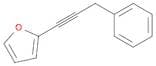
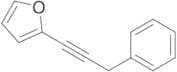
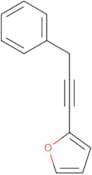
2-(3-Phenyl-1-propyn-1-yl)furan, mit der CAS-Nummer 502-22-7, ist eine organische Verbindung, die durch ihre Struktur eines Furanrings gekennzeichnet ist, der mit einer Propyngrupp und einer Phenylgruppe substituiert ist. Diese Verbindung weist eine Furan-Einheit auf, die ein fünfgliedriger aromatischer Ring ist, der ein Sauerstoffatom enthält, was zu ihrer potenziellen Reaktivität und Stabilität beiträgt. Das Vorhandensein der Phenylgruppe verbessert ihre aromatischen Eigenschaften, während das Propyngrupp einen Dreifachbindung einführt, die an verschiedenen chemischen Reaktionen, wie Addition oder Substitution, teilnehmen kann. Die Verbindung ist typischerweise eine farblose bis blassgelbe Flüssigkeit oder Feststoff, abhängig von ihrer Reinheit und spezifischen Bedingungen. Sie kann interessante Eigenschaften wie Fluoreszenz oder photochemische Reaktivität aufgrund ihres konjugierten Systems aufweisen. Darüber hinaus kann ihre einzigartige Struktur spezifische biologische Aktivitäten verleihen, was sie in der medizinischen Chemie und Materialwissenschaft von Interesse macht. Wie bei vielen organischen Verbindungen sollte der Umgang mit Vorsicht erfolgen, wobei potenzielle Toxizität und Umweltauswirkungen zu berücksichtigen sind.
Formel:C13H10O
InChl:InChI=1S/C13H10O/c1-2-6-12(7-3-1)8-4-9-13-10-5-11-14-13/h1-3,5-7,10-11H,8H2
InChI Key:InChIKey=ICRHFCVRNWSKQH-UHFFFAOYSA-N
SMILES:C(#CCC1=CC=CC=C1)C2=CC=CO2
Synonyme:- 2-(3-Phenyl-1-propyn-1-yl)furan
- Carlina oxide
- Furan, 2-(3-phenyl-1-propyn-1-yl)-
- Furan, 2-(3-phenyl-1-propynyl)-
Sortieren nach
Reinheit (%)
0
100
|
0
|
50
|
90
|
95
|
100
4 Produkte.
2-(3-phenylprop-1-ynyl)furan
CAS:Formel:C13H10OReinheit:95%+Farbe und Form:LiquidMolekulargewicht:182.2179Carlina Oxide
CAS:Kontrolliertes ProduktApplications Carlina oxide is a natural polyacetylene from Carlina acaulis (Asteraceae). It showed antimicrobial, anti-inflammatory, anti-ulcer and antioxidant activities in rats.
References Herrmann, F., et al.: Planta Medica, 77, 1905 (2011); Dordevic, S., et al.: J. Ethnopharmacol., 109, 458 (2007)Formel:C13H10OFarbe und Form:NeatMolekulargewicht:182.218Carlina oxide
CAS:Carlina oxide is a natural antibacterial compound that has been shown to inhibit the growth of C. glabrata and other bacteria. It is an antioxidant compound with strong antioxidative activity, which has been demonstrated by its ability to protect cells from damage induced by hydrogen peroxide. Carlina oxide also shows potent cytotoxicity against human cancer cells and has been shown to be effective in animal models for the treatment of infections caused by E. coli and F. faecalis strains. This compound has not yet been synthesized but can be extracted from the leaves of carline thistle (Carlina vulgaris).Formel:C13H10OReinheit:Min. 95%Molekulargewicht:182.22 g/molCarlina oxide
CAS:Carlina oxide is both an AChE inhibitor and an antioxidant, effective in eliminating mosquito larvae (LC50=1.39 μg/mL). Furthermore, Carlina oxide exhibits cytotoxicity in vertebrate cells, human dermis, and HCT116 and MDA-MB231 cell lines.Formel:C13H10OFarbe und Form:SolidMolekulargewicht:182.22