CymitQuimica logo

CAS 50276-96-5

:

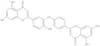
Ochnoflavon

Beschreibung:
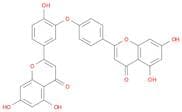
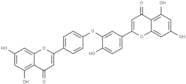
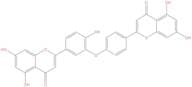
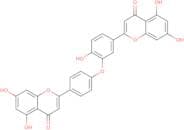
Ochnoflavon, mit der CAS-Nummer 50276-96-5, ist eine natürlich vorkommende Flavonoidverbindung, die hauptsächlich aus Pflanzen der Gattung Ochna gewonnen wird. Sie zeichnet sich durch ihre charakteristische chemische Struktur aus, die ein Flavon-Gerüst mit zusätzlichen funktionellen Gruppen umfasst, die zu ihrer biologischen Aktivität beitragen. Ochnoflavon weist eine Reihe von pharmakologischen Eigenschaften auf, einschließlich entzündungshemmender, antioxidativer und potenzieller krebsbekämpfender Wirkungen, was sie von Interesse in der medizinischen Chemie und der Forschung zu Naturstoffen macht. Die Verbindung kommt typischerweise in verschiedenen Pflanzenextrakten vor und wurde hinsichtlich ihrer Rolle in der traditionellen Medizin untersucht. Ihre Löslichkeit und Stabilität können je nach Lösungsmittel und Umweltbedingungen variieren, was für ihre Anwendung in biologischen Studien wichtig ist. Darüber hinaus ist die Wechselwirkung von Ochnoflavon mit biologischen Systemen, einschließlich ihres Wirkmechanismus auf molekularer Ebene, ein Bereich laufender Forschung, der ihre potenziellen therapeutischen Vorteile und die Notwendigkeit weiterer Untersuchungen zu ihrer Wirksamkeit und Sicherheitsprofilen hervorhebt.
Formel:C30H18O10
InChl:InChI=1/C30H18O10/c31-16-8-20(34)29-22(36)12-24(39-27(29)10-16)14-1-4-18(5-2-14)38-26-7-15(3-6-19(26)33)25-13-23(37)30-21(35)9-17(32)11-28(30)40-25/h1-13,31-35H
InChI Key:InChIKey=NNPGECDACGBKDH-UHFFFAOYSA-N
SMILES:O=C1C=2C(OC(=C1)C3=CC(OC4=CC=C(C=C4)C=5OC=6C(C(=O)C5)=C(O)C=C(O)C6)=C(O)C=C3)=CC(O)=CC2O
Synonyme:
  • 4H-1-Benzopyran-4-one, 2-[4-[5-(5,7-dihydroxy-4-oxo-4H-1-benzopyran-2-yl)-2-hydroxyphenoxy]phenyl]-5,7-dihydroxy-
  • 2-[4-[5-(5,7-Dihydroxy-4-oxo-4H-1-benzopyran-2-yl)-2-hydroxyphenoxy]phenyl]-5,7-dihydroxy-4H-1-benzopyran-4-one
  • 2-{4-[5-(5,7-dihydroxy-4-oxo-4H-chromen-2-yl)-2-hydroxyphenoxy]phenyl}-5,7-dihydroxy-4H-chromen-4-one
  • 2-[4-[5-(5,7-Dihydroxy-4-oxochromen-2-yl)-2-hydroxyphenoxy]phenyl]-5,7-dihydroxychromen-4-one
  • 4H-1-Benzopyran-4-one, 2-(4-(5-(5,7-dihydroxy-4-oxo-4H-1-benzopyran-2-yl)-2-hydroxyphenoxy)phenyl)-5,7-dihydroxy-
  • Ochnaflavone
  • Ochinaflavone
  • Similar to pyriloxanone -7-O- -d - glucopyranoside
Sortieren nach

Reinheit (%)
0
100
|
0
|
50
|
90
|
95
|
100
4 Produkte.
  • Ochnaflavone

    CAS:
    Formel:C30H18O10
    Molekulargewicht:538.4579

    Ref: IN-DA00DKNC

    5mg
    Nachfragen
  • Ochnaflavone

    CAS:
    Ochnaflavone is a natural product for research related to life sciences. The catalog number is TN5501 and the CAS number is 50276-96-5.
    Formel:C30H18O10
    Reinheit:98%
    Farbe und Form:Solid
    Molekulargewicht:538.46

    Ref: TM-TN5501

    5mg
    2.248,00€
  • Ochnaflavone

    CAS:
    Formel:C30H18O10
    Reinheit:95%~99%
    Molekulargewicht:538.464

    Ref: BP-BP2410

    5mg
    530,00€
    10mg
    915,00€
    20mg
    1.437,00€
    100mg
    4.683,00€
  • Ochnaflavone

    CAS:

    Ochnaflavone is a biflavonoid compound, which is a type of naturally occurring flavonoid dimer. It is derived primarily from plants within the Ochnaceae family. Ochnaflavone demonstrates its bioactivity through various mechanisms, including the modulation of cellular signaling pathways, antioxidative activities, and inhibition of specific enzymes involved in inflammatory processes.

    Ochnaflavone’s potential therapeutic applications span several areas, including anti-inflammatory, anticancer, and antiviral treatments. Studies have shown that its ability to scavenge free radicals and modulate key molecular targets makes it a subject of interest for further pharmacological research. The compound’s modulatory effects on pathways such as NF-κB and its inhibitory action on enzymes like COX-2 suggest promising roles in managing conditions characterized by inflammation and abnormal cellular proliferation. Continued investigation and detailed in vitro and in vivo studies are warranted to elucidate its full potential and therapeutic index.

    Formel:C30H18O10
    Reinheit:Min. 95%
    Molekulargewicht:538.5 g/mol