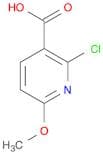
CAS 503000-87-1
:2-chlor-6-methoxypyridin-3-carbonsäure
Beschreibung:
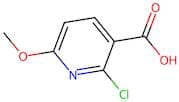
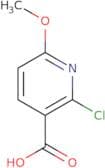
2-chlor-6-methoxypyridin-3-carbonsäure ist eine heterocyclische organische Verbindung, die durch ihre Pyridinringstruktur gekennzeichnet ist, die ein Chloratom und eine Methoxygruppe als Substituenten enthält. Das Vorhandensein der Carbonsäurefunktion trägt zu seinen sauren Eigenschaften bei, wodurch es in polaren Lösungsmitteln löslich ist. Diese Verbindung zeigt typischerweise eine moderate Stabilität unter Standardbedingungen, kann jedoch empfindlich auf starke Basen oder Oxidationsmittel reagieren. Ihre molekulare Struktur ermöglicht potenzielle Wechselwirkungen in biologischen Systemen, die in pharmazeutischen Anwendungen von Interesse sein könnten. Das Chloratom kann die Reaktivität und biologische Aktivität der Verbindung beeinflussen, während die Methoxygruppe die Lipophilie erhöhen kann. Insgesamt ist 2-chlor-6-methoxypyridin-3-carbonsäure eine vielseitige Verbindung mit potenziellen Anwendungen in der medizinischen Chemie, Agrochemie und Materialwissenschaft, aufgrund ihrer einzigartigen funktionellen Gruppen und strukturellen Merkmale.
Formel:C7H6ClNO3
InChl:InChI=1/C7H6ClNO3/c1-12-5-3-2-4(7(10)11)6(8)9-5/h2-3H,1H3,(H,10,11)
SMILES:COc1ccc(c(Cl)n1)C(=O)O
Synonyme:- 2-Chloro-6-methoxynicotinic acid
- 3-Pyridinecarboxylic Acid, 2-Chloro-6-Methoxy-
Sortieren nach
Reinheit (%)
0
100
|
0
|
50
|
90
|
95
|
100
4 Produkte.
2-Chloro-6-methoxynicotinic acid
CAS:Formel:C7H6ClNO3Reinheit:98%Farbe und Form:SolidMolekulargewicht:187.58042-Chloro-6-methoxynicotinic acid
CAS:2-Chloro-6-methoxynicotinic acidFormel:C7H6ClNO3Reinheit:≥95%Farbe und Form: solidMolekulargewicht:187.58g/mol2-Chloro-6-methoxynicotinic acid
CAS:Formel:C7H6ClNO3Reinheit:95%Farbe und Form:SolidMolekulargewicht:187.582-Chloro-6-methoxynicotinic acid
CAS:2-Chloro-6-methoxynicotinic acid is a halogenated organic compound that has the molecular formula CHClNO. It is a colorless solid. 2-Chloro-6-methoxynicotinic acid is an intermediate in the industrial production of other chemicals and pharmaceuticals. This compound reacts with nucleophiles such as chlorine, hydrochloric acid, and sodium hydroxide to form chlorides, which are important intermediates in chemical reactions. 2-Chloro-6-methoxynicotinic acid can be converted to a variety of different compounds by reacting it with other reagents or by using specific catalysts. For example, it can react with chlorine gas to produce trichloromethylating agents such as dichloromethyl ether and chloral hydrate.Formel:C7H6ClNO3Reinheit:Min. 95%Molekulargewicht:187.58 g/mol