CAS 50358-35-5
:6-Methylchinolin-5-amin
Beschreibung:
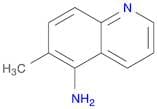
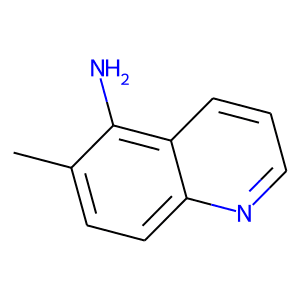
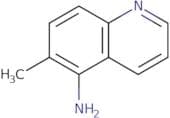
6-Methylchinolin-5-amin ist eine organische Verbindung, die durch ihre Chinolinstruktur gekennzeichnet ist, die aus einem fusionierten Benzol- und Pyridinring besteht. Die Anwesenheit einer Methylgruppe an der Position 6 und einer Aminogruppe an der Position 5 trägt zu ihren einzigartigen chemischen Eigenschaften bei. Diese Verbindung erscheint typischerweise als Feststoff und ist in organischen Lösungsmitteln löslich, was ihre aromatische Natur widerspiegelt. Sie kann aufgrund der Aminogruppe basische Eigenschaften aufweisen, die es ihr ermöglichen, an verschiedenen chemischen Reaktionen teilzunehmen, wie nucleophilen Substitutionen oder Kupplungsreaktionen. Darüber hinaus kann 6-Methylchinolin-5-amin als Baustein in der Synthese komplexerer Moleküle, einschließlich pharmazeutischer Produkte und Agrochemikalien, dienen. Ihre potenziellen biologischen Aktivitäten können antimikrobielle oder krebshemmende Eigenschaften umfassen, was sie in der medizinischen Chemie von Interesse macht. Sicherheitsdaten sollten für den Umgang und die Lagerung konsultiert werden, wie bei jeder chemischen Substanz, um sicherzustellen, dass die richtigen Vorsichtsmaßnahmen getroffen werden.
Formel:C10H10N2
InChl:InChI=1/C10H10N2/c1-7-4-5-9-8(10(7)11)3-2-6-12-9/h2-6H,11H2,1H3
SMILES:Cc1ccc2c(cccn2)c1N
Synonyme:- 5-Quinolinamine, 6-methyl-
- 6-Methylquinolin-5-amine
- 5-Amino-6-methylquinoline
- AKOS BBS-00005361
- 6-METHYL-5-QUINOLINAMINE
- 5-Amino-6-methylquinoline 97%
- 6-METHYL-QUINOLIN-5-YLAMINE
- ASINEX-REAG BAS 09889230
- 6-Methyl-5-aminoquinoline, 6-Methylquinolin-5-ylamine
- 6-methyl-5-quinolinylamine
- AKOS AUF01722
Sortieren nach
Reinheit (%)
0
100
|
0
|
50
|
90
|
95
|
100
4 Produkte.
5-Quinolinamine, 6-methyl-
CAS:Formel:C10H10N2Reinheit:95%Farbe und Form:SolidMolekulargewicht:158.19986-Methyl-5-quinolinamine
CAS:6-Methyl-5-quinolinamine (6MQ) is a cationic quinolone antibacterial that inhibits bacterial growth by binding to DNA. It has been shown to inhibit the growth of bacteria, such as Escherichia coli and Staphylococcus aureus. 6MQ binds to the DNA gyrase enzyme and prevents it from unwinding the double helix, which prevents transcription and replication. The quinoline ring in this compound also contains an amine group, which is important for its antibacterial activity. 6MQ forms hydrogen bonds with the carboxylic acid groups on the surface of bacterial cells, leading to cell death. 6MQ can be synthesized by reacting malonate with fluorine gas in order to form an intermediate molecule, which reacts with ammonia and methyl iodide in order to form a quinoline ring.Formel:C10H10N2Reinheit:Min. 95%Molekulargewicht:158.2 g/mol