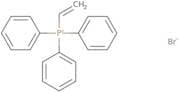
CAS 5044-52-0
:Phosphonium, ethenyltriphenyl-, bromid (1:1)
Beschreibung:
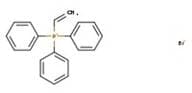
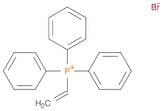
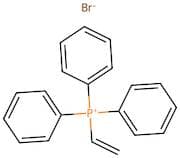
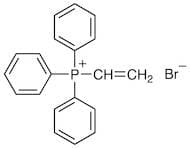
Phosphonium, ethenyltriphenyl-, bromid (1:1), allgemein als Phosphoniumsalz bezeichnet, ist durch seine quartäre Ammoniumstruktur gekennzeichnet, bei der ein Phosphoratome an drei Phenylgruppen und eine Ethenylgruppe gebunden ist, zusammen mit einem Bromid-Gegenion. Diese Verbindung zeigt typischerweise Eigenschaften, die mit ionischen Salzen assoziiert sind, wie hohe Löslichkeit in polaren Lösungsmitteln und die Fähigkeit, Elektrizität in Lösung zu leiten. Die Anwesenheit der Ethenylgruppe führt zu einem Potenzial für Reaktivität, insbesondere in Polymerisationsreaktionen oder als Ligand in der Koordinationschemie. Phosphoniumsalze werden häufig in der organischen Synthese, Katalyse und als Zwischenprodukte bei der Herstellung verschiedener organischer Verbindungen verwendet. Die Stabilität des Phosphoniumions kann je nach den an das Phosphoratome gebundenen Substituenten variieren, was seine Reaktivität und Anwendungen beeinflusst. Darüber hinaus kann das Bromidion an nucleophilen Substitutionsreaktionen teilnehmen, was diese Verbindung in der synthetischen organischen Chemie vielseitig macht. Insgesamt ist Phosphonium, Ethenyltriphenyl-, Bromid eine bedeutende Verbindung sowohl im akademischen als auch im industriellen Kontext der Chemie.
Formel:C20H18BrP
InChl:InChI=1/C20H18P.BrH/c1-2-21(18-12-6-3-7-13-18,19-14-8-4-9-15-19)20-16-10-5-11-17-20;/h2-17H,1H2;1H/q+1;/p-1
InChI Key:InChIKey=VRAYVWUMBAJVGH-UHFFFAOYSA-M
SMILES:[P+](C=C)(C1=CC=CC=C1)(C2=CC=CC=C2)C3=CC=CC=C3.[Br-]
Synonyme:- Bromotriphenylvinylphosphorane
- Ethenyl(Triphenyl)Phosphonium Bromide
- NSC 84065
- Phosphonium, ethenyltriphenyl-, bromide
- Phosphonium, ethenyltriphenyl-, bromide (1:1)
- Phosphonium, triphenylvinyl-, bromide
- Schweizers
- Triphenylvinylphosphonium bromide
- Vinyl(triphenyl)phosphine bromide
- Vinyltriphenylphosphonium bromide
- SCHWEIZER'S REAGENT
- VINYL TRIPHENYLPHOSPHONIUM BROMIDE (TRIPHENYL VINYLPHOSPHONIUM BROMIDE)
- Schweizers Reagent, Vinyltriphenylphosphonium bromide
- Vinyltriphenylphosphoniumbromide,97%
- Schweizer'sReagent~Triphenylvinylphosphoniumbromide
- Weitere Synonyme anzeigen
Sortieren nach
Reinheit (%)
0
100
|
0
|
50
|
90
|
95
|
100
6 Produkte.
Vinyltriphenylphosphonium bromide, 97%
CAS:This Thermo Scientific Chemicals brand product was originally part of the Alfa Aesar product portfolio. Some documentation and label information may refer to the legacy brand. The original Alfa Aesar product / item code or SKU reference has not changed as a part of the brand transition to Thermo SciFormel:C20H18BrPReinheit:97%Farbe und Form:White to cream or pale yellow, PowderMolekulargewicht:369.24Triphenyl(vinyl)phosphonium bromide
CAS:Formel:C20H18BrPReinheit:97%Farbe und Form:SolidMolekulargewicht:369.2347Triphenyl(Vinyl)Phosphonium Bromide
CAS:Triphenyl(Vinyl)Phosphonium BromideReinheit:97%Molekulargewicht:369.23g/molTriphenyl(vinyl)phosphonium Bromide
CAS:Formel:C20H18BrPReinheit:>96.0%(T)(HPLC)Farbe und Form:White to Orange to Green powder to crystalMolekulargewicht:369.24Triphenyl(vinyl)phosphonium bromide
CAS:Formel:C20H18BrPReinheit:97%;RGFarbe und Form:Liquid, No data available.Molekulargewicht:369.242Triphenylvinylphosphonium Bromide
CAS:Triphenylvinylphosphonium bromide is a model system that is used to study the reaction mechanism of hydroxyl group and hydrogen fluoride. It can be used to synthesize heterocycles such as quinolines. Triphenylvinylphosphonium bromide is also used in the synthesis of sodium salts, which are commonly used in the laboratory. This compound has been shown to have an effect on protein synthesis and crystalline cellulose, which is a carbohydrate polymer that can be hydrolyzed by enzymes. Triphenylvinylphosphonium bromide reacts with carbonyl groups and metal hydroxides, leading to biochemical properties such as carboxy groups and dimethyl fumarate. Triphenylvinylphosphonium bromide also inhibits non-nucleoside inhibitors, specifically 2',3'-dideoxyinosine (ddI).Formel:C20H18BrPReinheit:Min. 95%Molekulargewicht:369.23 g/mol