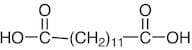
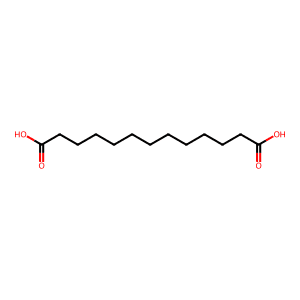
CAS 505-52-2
:Tridecandisäure
- 1,13-Tridecanedioic acid
- Brassylic acid
- NSC 9498
- Tridecanedioate
- Tridecanedioic acid
- α,ω-Tridecanedioic acid
- ω-Carboxylauric acid
- 1,11-Undecanedicarboxylic acid
Tridecanedioic Acid
CAS:Formel:C13H24O4Reinheit:>96.0%(GC)(T)Farbe und Form:White to Light yellow to Dark green powder to crystalMolekulargewicht:244.331,11-Undecanedicarboxylic acid
CAS:1,11-Undecanedicarboxylic acidReinheit:98%Molekulargewicht:244.33g/molTridecanedioic acid, 10mM (in DMSO)
CAS:Tridecanedioic acid, 10mM (in DMSO)Reinheit:≥95%Molekulargewicht:244.33g/molTridecanedioic acid
CAS:Tridecanedioic acid (Brassilic acid) is an unusual odd-numbered dicarboxylic acid that appears in the urines of children with neonatal adrenoleukodystrophy.Formel:C13H24O4Reinheit:99.78%Farbe und Form:White FlakeMolekulargewicht:244.331,11-Undecanedicarboxylic Acid
CAS:Applications 1,11-Undecanedicarboxylic Acid is used in the synthesis of two Bis(tetrahydroisoquinoline) which were highly cytotoxic for cancer-cell cultures and less toxic to healthy cells and exhibited noticeable antimicrobial activity against Gram-positive and Gram-negative bacteria and fungal strain Candida albicans.
References Terent’eva, E. O., et al.: Chem. Nat. Compd., 53, 328-332 (2017)Formel:C13H24O4Farbe und Form:NeatMolekulargewicht:244.331,11-Undecanedicarboxylic acid
CAS:Formel:C13H24O4Reinheit:97%Farbe und Form:Solid, PowderMolekulargewicht:244.331Tridecanedioic Acid
CAS:Tridecanedioic Acid is a polycarboxylic acid that has reactive functional groups. It is used in detergent compositions as an inhibitor of the formation of soaps and hard water deposits. Tridecanedioic acid has been shown to inhibit pancreatitis, which may be due to its ability to inhibit the conversion of fatty acids into prostaglandins. Tridecanedioic acid also has anti-cancer properties, which have been shown in animal studies. In addition, it has broad-spectrum antimicrobial activity against gram-positive bacteria, such as Clostridium perfringens and Staphylococcus aureus. This compound inhibits protein synthesis by inhibiting enzymes belonging to the cytochrome P450 family.
Formel:C13H24O4Reinheit:Min. 95%Molekulargewicht:244.33 g/mol