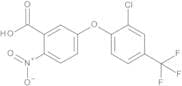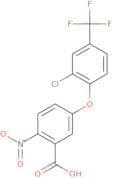
CAS 50594-66-6
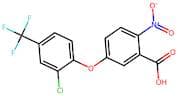
:Acifluorfen
Beschreibung:
Acifluorfen ist ein selektives Herbizid, das hauptsächlich zur Bekämpfung von breitblättrigen Unkräutern und bestimmten Gräsern in verschiedenen Kulturen eingesetzt wird. Es gehört zur Klasse der Verbindungen, die als Diphenylether bekannt sind, und zeichnet sich durch seine Fähigkeit aus, das Enzym Protoporphyrinogen-Oxidase zu hemmen, das für die Biosynthese von Chlorophyll entscheidend ist. Diese Hemmung führt zur Ansammlung von toxischen Porphyrinverbindungen, was zum Absterben der Pflanzen führt. Acifluorfen wird typischerweise nach der Keimung angewendet und ist in Kulturen wie Sojabohnen und Erdnüssen wirksam. Die Substanz ist bei Raumtemperatur ein farbloser bis blassgelber Feststoff und ist mäßig in Wasser löslich, mit höherer Löslichkeit in organischen Lösungsmitteln. Ihre Stabilität wird von Umweltfaktoren beeinflusst und sie wird allgemein als wenig giftig für Säugetiere angesehen, kann jedoch schädlich für aquatische Organismen sein. Eine ordnungsgemäße Handhabung und Anwendung sind entscheidend, um die Umweltauswirkungen zu minimieren und die Sicherheit zu gewährleisten.
Formel:C14H7ClF3NO5
InChl:InChI=1S/C14H7ClF3NO5/c15-10-5-7(14(16,17)18)1-4-12(10)24-8-2-3-11(19(22)23)9(6-8)13(20)21/h1-6H,(H,20,21)
InChI Key:InChIKey=NUFNQYOELLVIPL-UHFFFAOYSA-N
SMILES:O(C1=CC(C(O)=O)=C(N(=O)=O)C=C1)C2=C(Cl)C=C(C(F)(F)F)C=C2
Synonyme:- 2-Nitro-5-(2-chloro-4-(trifluoromethyl)phenoxy)benzoic acid
- 2-Nitro-5-(2-chloro-4-trifluoromethylphenoxy)benzoic acid
- 3-Carboxy-2′-chloro-4′-trifluoromethyl-4-nitrodiphenyl ether
- 5-(2-Chloro-Α,Α,Α-Trifluoro-P-Tolyloxy)-2-Nitrobenzoic Acid
- 5-[2-Chloro-4-(trifluoromethyl)phenoxy]-2-nitrobenzoic acid
- Acifluorfen
- Acifluorfen H
- Acifluorofen
- Benzoic acid, 5-[2-chloro-4-(trifluoromethyl)phenoxy]-2-nitro-
- Carbofluorfen
- Ppg-847
Sortieren nach
Reinheit (%)
0
100
|
0
|
50
|
90
|
95
|
100
10 Produkte.
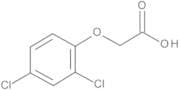
Chlorinated Acids Mix 1 100 µg/mL in Acetonitrile
CAS:Kontrolliertes ProduktFormel:C8H6Cl2O3Farbe und Form:MixtureMolekulargewicht:221.04EPA Method 515.2 Herbicide Mixture 402 100-1000 µg/mL in Methanol
CAS:Kontrolliertes ProduktFarbe und Form:MixtureAcifluorfen
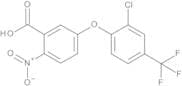
CAS:Acifluorfen: PROTOX inhibitor herbicide causing photooxidative damage in plants; may induce liver tumors in rodents.
Formel:C14H7ClF3NO5Reinheit:99.60%Farbe und Form:SolidMolekulargewicht:361.66Acifluorfen (90%)
CAS:Kontrolliertes ProduktApplications Acifluorfen is an herbicide against broadleaf weeds. An environmental toxin relating to in vivo toxicity of nitroaromatics.Environmental toxin on US EPA Toxic Release Inventory list (TRI) list.
Not a dangerous good if item is equal to or less than 1g/ml and there is less than 100g/ml in the package
References Gooch, A. et al.: Env. Toxicol. Chem., 36, 2227 (2017);Formel:C14H7ClF3NO5Reinheit:90%Farbe und Form:Light BrownMolekulargewicht:361.66Acifluorofen
CAS:Acifluorfen is a herbicide that is used to control broadleaf weeds and grasses. It inhibits the photosynthetic activity of plants by inhibiting the synthesis of chlorophyll. Acifluorfen has been shown to be carcinogenic in rats and mice, but not in other species, such as dogs. Acifluorfen's potential for carcinogenicity may be due to its ability to bind to DNA and inhibit transcription or replication, which can lead to cell death. Acifluorfen also binds to many other proteins with varying degrees of affinity. The conformational properties of acifluorfen are similar to those of the plant hormone auxin. This similarity has led researchers to speculate that acifluorfen may have some physiological effects on plants similar to those of auxin, including an effect on locomotor activity.Formel:C14H7ClF3NO5Reinheit:Min. 95%Molekulargewicht:361.66 g/mol