CAS 50622-09-8
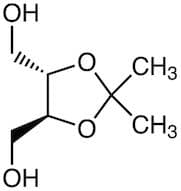
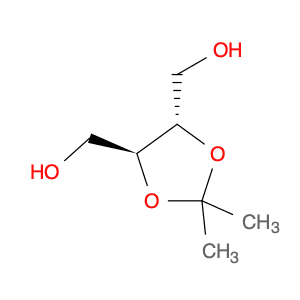
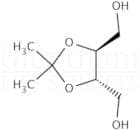
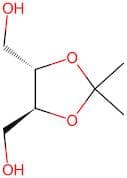
:(4S,5S)-2,2-Dimethyl-1,3-dioxolan-4,5-dimethanol
Beschreibung:
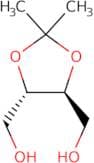
(4S,5S)-2,2-Dimethyl-1,3-dioxolan-4,5-dimethanol ist eine chemische Verbindung, die durch ihre einzigartige Dioxolan-Ringstruktur gekennzeichnet ist, die zwei Hydroxymethylgruppen an den Positionen 4 und 5 und zwei Methylgruppen an der Position 2 aufweist. Diese Verbindung ist ein chirales Molekül mit einer spezifischen Stereochemie, die durch die Konfiguration (4S,5S) bezeichnet wird, was die räumliche Anordnung ihrer Atome anzeigt. Die Anwesenheit des Dioxolanrings trägt zu ihrer Stabilität und Reaktivität bei, was sie zu einem potenziellen Kandidaten für verschiedene chemische Reaktionen macht, einschließlich solcher in der organischen Synthese. Die Hydroxymethylgruppen verbessern ihre Löslichkeit in polaren Lösungsmitteln und können an Wasserstoffbrückenbindungen teilnehmen, was ihre physikalischen Eigenschaften wie Siedepunkt und Schmelzpunkt beeinflusst. Darüber hinaus deutet die Struktur der Verbindung auf potenzielle Anwendungen in der Pharmazie oder als Zwischenprodukte in der organischen Synthese aufgrund der vorhandenen funktionellen Gruppen hin. Insgesamt ist (4S,5S)-2,2-Dimethyl-1,3-dioxolan-4,5-dimethanol bemerkenswert für seine Stereochemie und funktionale Vielseitigkeit in chemischen Reaktionen.
Formel:C7H14O4
InChl:InChI=1S/C7H14O4/c1-7(2)10-5(3-8)6(4-9)11-7/h5-6,8-9H,3-4H2,1-2H3/t5-,6-/m0/s1
InChI Key:InChIKey=INVRLGIKFANLFP-WDSKDSINSA-N
SMILES:C(O)[C@H]1[C@H](CO)OC(C)(C)O1
Synonyme:- (+)-2,3-O-Isopropylidene-<span class="text-smallcaps">L</span>-threitol
- (+)-2,3-O-Isopropylidene-L-Threitol
- (2,2-Dimethyl-1,3-dioxolane-4,5-diyl)dimethanol
- (4S,5S)-2,2-Dimethyl-1,3-dioxolane-4,5-dimethanol
- (4S,5S)-4,5-Bis(hydroxymethyl)-2,2-dimethyl-1,3-dioxolane
- 1,3-Dioxolane-4,5-Dimethanol, 2,2-Dimethyl-
- 1,3-Dioxolane-4,5-dimethanol, 2,2-dimethyl-, (4S,5S)-
- 1,3-Dioxolane-4,5-dimethanol, 2,2-dimethyl-, (4S-trans)-
- 256-658-6
- [(4S,5S)-2,2-dimethyl-1,3-dioxolane-4,5-diyl]dimethanol
Sortieren nach
Reinheit (%)
0
100
|
0
|
50
|
90
|
95
|
100
9 Produkte.
(+)-2,3-O-Isopropylidene-L-threitol
CAS:Formel:C7H14O4Reinheit:>97.0%(GC)Farbe und Form:White or Colorless to Light yellow powder to lump to clear liquidMolekulargewicht:162.191,3-Dioxolane-4,5-dimethanol, 2,2-dimethyl-, (4S,5S)-
CAS:Formel:C7H14O4Reinheit:98%Farbe und Form:SolidMolekulargewicht:162.18372,3-O-Isoproylidene-L-threitol
CAS:Formel:C7H14O4Reinheit:(GC) ≥ 97.0%Farbe und Form:Conflicting attributes definedMolekulargewicht:162.19(+)-2,3-O-Isopropylidene-L-threitol
CAS:(+)-2,3-O-Isopropylidene-L-threitolReinheit:99%Molekulargewicht:162.18g/mol2,3-O-Isopropylidene-L-threitol
CAS:Kontrolliertes ProduktApplications 2,3-O-Isopropylidene-L-threitol is an intermediate in the synthesis of versicolactone compounds.
References Wang, L., et al.: Tetrahedron. Lett., 54, 6729 (2013);Formel:C7H14O4Farbe und Form:NeatMolekulargewicht:162.18((4S,5S)-2,2-Dimethyl-1,3-dioxolane-4,5-diyl)dimethanol
CAS:Formel:C7H14O4Reinheit:99%+(GC-MS);RGFarbe und Form:No data available.Molekulargewicht:162.1852,3-O-Isopropylidene-L-threitol
CAS:2,3-O-Isopropylidene-L-threitol is a chiral sugar alcohol that is a new type of HDAC inhibitor. It has been shown to be an effective inhibitor of histone deacetylase (HDAC) and can be used in the treatment of certain cancers. 2,3-O-Isopropylidene-L-threitol is considered to be enantiomerically pure because it contains only one stereoisomer. It is also synthesized via a dehydrogenative process, which starts with the addition of 2 equivalents of phenol to diphenol followed by the addition of 4 equivalents of biphenyl. This product can also be used to make polycarbonates with functional groups such as epoxy or vinyl groups.Formel:C7H14O4Reinheit:Min. 95%Farbe und Form:Yellow PowderMolekulargewicht:162.18 g/mol