CAS 50700-61-3
:3-Hydroxy-1-methylpyridin-4(1H)-on
Beschreibung:
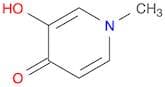
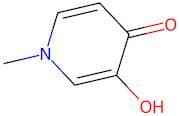
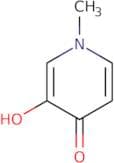
3-Hydroxy-1-methylpyridin-4(1H)-on, auch bekannt unter seiner CAS-Nummer 50700-61-3, ist eine heterocyclische organische Verbindung, die durch einen Pyridinring mit einer Hydroxylgruppe und einer Methylgruppe gekennzeichnet ist. Diese Verbindung zeigt typischerweise ein blassgelbes bis hellbraunes Aussehen und ist in polaren Lösungsmitteln wie Wasser und Alkoholen löslich, was auf die Anwesenheit der Hydroxylgruppe zurückzuführen ist. Sie ist bekannt für ihre potenziellen biologischen Aktivitäten, einschließlich antioxidativer Eigenschaften und möglicher Anwendungen in der Pharmazie und Agrochemie. Die Struktur der Verbindung ermöglicht Wasserstoffbrückenbindungen, die ihre Reaktivität und Wechselwirkungen mit anderen Molekülen beeinflussen können. Darüber hinaus kann sie an verschiedenen chemischen Reaktionen teilnehmen, wie Oxidation oder Komplexierung mit Metallionen, was sie in der Koordinationschemie von Interesse macht. Insgesamt ist 3-Hydroxy-1-methylpyridin-4(1H)-on eine vielseitige Verbindung mit erheblichen Implikationen sowohl in der Forschung als auch in industriellen Anwendungen.
Formel:C6H7NO2
InChl:InChI=1/C6H7NO2/c1-7-3-2-5(8)6(9)4-7/h2-4,9H,1H3
SMILES:Cn1ccc(=O)c(c1)O
Synonyme:- 3-Hydroxy-1-methyl-4(1H)-pyridinone
- 4(1H)-pyridinone, 3-hydroxy-1-methyl-
Sortieren nach
Reinheit (%)
0
100
|
0
|
50
|
90
|
95
|
100
4 Produkte.
3-hydroxy-1-methyl-4(1H)-Pyridinone
CAS:Formel:C6H7NO2Reinheit:97%Farbe und Form:SolidMolekulargewicht:125.12533-Hydroxy-1-methylpyridin-4(1H)-one
CAS:Formel:C6H7NO2Reinheit:97%Farbe und Form:SolidMolekulargewicht:125.1273-Hydroxy-1-methylpyridin-4(1H)-one
CAS:3-Hydroxypyridin-4(1H)-one is a compound that belongs to the group of organic compounds called pyridines. It is a colorless, crystalline solid with a melting point of 210 °C. 3-Hydroxypyridin-4(1H)-one is soluble in ether and chloroform. 3-Hydroxypyridin-4(1H)-one forms complexes with metal ions such as copper, zinc, and nickel. The stability constants for these complexes are in the order of Cu > Zn > Ni. Potentiometric titration experiments show that the ligands are stronger bases than water and therefore react more strongly with copper ions than hydroxide ions.Formel:C6H7NO2Reinheit:Min. 95%Farbe und Form:PowderMolekulargewicht:125.13 g/mol