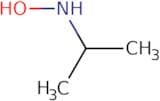
CAS 5080-22-8
:Isopropylhydroxylamin
Beschreibung:
Isopropylhydroxylamin, mit der CAS-Nummer 5080-22-8, ist eine organische Verbindung, die durch ihre Hydroxylamin-Gruppe gekennzeichnet ist, die an eine Isopropylgruppe gebunden ist. Sie erscheint als farblose bis blassgelbe Flüssigkeit und ist bekannt für ihre Rolle als Reduktionsmittel und in verschiedenen chemischen Synthesen. Die Verbindung ist in Wasser und polaren organischen Lösungsmitteln löslich, was ihre Nützlichkeit in chemischen Reaktionen erhöht. Isopropylhydroxylamin wird häufig in der Synthese von Arzneimitteln und Agrochemikalien sowie in der analytischen Chemie zur Detektion bestimmter Metallionen verwendet. Sie weist eine moderate Toxizität auf, was eine sorgfältige Handhabung und angemessene Sicherheitsmaßnahmen während der Verwendung erfordert. Darüber hinaus kann sie an verschiedenen Reaktionen teilnehmen, einschließlich Oxidation und Kondensation, was sie zu einem vielseitigen Reagenz in der organischen Synthese macht. Ihre Stabilität und Reaktivität können von Faktoren wie pH und Temperatur beeinflusst werden, die wichtige Überlegungen in ihren Anwendungen sind. Insgesamt ist Isopropylhydroxylamin eine wertvolle Verbindung sowohl in industriellen als auch in Forschungseinrichtungen.
Formel:C3H9NO
InChl:InChI=1S/C3H9NO/c1-3(2)4-5/h3-5H,1-2H3
InChI Key:InChIKey=ODHYIQOBTIWVRZ-UHFFFAOYSA-N
SMILES:C(NO)(C)C
Synonyme:- 2-Propanamine, N-hydroxy-
- Hydroguard I 15
- Hydroxylamine, N-isopropyl-
- Ipha
- Isopropyl hydroxyamine
- Isopropylhydroxylamine
- N-Hydroxy-2-propanamine
- N-hydroxypropan-2-amine
- N-Isopropylhydroxylamine
Sortieren nach
Reinheit (%)
0
100
|
0
|
50
|
90
|
95
|
100
1 Produkte.
N-Isopropylhydroxylamine - 15% aqueous solution
CAS:N-Isopropylhydroxylamine is a chemical compound that can be used as a solvent for organic compounds. It has been shown to have genotoxic properties, which may be due to the production of hydrogen peroxide. N-Isopropylhydroxylamine is also an antioxidant compound and has been shown to have anti-inflammatory effects. It has been found to inhibit the growth of fibroblast cells in vitro by binding to basic fibroblast growth factor (bFGF). This chemical is stable at neutral pH and hydrochloric acid, but unstable in the presence of inorganic acids.Formel:C3H9NOReinheit:(Titration) Min 15%Farbe und Form:Clear LiquidMolekulargewicht:75.11 g/mol