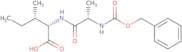
CAS 50903-75-8
:Z-Ala-Ile-OH
Beschreibung:
Z-Ala-Ile-OH, auch bekannt als Z-Ala-Isoleucin, ist ein peptidderivates, das durch das Vorhandensein einer Z (Benzyloxycarbonyl)-Schutzgruppe am Aminosäure Alanin (Ala) und Isoleucin (Ile) am C-Terminus gekennzeichnet ist. Diese Verbindung wird typischerweise in der Peptidsynthese und Forschung aufgrund ihrer Stabilität und Fähigkeit verwendet, Aminogruppen während chemischer Reaktionen zu schützen. Die Z-Gruppe verbessert die Löslichkeit und Stabilität des Peptids in verschiedenen Lösungsmitteln, was es für verschiedene Anwendungen in der Biochemie und der medizinischen Chemie geeignet macht. Die Struktur von Z-Ala-Ile-OH umfasst eine Carbonsäurefunktion, die entscheidend für ihre Reaktivität und Wechselwirkungen in biologischen Systemen ist. Als synthetischer Zwischenstoff kann es in der Entwicklung komplexerer Peptide und Proteine verwendet werden. Seine CAS-Nummer, 50903-75-8, ermöglicht eine einfache Identifizierung und Referenz in chemischen Datenbanken. Insgesamt dient Z-Ala-Ile-OH als wichtiger Baustein in der Peptidchemie und trägt zur Synthese bioaktiver Verbindungen bei.
Formel:C17H24N2O5
InChl:InChI=1/C17H24N2O5/c1-4-11(2)14(16(21)22)19-15(20)12(3)18-17(23)24-10-13-8-6-5-7-9-13/h5-9,11-12,14H,4,10H2,1-3H3,(H,18,23)(H,19,20)(H,21,22)
SMILES:CCC(C)C(C(=O)O)N=C(C(C)N=C(O)OCc1ccccc1)O
Synonyme:- N-[(benzyloxy)carbonyl]alanylisoleucine
Sortieren nach
Reinheit (%)
0
100
|
0
|
50
|
90
|
95
|
100
1 Produkte.
Z-Ala-Ile-OH
CAS:Z-Ala-Ile-OH is a hydroxamic acid that is used in peptide synthesis. It is a monomer that is hydrophobic and has an affinity for peptidyl acceptors. The synthetic method for Z-Ala-Ile-OH involves the use of aspartic acid and aspartate semialdehyde, which are used to synthesize the hydroxamic acid via an amidation reaction. The nomenclature of Z-Ala-Ile-OH is based on its structure and the order of amino acids found in it. Aspartic acid and asparagine are both amino acids found in Z-Ala-Ile-OH, with the -NH2 group being replaced by -OH in this particular molecule. This substitution results in a more hydrophobic compound than aspartate semialdehyde.
Formel:C17H24N2O5Reinheit:Min. 95%Molekulargewicht:336.38 g/mol